

Close Menu
  • Home
  • Identity
  • Inventions
  • Future
  • Science
  • Startups
  • Spanish
What's Hot

Meta Inc. files suit over privacy concerns over AI smart glasses after employees review nude, sex and other footage

Anthropic CEO Dario Amodei may still be trying to strike a deal with the Pentagon

Oura acquires Doublepoint, a startup specializing in gesture recognition technology

Facebook X (Twitter) Instagram
  • Home
  • About Us
  • Advertise with Us
  • Contact Us
  • DMCA
  • Privacy Policy
  • Terms & Conditions
  • User-Submitted Posts
Facebook X (Twitter) Instagram
Fyself News
  • Home
  • Identity
  • Inventions
  • Future
  • Science
  • Startups
  • Spanish
Fyself News
Home » Introducing the world’s smallest AI supercomputer. It packs “doctor-level intelligence” and is small enough to fit in your pocket, according to its developers.
Science

Introducing the world’s smallest AI supercomputer. It packs “doctor-level intelligence” and is small enough to fit in your pocket, according to its developers.

userBy userMarch 4, 2026No Comments3 Mins Read
Share Facebook Twitter Pinterest Telegram LinkedIn Tumblr Email Copy Link
Follow Us
Google News Flipboard
Share
Facebook Twitter LinkedIn Pinterest Email Copy Link

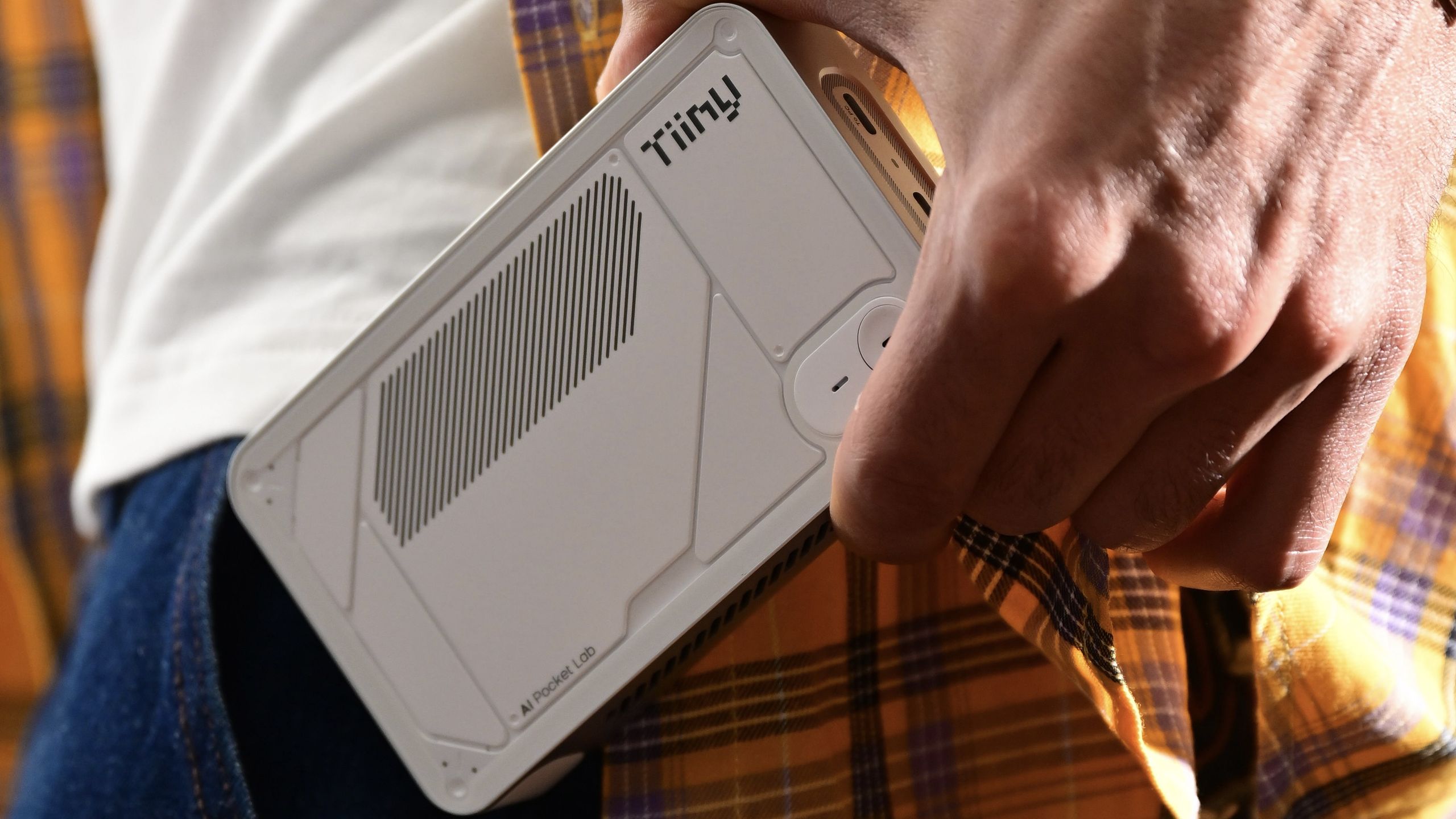
A US startup has developed what it claims is the world’s smallest artificial intelligence (AI) supercomputer. It’s packed with high-performance hardware and plenty of RAM, and is compact enough to fit in your pocket, yet can run “Ph.D. intelligence” AI models, company representatives say. This means being capable of autonomous problem solving, abstract reasoning, and strategic planning.

“AI Pocket Lab,” as the creators of Tiiny AI branded the device, can run complex 120 billion parameter large-scale language models (LLMs) locally, without relying on an internet connection. These systems typically require data center-class infrastructure to run, but this opens up the possibility of local expert-level coding capabilities, document evaluation and refinement, or multi-step inference.

It’s built around a 12-core ARM processor, the kind commonly found in smartphones, laptops, and tablets. Despite the device’s small frame, measuring just 5.59 x 3.15 x 1.00 inches (14.2 x 8 x 2.53 cm), it packs 80 GB of LPDDR5X RAM. For comparison, most modern laptops have between 8GB and 32GB of RAM.

you may like

Pocket Lab’s massive 48GB of RAM is also reserved exclusively for its Neural Processing Unit (NPU), a chip optimized for AI-related computations. For years, Intel and AMD have been building processors with dedicated NPUs to handle AI workloads and meet Microsoft’s 40 trillion operations per second (TOPS) threshold for running AI features in Windows 11.

Pocket Lab’s computational power qualifies it as a supercomputer (rather than a standard mini-PC or workstation), allowing it to perform workloads that would typically require a multi-GPU, datacenter-class system, especially local inference with over 100 billion parameter language models. Current models that can run on the device include GPT-OSS 120B, large-scale Phi models, and high-parameter Llama family models.

This is part of a recent push into edge computing for AI, aimed at mitigating some of the power constraints and environmental impact of distributed AI processing.

pocket power

Although AI Pocket Lab is far from matching the world’s most powerful supercomputers, it can deliver 190 TOPS of computing power between its NPU and CPU. This represents another step towards miniaturization, following Nvidia’s recently announced Project Digits mini PC. It doesn’t have the processing power of an Nvidia project, but it’s a fraction of the size.

Get the world’s most fascinating discoveries delivered straight to your inbox.

To pack so much power into such a modest chassis, the Tiiny AI team relied on a number of technologies and optimizations. Chief among them was what the company called TurboSparse. This is an innovation that allows large-scale LLMs to run faster on more limited hardware by ensuring that the system calls only the parts of the model it needs at any given time. Traditional models use all parameters for each word of processing/output, whereas TurboSparse models use only certain parameters for each step.

Another important feature is PowerInfer, which enables heterogeneous scheduling of CPUs, GPUs, and NPUs on devices. This means that each processor is given only the most powerful workload, which increases overall system efficiency and reduces power consumption. PowerInfer also includes intelligent power management to determine when full power is needed and when it’s OK to use less by eliminating unnecessary calculations.

The implications of small AI supercomputers go beyond reducing dependence on environmentally harmful data centers. This is a privacy boon, allowing users to deploy the power of advanced LLM without an internet connection and without data being processed in the cloud by a third party, while enabling AI access in field environments such as remote research stations or out-of-range ships and aircraft.


Source link

#Biotechnology #ClimateScience #Health #Science #ScientificAdvances #ScientificResearch
Follow on Google News Follow on Flipboard
Share. Facebook Twitter Pinterest LinkedIn Tumblr Email Copy Link
Previous ArticleEU project to accelerate hydrogen production in Norway
Next Article Coruna iOS exploit kit uses 23 exploits across 5 chains targeting iOS 13 to 17.2.1
user
  • Website

Related Posts

‘Truly extraordinary’: Megalaser beaming at us from the far side of space is the brightest ‘cosmic light’ we’ve ever seen

March 4, 2026

Killer whale fin chewed up on Russian coast points to possible cannibalism, scientists say, could explain why some pods are so tightly bound together

March 4, 2026

NASA fixes Artemis II rocket that will carry astronauts around the moon for April launch

March 4, 2026
Add A Comment
Leave A Reply Cancel Reply

Latest Posts

Meta Inc. files suit over privacy concerns over AI smart glasses after employees review nude, sex and other footage

Anthropic CEO Dario Amodei may still be trying to strike a deal with the Pentagon

Oura acquires Doublepoint, a startup specializing in gesture recognition technology

Netflix acquires Ben Affleck’s AI film production company InterPositive

Trending Posts

Subscribe to News

Subscribe to our newsletter and never miss our latest news

Please enable JavaScript in your browser to complete this form.
Loading

Welcome to Fyself News, your go-to platform for the latest in tech, startups, inventions, sustainability, and fintech! We are a passionate team of enthusiasts committed to bringing you timely, insightful, and accurate information on the most pressing developments across these industries. Whether you’re an entrepreneur, investor, or just someone curious about the future of technology and innovation, Fyself News has something for you.

Castilla-La Mancha Ignites Innovation: fiveclmsummit Redefines Tech Future

Local Power, Health Innovation: Alcolea de Calatrava Boosts FiveCLM PoC with Community Engagement

The Future of Digital Twins in Healthcare: From Virtual Replicas to Personalized Medical Models

Human Digital Twins: The Next Tech Frontier Set to Transform Healthcare and Beyond

Facebook X (Twitter) Instagram Pinterest YouTube
  • Home
  • About Us
  • Advertise with Us
  • Contact Us
  • DMCA
  • Privacy Policy
  • Terms & Conditions
  • User-Submitted Posts
© 2026 news.fyself. Designed by by fyself.

Type above and press Enter to search. Press Esc to cancel.