


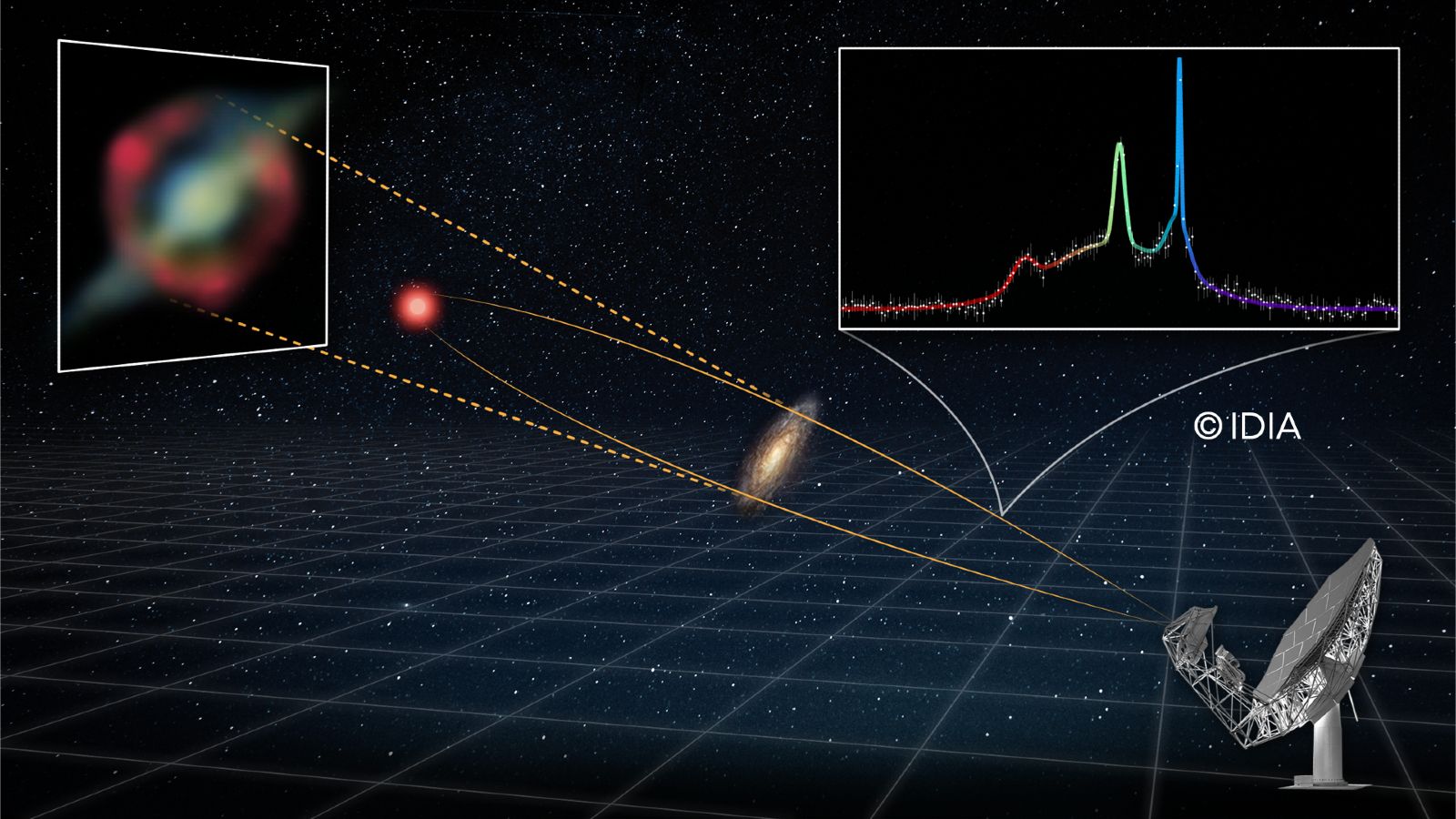
Astronomers have discovered a supercharged space laser beaming toward Earth from the far side of the universe. A beam of cosmic energy revealed in part by a strange space-time trick first predicted by Einstein is the brightest and most distant beam of its kind ever observed.
A natural laser called a “hydroxyl megamaser” is essentially a huge beam of electromagnetic radiation emitted when a pair of galaxies violently merge. During these cosmic collisions, giant gas clouds are compressed and large reservoirs of hydroxyl (OH) molecules are excited, emitting high-energy microwaves.
It is similar to an artificial laser that works by exciting particles and amplifying the resulting light waves with mirrors. However, in the case of a maser, microwaves are amplified instead of visible light, hence the “M” at the beginning of the name. (Laser is an acronym for “light amplification by stimulated emission of radiation.” If you replace “light” with “microwave,” you get maser.)
you may like
Researchers are particularly interested in megamasers because they can reveal how ancient galaxies form, grow, evolve, and die. As a result, they are often called “cosmic beacons”.
In a new study uploaded to the preprint server arXiv on February 13 and accepted for future publication in Monthly Notices: Letters, a journal of the Royal Astronomical Society, researchers using the MeerKAT telescope, a 64-radio receiving antenna in South Africa, have discovered a new hydroxyl megamaser coming from a pair of colliding galaxies, named HATLAS J142935.3-002836.
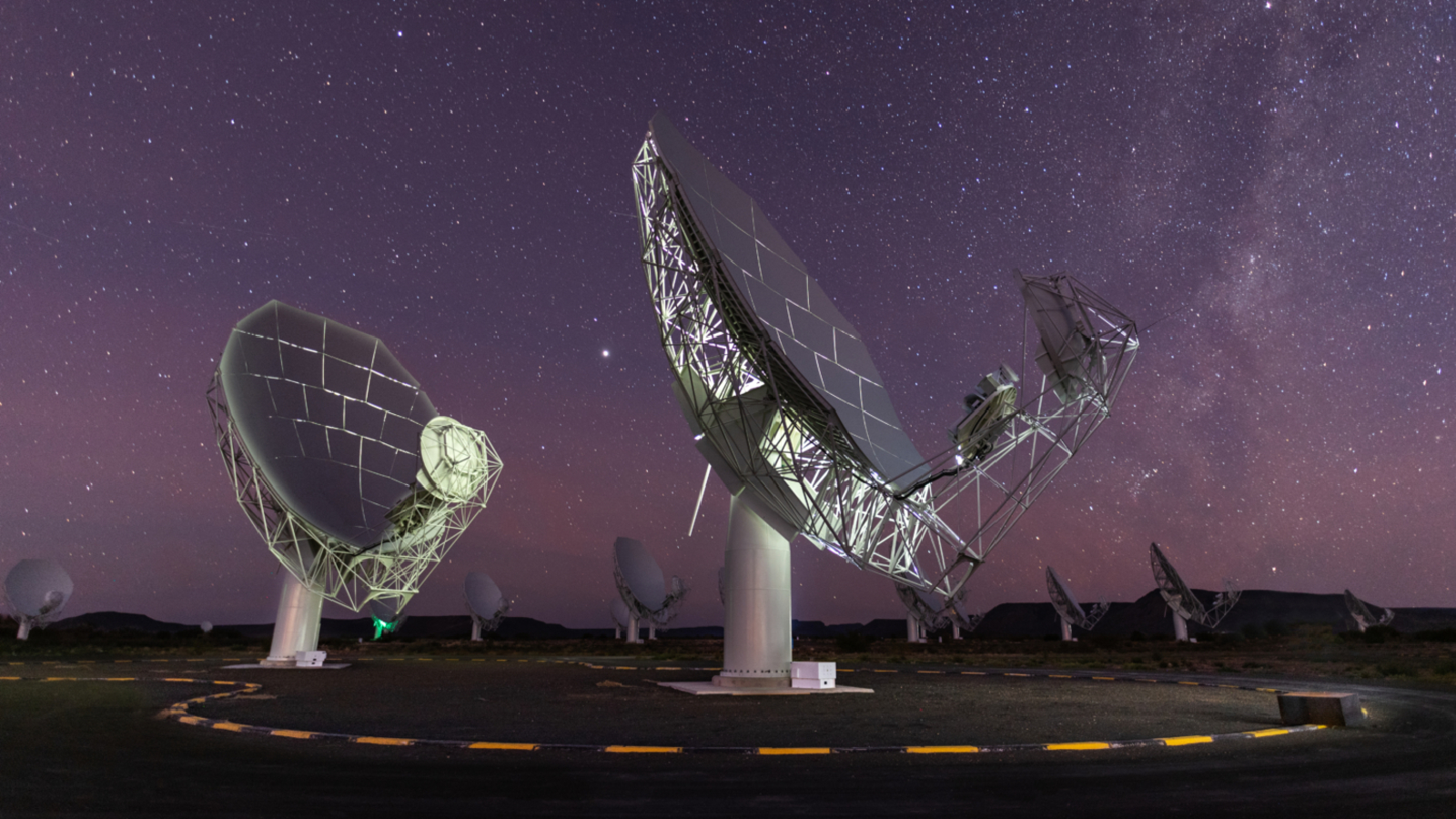
The microwaves emitted by this system are so elongated, about 18 centimeters (7 inches or 1,665 megahertz) long, and so much brighter than other megamasers, that the researchers suggest that the signal should be classified as a “gigamaser” (the next theoretical next order of magnitude for these space lasers).
HATLAS J142935.3–002836 was first discovered in 2014 and is approximately 8 billion light-years from Earth. This means that the microwaves we see were emitted when the universe was about half its current age. This makes it the farthest megamaser ever confirmed.
“This system is truly extraordinary,” study lead author Tato Manamela, an astronomer at the University of Pretoria in South Africa, said in a statement. “We are observing radio waves equivalent to lasers on the far side of the universe.”
Signals from very far away are usually too weak to be picked up by telescopes like MeerKAT. However, the maser fire from HATLAS J142935.3–002836 was further amplified by a rare phenomenon called gravitational lensing, first predicted by Albert Einstein’s theory of relativity in 1905.
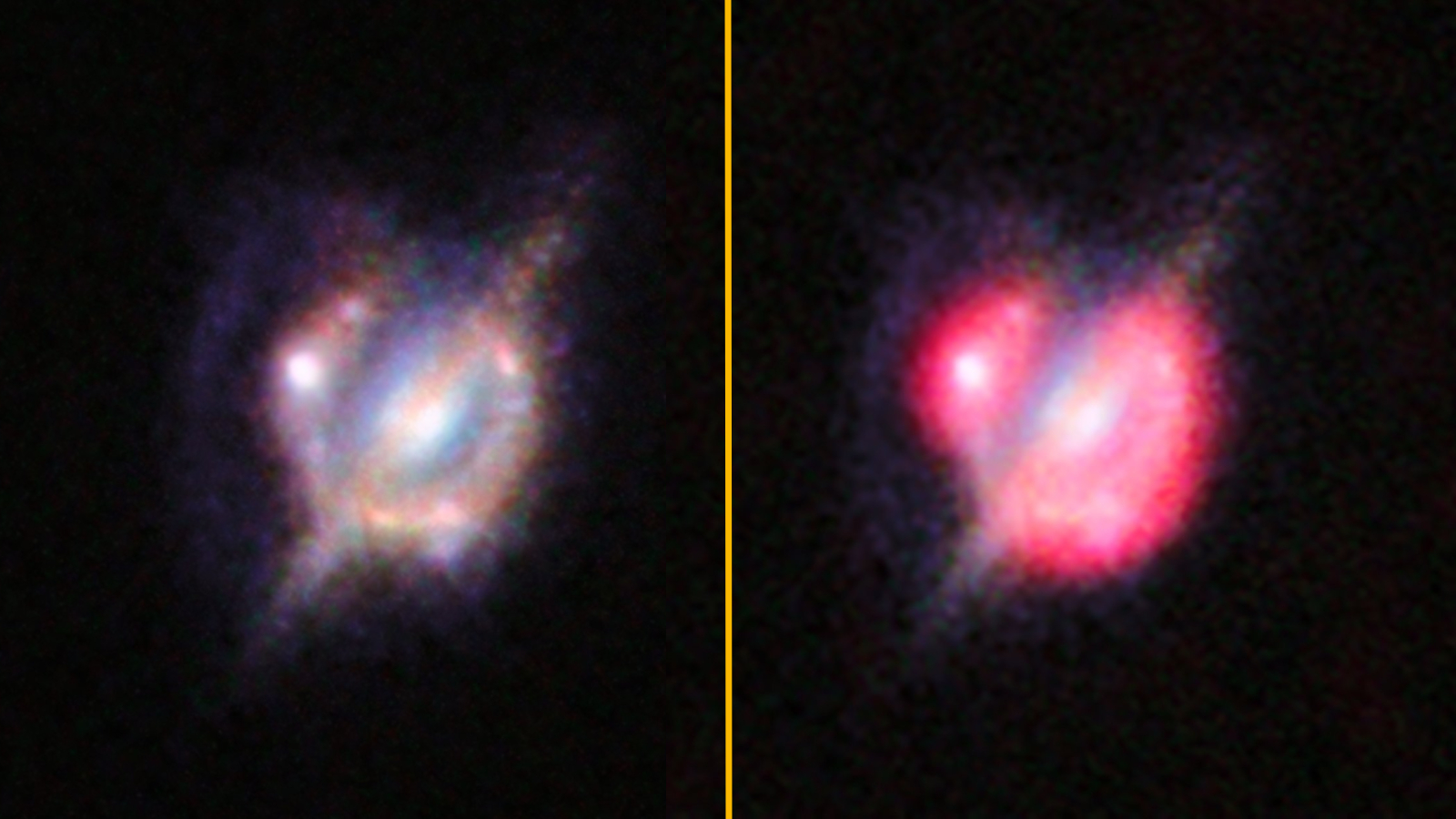
Gravitational lensing occurs when electromagnetic radiation from a distant object, such as a galaxy, is bent around a massive object located directly between the source and the observer. Obviously, radiation doesn’t actually bend (because light always travels in a straight line). Instead, we travel through a distorted space-time, misshapen by the massive gravity of the central object.
From an observer’s perspective, this phenomenon often forms a ring of light around a central object, known as an “Einstein ring.” But the light source (in this case, the microwave source) is also magnified, making it much easier to analyze distant objects.
The research team now plans to direct MeerKAT at similar systems in hopes of discovering more secret megamasers and gigamasers lurking inside gravitational lensed objects. This could greatly increase the number of these rare space lasers that can be studied.
“This is just the beginning,” Manamela said. “We don’t want to find just one system. We want to find hundreds or thousands of systems.”