


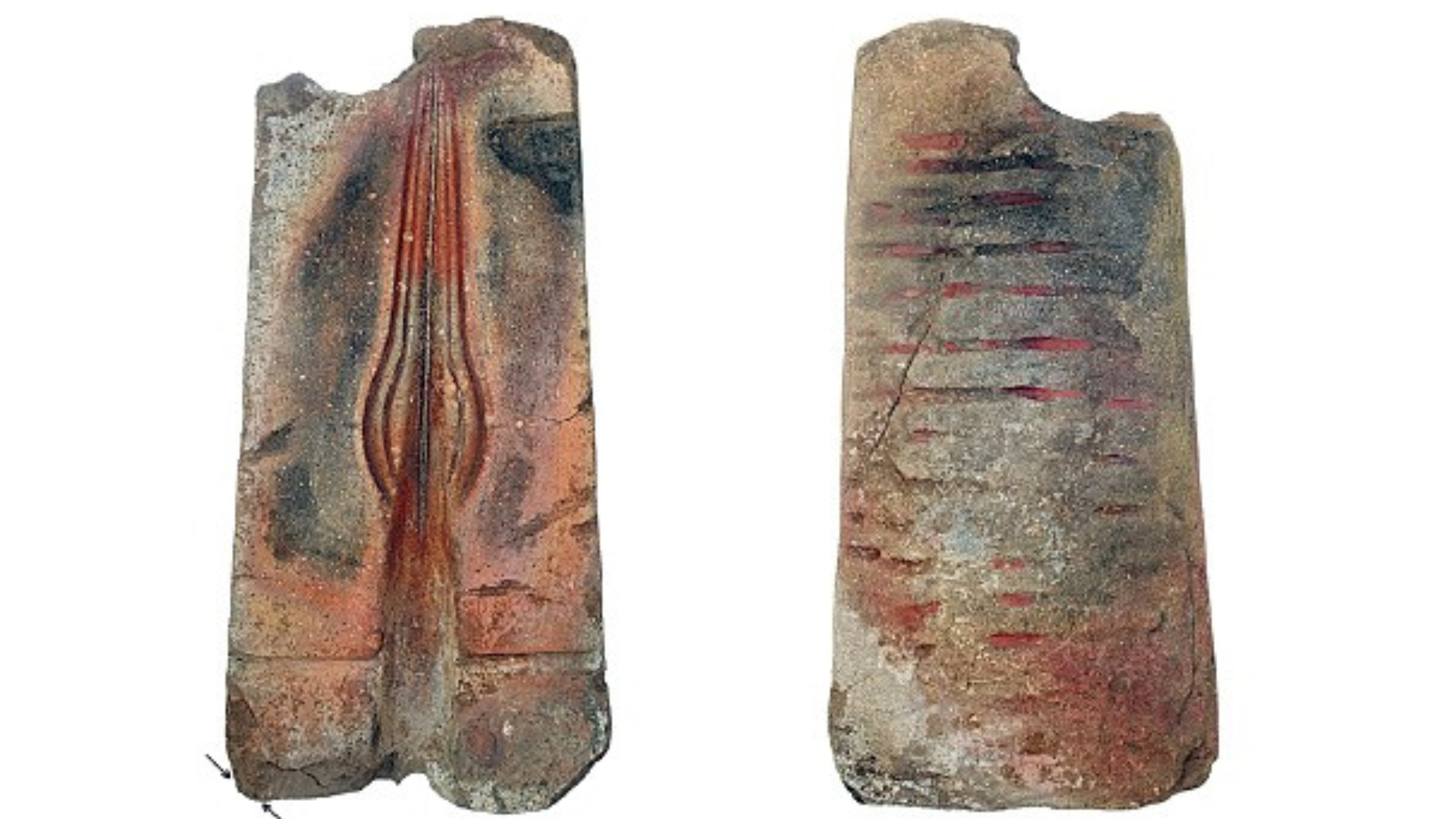
A seemingly dull rectangular stone used as part of the foundation of an old barn in a Czech garden is actually half of a rare Bronze Age mold used to make spearheads, new research has found.
The approximately 9-inch (23-centimeter)-long mold, carved in a volcanic rock known as rhyolite tuff, dates from the Late Bronze Age, around 1350 BC.
“This is the best-preserved and most complete bronze spear mold in Central Europe,” Milan Salas, lead author of the study and an archaeologist at the Moravian Museum in the Czech Republic, told Live Science in an email. “Based on the shape of the spear point and the type of raw materials used, it is likely that this type was imported from northern Hungary to southern Moravia.”
Article continues below
you may like
The newly discovered 2.4-pound (1.1-kilogram) mold matches other molds from the Urnfield culture, which appeared in the mid-second millennium BC and was known for cremating the dead and interring them in urns in field graves.
In their analysis, Salas and his colleagues write that such molds allowed for more uniform casting of metal tools and weapons, such as spearheads, axes, and daggers. This would have made armed conflict more likely to persist and strengthened cultural trade and political power in Central Europe’s Carpathian Basin, the researchers wrote in their study, published in 2025 in the journal Archeologické Rozhledy (Czech for “Archaeological Views”).
“This type of spearhead, characterized by ribs along the blade and sharp ridges in the socket, is common in the Carpathian region,” Salás told the Czech Republic’s official international broadcaster, Radio Prague International. “It’s essentially [a] Continuous production. As you can see, the mold was used very intensively. Perhaps dozens of spearheads were thrown from there. ”
The stone was discovered in 2007 by homeowner J. Tomanek. He noticed that a gray board was slightly sticking out of the ground and may have fallen off after being used for a barn foundation. In 2019, Tomanek donated the stone to the Moravian Museum, where Salas used X-ray fluorescence scanning to examine the stone more closely to determine which elements made up the mold.
“It was proven that the bronze was cast in a mold, and both halves of the mold were held together with copper wire,” Salas told Live Science in an email.

The story behind the mold
To trace the origin of the mold, study co-author Antonin Pushkistal, professor of geology at Masaryk University, worked with Salas to use X-ray diffraction, a technique that determines the atomic structure of certain crystalline solids, such as stone. This revealed that the mold was made from rhyolite tuff, a rock commonly found in Hungary’s Buk Mountains and around the nearby city of Sargótarjan.
About 20 million years ago, the area was home to a huge volcano that produced “an enormous amount of tuff,” Przyhistal said. “Unfortunately, we cannot pinpoint exactly where the mold was manufactured, but in general its provenance is clear (from northern Hungary to southeastern Slovakia),” he told LiveScience in an email.
What to read next
Other Bronze Age weapons and armor have been discovered in nearby areas of the Carpathian Basin, but this mold provides a behind-the-scenes look at how these items were created.
“In this case, the intense charring and heat signatures clearly indicate repeated use and serial production of the bronze casting,” Salas said.
Often molds from the Urnfield period are found in settlements. Even more rarely, they are sometimes excavated from burial sites as grave goods. It is unclear how the Arnfield culture spearhead mold ended up in the man’s garden, but it was “most likely redeposited in modern times from nearby Arnfield-era sites,” the authors write in their study.
“This interesting case shows how long the path can sometimes be from the discovery of a unique archaeological object (in 2007) to its scientific evaluation in a specialized journal (in 2025),” Przyhistal said.
Salaš, M., Přichystal, A., Petřík, J., Slavíček, K., Všianský, D., Nosek, V. (2025). An example of long-distance imports from the Urunfield period is the unique stone mold for casting spearheads and its technical contribution from Morkhuki in southern Moravia. Archeologické Rozhledy, 77(2). https://doi.org/10.35686/ar.2025.272