


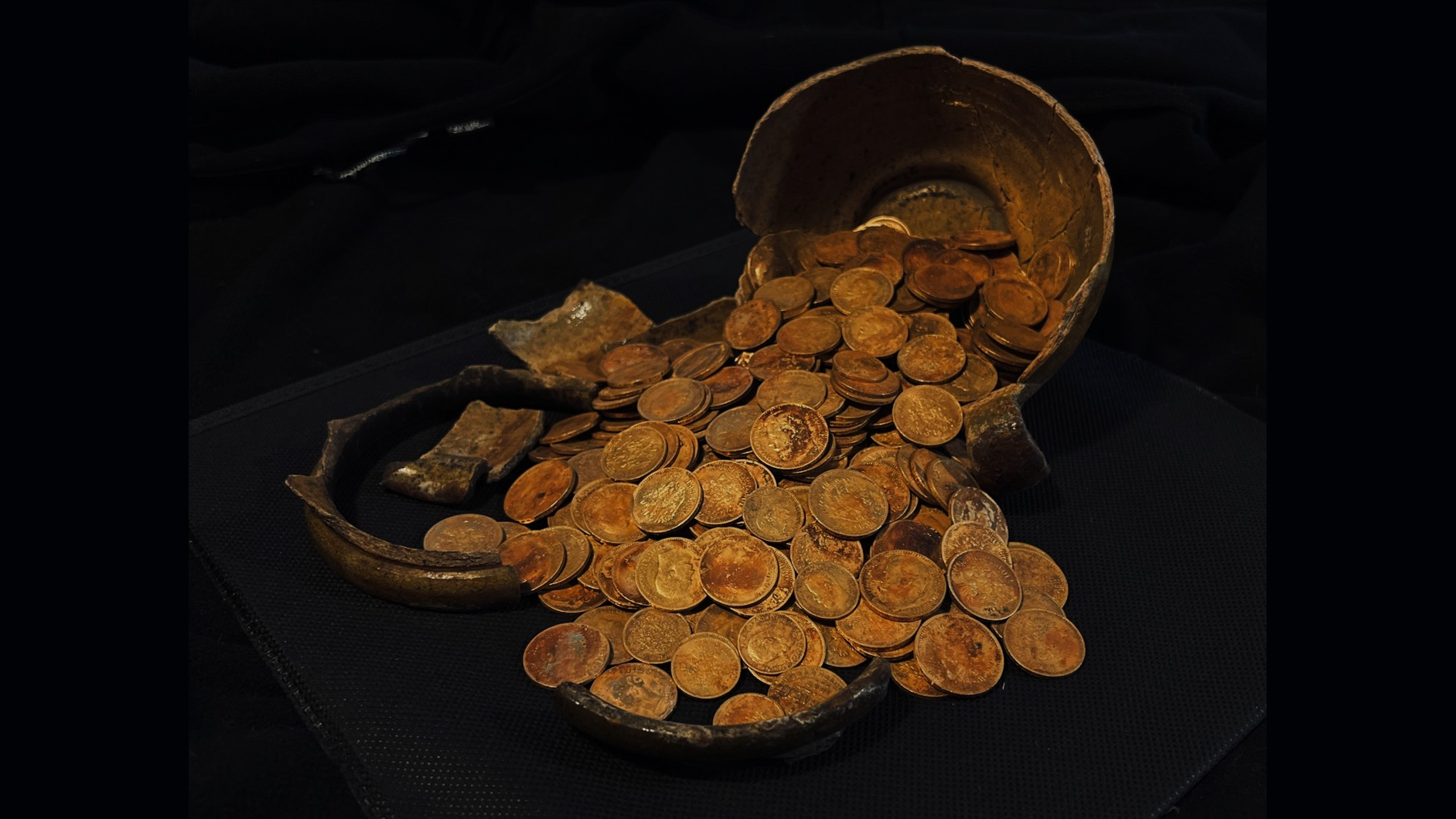
Archaeologists have discovered a trove of 100-year-old gold rubles under a house in northwestern Russia. The 409 coins were minted during the decline of the Russian Empire and could be worth more than $500,000 today.
In 2025, researchers from the Institute of Archeology of the Russian Academy of Sciences and the All-Russian Museum of History and Ethnology excavated the foundations of a historic house ahead of new construction in the city of Torzhok, about 260 miles (420 kilometers) southeast of St. Petersburg, according to a March 5 statement.
Article continues below
you may like

Two coins were minted during the reigns of earlier tsars (Nikolai I and Alexander III), while the rest date from the reign of Nicholas II, the last Russian tsar before the 1917 Russian Revolution. Nikolai and the remaining members of the Romanov royal family were executed in 1918. Rumors persisted for decades that his daughter, Grand Duchess Anastasia Nikolaevna, had escaped execution, but researchers now believe that she was murdered along with her. family.
Experts believe that the Torjok treasure was hidden during or after the start of the revolution, and that its owner intended to return to retrieve it. Archival documents suggest that 24 families lived in the area in the late 19th and early 20th centuries, but experts are unsure which families were hiding their savings because historical and modern house numbers do not match.

The total amount of coins in the vault amounts to 4,085 rubles. According to historical currency tables, the exchange rate in 1916 was 6.7 rubles per US dollar. When accounting for inflation, $610 in 1916 is equivalent to more than $18,000 today, suggesting this hoarding was a significant portion of someone’s savings. However, the melting value of one 10 ruble coin, which is 90% gold, is nearly $1,300, meaning the value of the entire hoard could be well over $500,000.
The treasure will now be transferred to the All-Russian Historical and Ethnographic Museum, the statement said.