
Nvidia’s DLSS 5 uses generative AI to enhance photorealism in video games, with ambitions beyond gaming
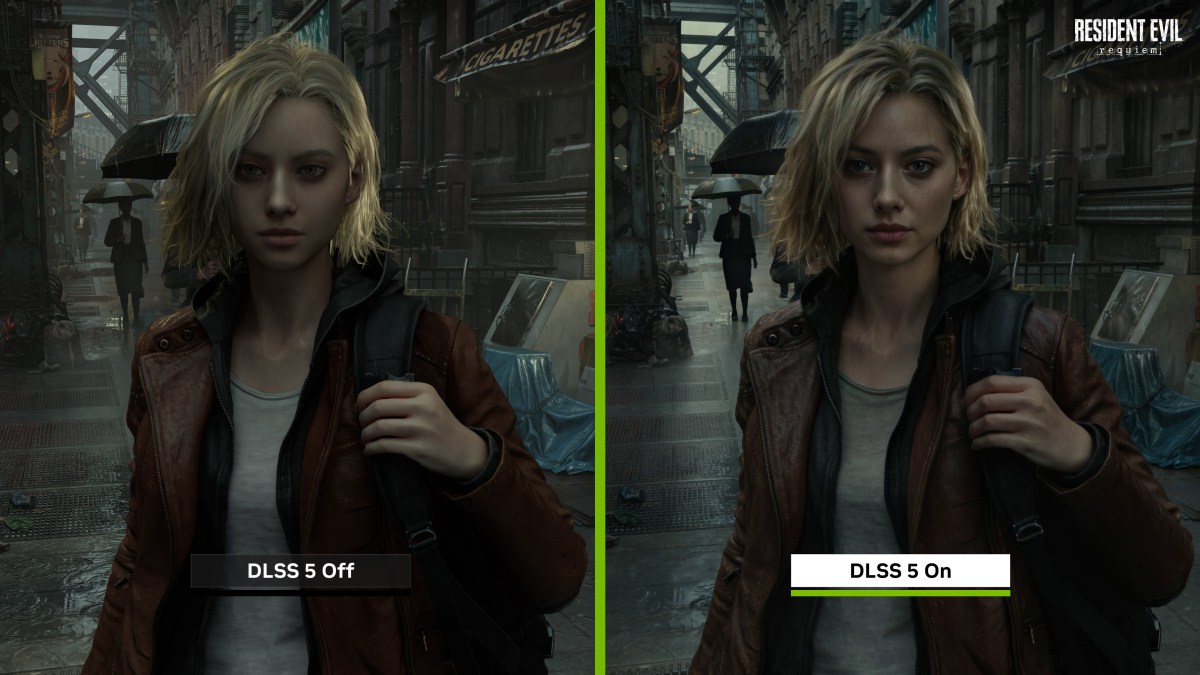
Nvidia CEO Jensen Huang on Monday used the company’s keynote at Nvidia GTC to introduce DLSS 5, a new version of the chipmaker’s AI graphics technology designed to make video games more realistic with less computing power.
The new DLSS 5 system combines traditional 3D graphics data with generative AI models that can predict and fill in parts of an image, allowing Nvidia’s GPUs to generate detailed scenes and lifelike characters without having to render every element from scratch.
“We have merged controllable 3D graphics, virtual world ground truth, and structured data with generative AI and probabilistic computing,” Huang said in his keynote. “One of them is completely predictive, and the other is probabilistic but very realistic.”
Huang said that by combining two ideas: structured data and generative AI, developers can create content that is “beautiful, surprising, and controllable.”
“This concept of marrying structured information and generative AI will be repeated in industry after industry,” Huang said. “Structured data is the foundation of trustworthy AI.”
Although gaming makes up a smaller portion of Nvidia’s revenue today than it has historically, gaming is the industry that made Nvidia what it is today. Huang framed DLSS 5’s approach as an example of a broader computing shift and suggested that the approach could extend far beyond gaming and into enterprise computing.
tech crunch event
San Francisco, California
|
October 13-15, 2026
The billionaire executive cited enterprise data platforms like Snowflake, Databricks, and BigQuery as examples of structured datasets that future AI systems can analyze and generate insights.
“In the future, these data structures will be used by AI, and the AI will be much faster than we are,” Huang said. “Agents of the future will use not only generative databases, which are unstructured databases, but also structured databases, which will represent a large portion of the world.”
Source link

