
Muon detector network for monitoring space and terrestrial weather
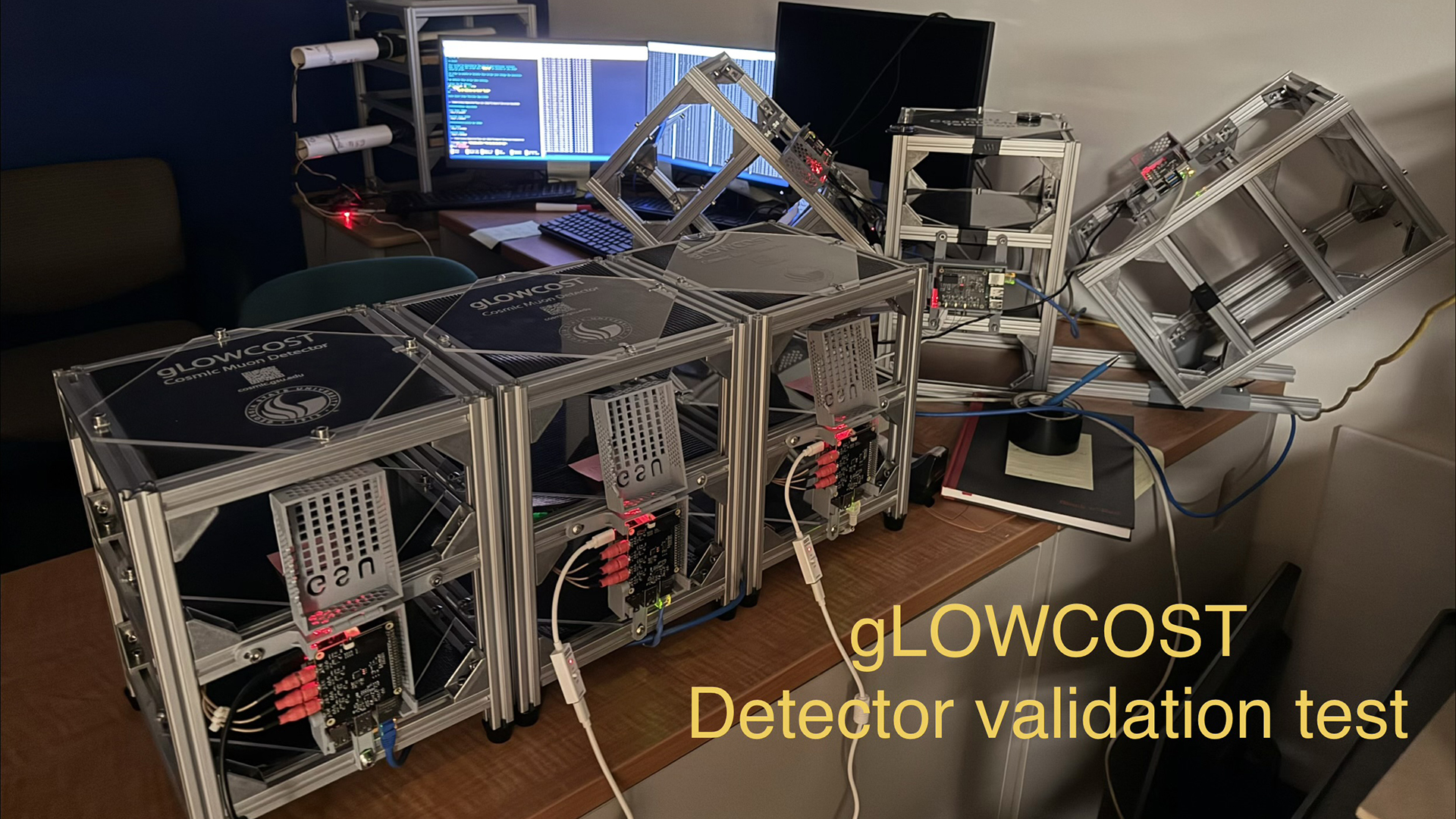
gLOWCOST is an international scientific effort aimed at transforming Earth into a large-scale network of low-cost cosmic-ray muon detectors to monitor dynamic changes in space and terrestrial weather.
The gLOWCOST project (short for Global Low-Cost Cosmic Ray Muon Detector Network for Monitoring Dynamic Changes in Space and Surface Weather) is a flagship international effort headquartered at the Georgia State University COSMIC Center established in 2023. In an era where space weather and atmospheric changes increasingly impact a hyper-connected society, gLOWCOST provides an innovative ground-based solution for real-time environmental monitoring.
The project aims to turn Earth into a giant integrated laboratory by leveraging cutting-edge particle detection techniques and distributed network architectures developed in research into nuclear physics experiments. We bridge the gap between fundamental physics research and real-world planetary-scale applications, ensuring that critical data about the space environment is accessible, affordable, and actionable for both scientists and the public.
The gLOWCOST project is led by Professor Xiaochun He, an experimental high-energy nuclear physicist, along with an interdisciplinary faculty leadership team at Georgia State University (GSU), including Professor Ashwin Ashok (Department of Computer Science), Professor Unil Perera (condensed matter physicist), and Professor Vyacheslav (Slava) Sadikov (solar physicist). As of February 2026, more than 17 gLOWCOST detectors have been installed in 10 countries across five continents outside the United States.

Research interests and strategic drivers
The gLOWCOST project is comprised of three major research thrusts that represent our long-term commitment to scientific discovery and social impact.
Global space weather monitoring
The main scientific objective is to build an unprecedented global muon detector network to monitor space weather. Unlike traditional satellites, which are susceptible to solar storms, our ground network provides a resilient and easily scalable solution with real-time sensitivity to changes in space weather. By tracking the anisotropy and fluctuations of cosmic-ray muon fluxes on the ground around the world, we can monitor the arrival of coronal mass ejections and solar energetic particle events that threaten the stability of power grids, satellite communications, and GPS.
Upper atmosphere dynamics
Muons are sensitive to the temperature and density of the atmosphere in which they are produced. gLOWCOST uses cosmic ray data as a proxy for long-term monitoring of the upper atmosphere. This research focus focuses on understanding how the atmosphere “breathes” – how it expands and contracts in response to seasonal changes and solar cycles, providing critical data for climate modeling and aviation safety.
radiation and health
High-energy particles pose a serious health risk, especially for frequent flyers, polar flight crews, and future space travelers. gLOWCOST specializes in mapping the ground radiation environment at a detailed level. Our study investigates the correlation between cosmic ray flux and biological effects and contributes to the development of better shielding and safety protocols in high-altitude and high-latitude environments.
Join the gLOWCOST collaboration
Institutions, schools, and citizen groups are welcome to join the gLOWCOST collaboration and host detection stations. The process typically begins with an application describing the group’s interests, proposed site, internet access, and local team. In most cases, a non-binding Memorandum of Understanding (MoU) is established between the GSU and the prospective member institution. The memorandum specifies that the gLOWCOST detector will be assembled and tested at GSU (see second image). Meanwhile, the partner institution will be responsible for operating the detector and sharing data with the entire collaboration.
Together, the gLOWCOST collaboration fosters an enduring community actively engaged in global scientific research and STEM support.
Looking to the future
As the gLOWCOST project continues to expand, we invite partners from all over the world to join our network. Our goal is to move toward a world where Earth’s “cosmic signs” are as well understood and easily monitored as daily weather forecasts. Through the gLOWCOST project, GSU and its partners are making the mysteries of the universe accessible to all, for the benefit of all.
References
gLOWCOST website: https://cosmic.gsu.edu/
2. “Time-lag analysis of space weather effects on muon and neutron fluxes at different geomagnetic cutoff stiffnesses”, gLOWCOST Collaboration, Advances in Space Research, https://doi.org/10.1016/j.asr.2025.04.032
Please note: This is a commercial profile
This article will be published in an upcoming issue of Special Focus Publication.
Source link

