



Today’s top news

NASA plans to return the Artemis II moon rocket to its launch pad today, and the mission’s four astronauts will enter quarantine ahead of its scheduled launch on April 1.
This is the second rollout of the giant Space Launch System (SLS) and the Orion capsule on top of it, the first taking place on January 17th. However, after two wet dress rehearsals and two leaks, NASA decided to return the rocket to the vehicle assembly building for repairs.
And this wasn’t the first time Artemis Rocket was sent back to the shop. The Artemis I SLS rocket returned to the vehicle assembly building multiple times in 2022 before finally taking off and completing an unmanned test flight around the moon later that year. The cumulative delays have led NASA to announce a major overhaul of the Artemis program, with NASA now aiming for annual launches, potentially removing SpaceX and Boeing from the mission plan, and targeting two moon landings in 2028.
Once Artemis II reaches the launch pad, NASA will conduct another wet dress rehearsal and flight readiness review before announcing the launch window.
trend

Auroras could be seen over 20 U.S. states near the Canadian border this week after the National Oceanic and Atmospheric Administration (NOAA) warned that two coronal mass ejections (CMEs) are set to hit Earth.
CMEs are bursts of plasma emitted by the Sun. When they collide with Earth’s magnetic field, they can create magnetic storms, disrupt satellites and communication systems, and cause aurora borealis.
Thermosphere light shows are very common this month due to increased solar activity and the Earth’s sideways position relative to the sun during the spring equinox. Both phenomena made March 2026 the best month for northern lights in nearly a decade.
3 books to read
All five “letters” of DNA discovered on an asteroid speeding through the solar system. What can they tell us about the origin of life? [Live Science]Study finds more than 150,000 uncounted coronavirus deaths early in pandemic [The Associated Press]Iran war pushes global food insecurity to record levels, 363 million people could go hungry [Live Science]
today’s photo
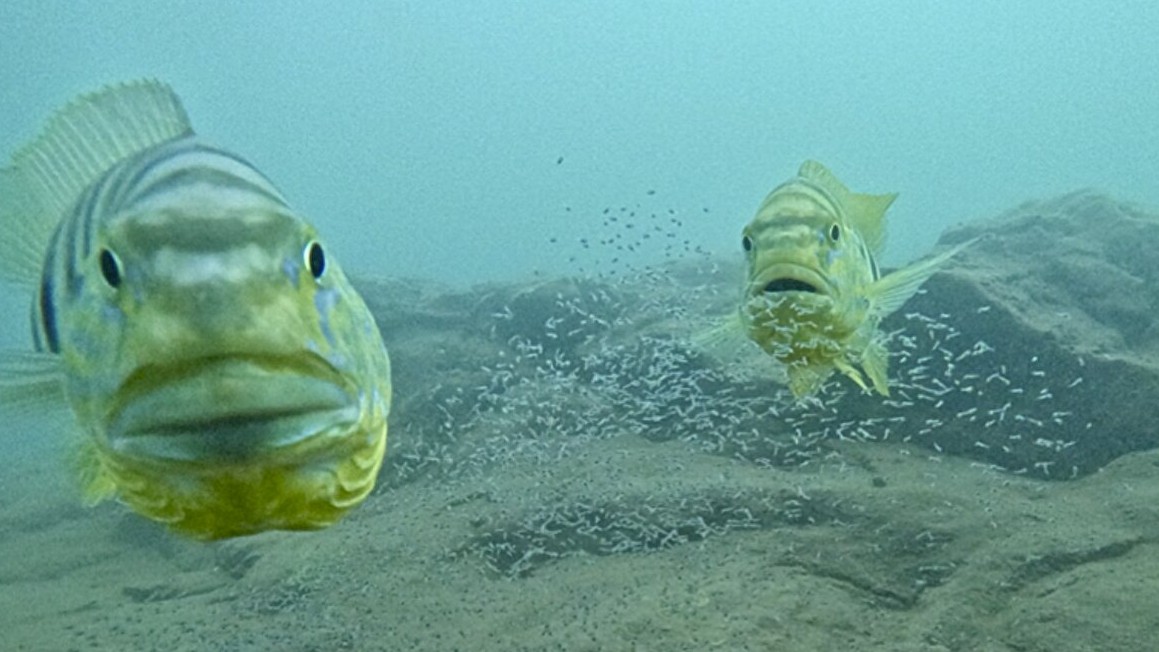
Emperor cichlids, which live in East Africa’s Lake Tanganyika, don’t like to be stared at and are likely to attack human divers who stare.
Interestingly, the fish also reacted aggressively when divers saw the eggs and hatchlings. This suggests that they share the ability to infer intent from gaze with primates and some birds.
said, said
word of the day
Doggerland — Named after a medieval Dutch fishing boat called a dogger, this now sunken woodland once connected Britain to mainland Europe during the last ice age.
quote of the day
“We feed them tuna. Like royalty, they eat the ocean’s top predators. What do we get in return?”
Rob Dunn, a professor of applied ecology at North Carolina State University, talks about our relationship with cats.
fun and games
NASA is preparing for a return to the moon. But how quickly can you name all 12 Apollo astronauts who walked on the moon?
Follow Live Science on social media
Want more science news? Follow our Live Science WhatsApp channel to keep up with the latest discoveries. It’s the best way to get expert reporting on the go, but even if you don’t use WhatsApp, you can use Facebook, X (formerly Twitter), Flipboard, Instagram, TikTok, YouTube, Bluesky, and LinkedIn.