


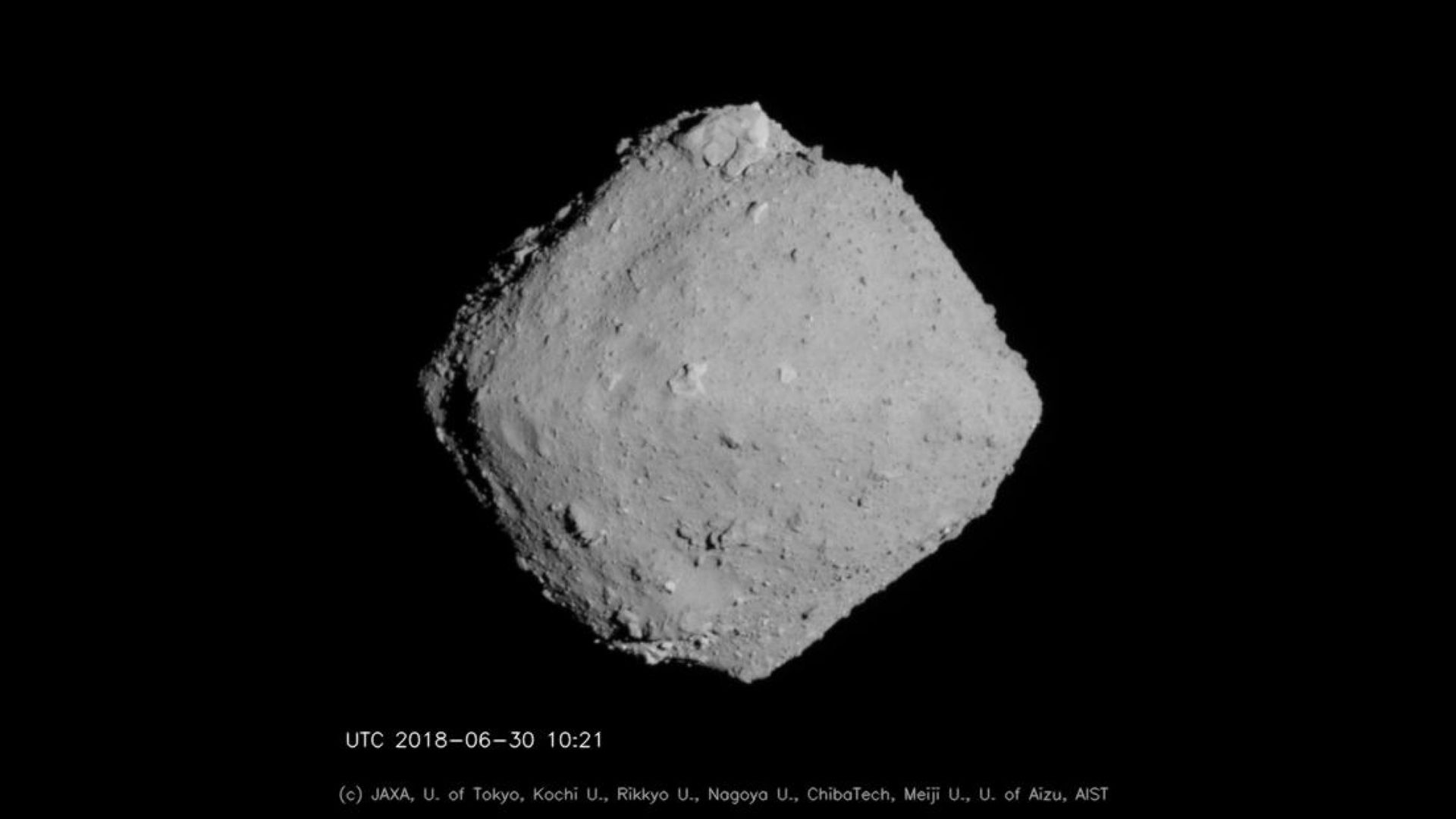
The “potentially dangerous” asteroid contains all the “letters” that make up DNA, suggesting that these vital ingredients may be common in the solar system.
Researchers made the discovery after analyzing samples collected from the asteroid Ryugu, a 3,000-foot (900-meter) wide space rock shaped like a top.
Scientists have detected the complete set of standard nucleobases that are the building blocks of DNA, the genetic basis of all life on Earth, and its lesser-known cousin RNA, according to a new study published Monday (March 16) in the journal Nature Astronomy.
Article continues below
you may like
This “does not mean that life existed on Ryugu,” study lead author Toshiki Koga, a biogeochemist at the Japan Agency for Marine-Earth Science and Technology, told AFP, according to Phys.org. “Rather, their presence indicates that primitive asteroids may have produced and stored molecules important for chemistry related to the origin of life.”
This is not the first time an asteroid has been found to contain all five nucleobases. NASA recovered the same set of nucleobases from asteroid Bennu in 2023, courtesy of the OSIRIS-REx spacecraft. Researchers also detected nucleobases in meteorites. Taken together, these findings suggest that nucleobases may be widespread in the solar system.
Origin of life in the universe?
Scientists do not know how life began on Earth. Some theories postulate that it originated here, such as in a deep-sea vent. But it’s also possible that life, or the components of life, never formed on Earth and were brought here on a comet or asteroid.
César Menor Salván, an astrobiologist at Spain’s University of Alcalá who was not involved in the study, stressed in an interview with AFP that the new results “do not suggest that the origin of life occurred in space.”
But “this and the Bennu results give us a very clear idea of what organic matter can form under prebiotic conditions anywhere in the universe,” Salvan added.
The Japan Aerospace Exploration Agency (JAXA) collected samples from Ryugu as part of the Hayabusa2 mission, launched in 2014. The unmanned Hayabusa2 spacecraft landed on the asteroid in 2019 and subsequently collected two dust samples from the asteroid’s surface, which were brought back to Earth in 2020.
The samples weigh just 5.4 grams (0.19 ounces) each, less than a quarter of their weight, but have excited scientists for years. Preliminary analysis of a small portion of material collected in 2023 reveals that the asteroid contains many of the building blocks of life, including one nucleobase (uracil) and numerous other organic materials, including the 15 amino acids that are the building blocks of proteins. These are prebiotic molecules, which are not life but are present in all life.
What to read next
One study also found microorganisms crawling throughout samples of the asteroid Ryugu. However, these microorganisms closely match Earth’s bacteria, and their presence is almost certainly the result of contamination after the samples were brought back to Earth. (Even NASA has trouble keeping Earth germs out of interplanetary spacecraft in ostensibly sterile rooms).
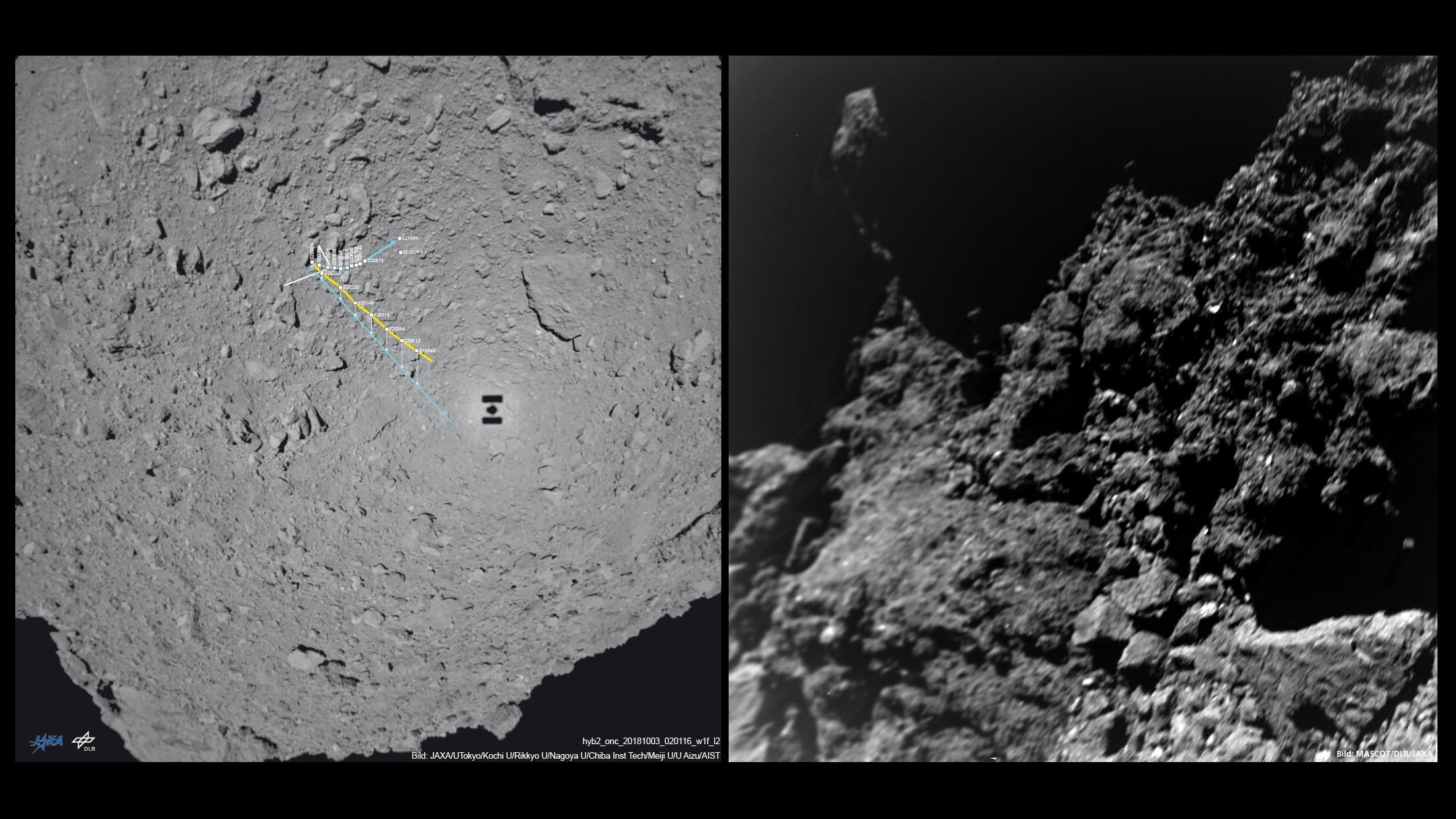
Closest look ever
In the new study, the researchers used more sample material and optimized analysis techniques to perform a much more comprehensive analysis of the nucleobases than they had done in the preliminary study.
Now, researchers have discovered all the nucleobases: adenine, guanine, cytosine, thymine, and uracil. These natural compounds are mixed with ribose and phosphate to form DNA and RNA. The researchers also looked at the nucleobase ratios and compared them to those found in Bennu and two other meteorites that fell to Earth: Murchison and Orgueil.
Nucleobases are classified into two groups based on their chemical structure. Adenine and guanine are purines known for their double-ring structure, while cytosine, thymine, and uracil belong to the pyrimidine class for their single-ring structure.
The researchers found that Ryugu contains similar amounts of purines and pyrimidines, but that Bennes and Orgueil were richer in pyrimidines, and Murchison was richer in purines. Remarkably, the researchers also identified a strong correlation between purine-pyrimidine ratios and ammonia concentrations in Ryugu, Bennu, and Orgueil, suggesting that ammonia, another life-friendly molecule, may have been an important factor driving similar nucleobase formation pathways in the rock’s different environments, the study says.
“Since there are no known formation mechanisms that would predict such a relationship, this discovery may point to a previously unrecognized pathway for nucleobase formation in early solar system material,” Koga said.
Ryugu and Bennu are a common type of asteroid known as carbonaceous asteroids, making up 75% of all asteroids in the solar system. Observations from the James Webb Space Telescope (JWST) suggest that both asteroids may originate from the same parent asteroid, which broke up billions of years ago. The Orgueil meteorite also originates from a carbonaceous asteroid.
These ancient rocks are remnants of a time when the solar system was still forming, some 4.5 billion years ago, when Earth was also forming. The detection of nucleobases therefore suggests that carbonaceous asteroids may have helped Earth obtain the chemicals that form life.
“The detection of diverse nucleobases in asteroid and meteorite material indicates their widespread presence throughout the solar system and supports the hypothesis that carbonaceous asteroids contributed to early Earth’s prebiotic chemical inventory,” the researchers wrote in their study.