


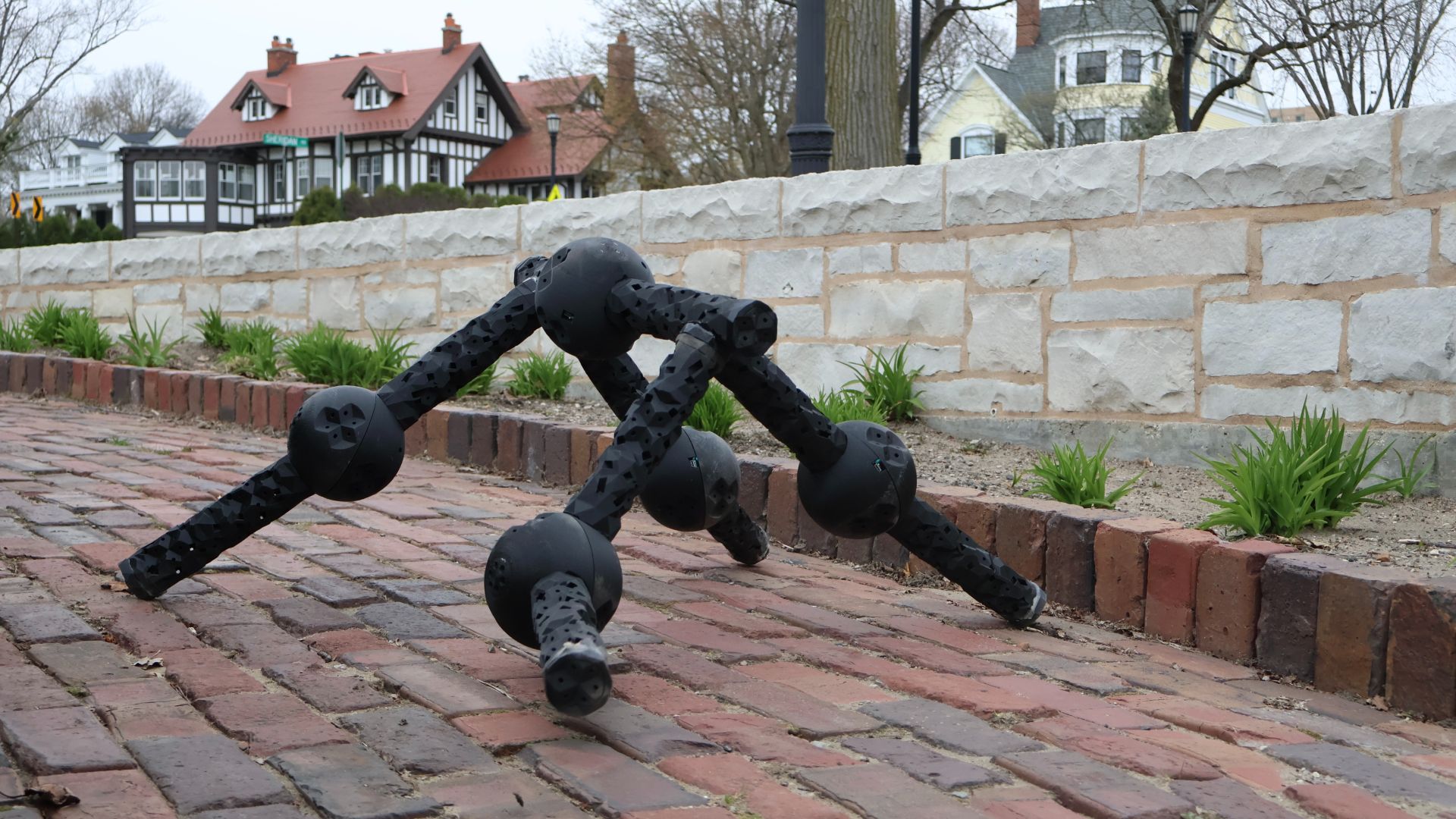
Researchers have developed a robot equipped with artificial intelligence that can autonomously navigate all types of terrain and keep moving even after severe damage.
Dubbed “legged metamachines,” these awkward-looking bots could reveal insights into human and animal evolution and provide a path for future robots to overcome limitations in locomotion, their creators say.
Article continues below
you may like
“Inside the sphere, the robot has everything it needs to survive: a nervous system, metabolism, and muscles,” study lead author Sam Kriegman, an assistant professor of computer science and chemistry, mechanical, and bioengineering at Northwestern University, said in a statement. “That means a circuit board, a battery, and a motor. The module is mechanically simple. It can only rotate around a single axis, but it’s incredibly athletic and smart.”
robot building blocks
The modular nature of the bot allows multiple parts or “limbs” to be attached to individual robots, allowing the robot’s shape and behavior to be modified without inhibiting its ability to advance over unstructured terrain.
Unlike most other mobile robots, which have strictly defined structures and tend to stick to the familiar two- or four-legged designs, these metamachines allow for a much wider range of configurations.

watch on
The study says this approach could allow researchers to create and study different forms of migration and examine concepts about the evolution of migration. In experiments, metamachines have already demonstrated locomotion modes similar to a hopping kangaroo or a waving seal.
Although the combination of limbs may seem awkward, robots exhibit an impressive ability to right themselves when encountering difficulties, even if they are completely knocked over. They can also jump over obstacles and perform acrobatics in the air.
evolution simulation
The impressive capabilities of these robots are made possible by the team’s powerful AI, which simulates evolutionary algorithms that drive natural selection.
Initially, simulation was purely software-based and limited to operations within computer programs. The AI was tasked with creating new vehicle body configurations from the robot’s modular parts, with the aim of creating the most effective combinations for traversing different terrain.
What to read next
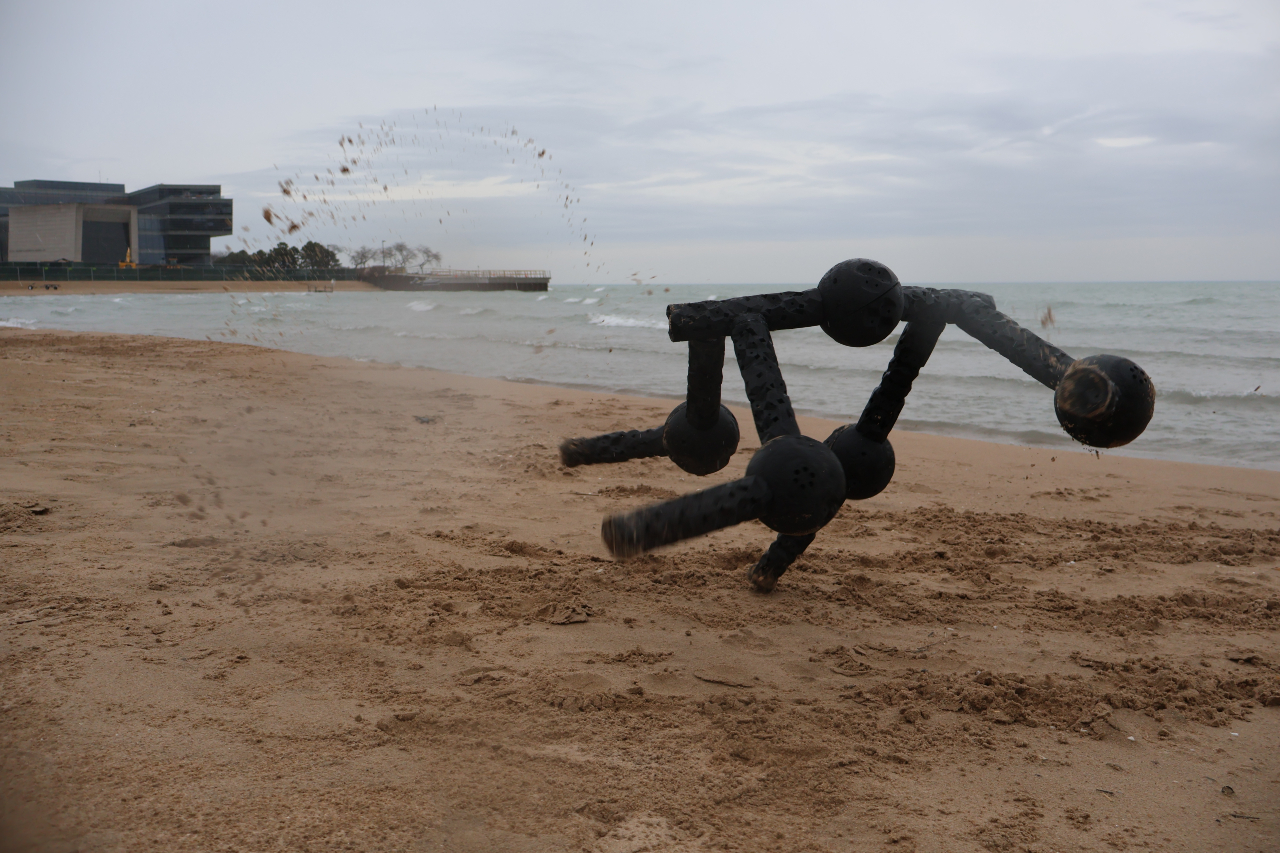
After the AI tested the designs in a virtual environment and discarded those it deemed unsuitable, the team assembled the best three-, four-, and five-legged designs the model had evolved. The machine was able to traverse broken terrain with gravel, grass, tree roots, fallen leaves, sand, mud, and uneven bricks without interruption or human intervention.
The most impressive part of the Metamachine puzzle was the robot’s ability to adapt when damaged. The team ran simulations in which the module adapted to continue moving despite various configurations being damaged or losing entire limbs.
Kriegman said that by compressing billions of years of evolution into seconds, robot design can rapidly advance beyond traditional configurations.
“Evolution can reveal new designs that are different from or beyond anything humans could have previously imagined,” Kriegman said. “So we really wanted to study how and why it works. The best way, or at least the most fun way, is to evolve the structure in realistic conditions.”
C. Yu, D. Matthews, J. Wang, J. Gu, D. Blackstone, M. Rubenstein, and S. Kriegman, Agile leg locomotion of reconfigurable modular robots, Proc. National Academy of Sciences. Science. US 123 (10) e2519129123, https://doi.org/10.1073/pnas.2519129123 (2026).