
Artemis II sets human spaceflight record with historic lunar flyby
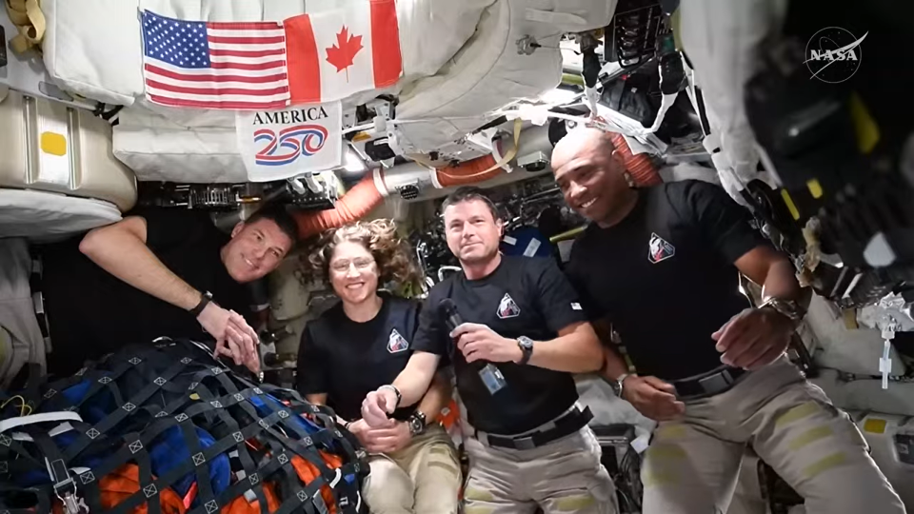
The Artemis II crew has completed a groundbreaking lunar flyby that will take human spaceflight farther from Earth than ever before, and has entered the return phase.
The four astronauts aboard the Orion spacecraft have reached the highest distance of approximately 252,756 miles, surpassing the long-standing record set by Apollo 13.
The milestone was achieved during a critical portion of the mission as the spacecraft passed behind the moon, temporarily cutting off communications with NASA for about 40 minutes.
This blackout was a planned result of the moon jamming signals to Earth, and coincided with the mission reaching its maximum distance from Earth.
Lunar flyby provides scientific observations and rare views
The six-hour lunar flyby gave the crew a long opportunity to observe and document the moon’s surface, including areas on the far side that are largely invisible from Earth.
Astronauts used handheld digital cameras to take high-resolution images of geological features under various lighting conditions.
At its closest approach, the Orion spacecraft passed approximately 4,000 miles above the lunar surface. Data collected during this phase, including images, telemetry, and communication logs, is expected to inform planning for future missions under the Artemis program, particularly those related to long-term lunar infrastructure development.
Record-breaking trajectory and mission schedule
Artemis II, launched from Kennedy Space Center on April 1 aboard a NASA Space Launch System rocket, is the first crewed mission in the Artemis program.
After the spacecraft reached orbit, it performed a series of propulsion burns that put it on a trajectory toward the moon.
The mission, announced Monday at 12:56 p.m. CDT, surpassed the previous human spaceflight distance record and marked a symbolic and operational milestone for Artemis II. The previous standard of 248,655 miles, set during Apollo 13, had stood for more than 50 years.
During the flight, the crew also reported witnessing a solar eclipse from deep space, which was described by NASA as an unprecedented event for human observers.
This alignment occurs as the moon moves between the spacecraft and the sun, providing a perspective not available on Earth or on low-Earth orbit missions.
As expected, the communications blackout, which lasted about 40 minutes, occurred while the constellation Orion was passing behind the moon as seen from Earth.
Contact was reestablished shortly after the spacecraft emerged and reconnected with mission controllers at NASA’s Johnson Space Center in Houston.
Six days into the mission, an international crew consisting of NASA astronauts Reed Wiseman, Victor Glover and Christina Koch, and Canadian Space Agency astronaut Jeremy Hansen will continue their observation mission until the spacecraft returns to Earth.
Crater named after astronaut’s late wife
In addition to scientific research, the crew proposed names for two lunar craters observed during the mission.
They agreed that one should be called Integrity, after the Orion spacecraft, and the other should be named in memory of astronaut Reed Wiseman’s late wife Carol, who died in 2020.
The proposal will be submitted to the International Astronomical Union, which oversees the naming of objects, and crew members hope it will be well received.
Separately, the astronauts received a phone call from President Donald Trump during the mission, who praised the crew and offered them an invitation to the White House upon their return.
Return trajectory and planned splashdown
With the lunar flyby completed, Artemis II is now on a four-day return journey to Earth. The mission is scheduled to conclude with a splashdown off the coast of San Diego on April 10.
Recovery efforts included evacuation of the crew by helicopter and transport to the USS John P. Murtha, where an initial medical evaluation will be performed. The astronauts will then be returned to land for further post-flight procedures.
Artemis II is designed as a test mission to validate systems and operational procedures in advance of future human landings.
The successful lunar flyby and record-setting orbit mark an important step toward a sustained human presence beyond low Earth orbit.
Source link

