
Hermeus raises $350 million to develop autonomous hypersonic fighter jet
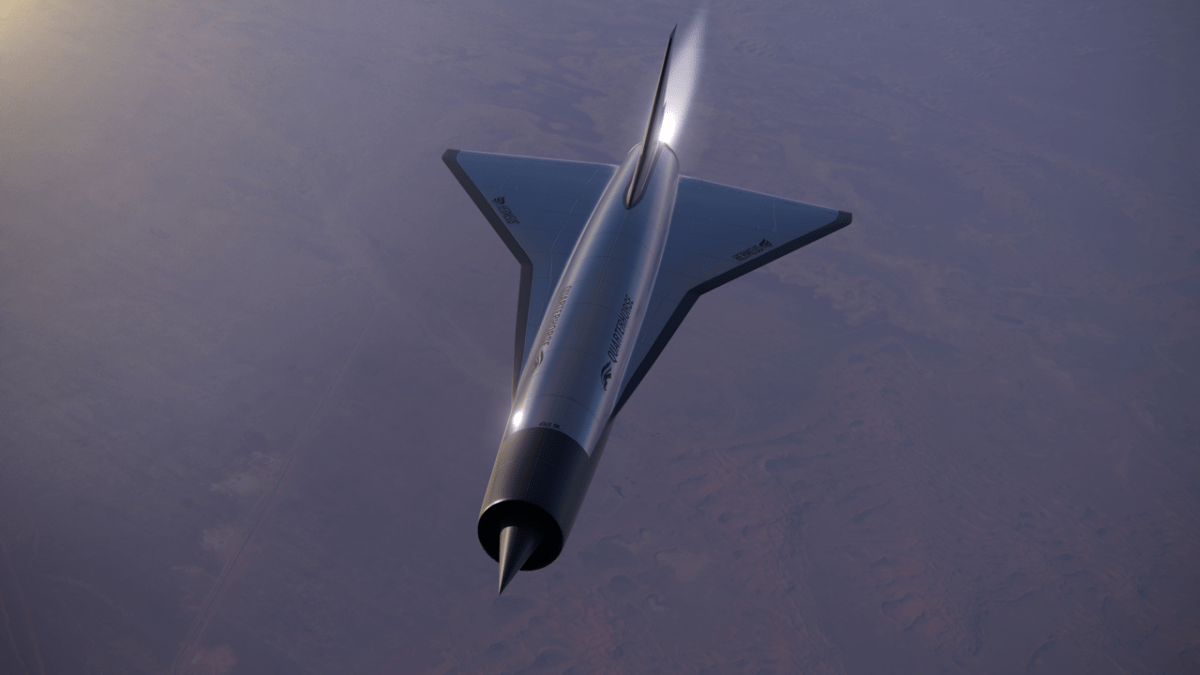
Defense startup Hermeus has raised $350 million in a funding round, pushing its valuation to $1 billion to continue developing what it calls the “fastest unmanned aerial vehicle.”
The Los Angeles-based startup announced Tuesday that it has raised $200 million in equity funding led by Khosla Ventures. Existing investors Canaan Partners, Founders Fund, In-Q-Tel, and RTX Ventures also participated. New outside capital is flowing in from media conglomerate Cox Enterprises’ venture fund and publicly traded closed-end investment firm Destiny Tech 100.
The remaining $150 million will be paid in the form of debt, which Hermeus co-founder and CEO AJ Piplica told TechCrunch will help the startup and its growing cap table maintain some control.
“We’re building a lot of hardware and expanding our manufacturing capacity, and if we can cover most of our spending without dilution, that’s absolutely the best way to do it,” he said in an interview.
Hermeus’ funding comes at a time when venture and corporate investors are pouring money into defense startups. Last year, VC investments in defense technology worldwide exceeded $9 billion in 265 rounds, with corporate investors contributing $2 billion in 28 rounds, according to Pitchbook.
But for Hermaeus, it wasn’t just good timing.
Piplica attributes at least some of the funding success to technological changes Hermeus made several years ago. He said the startup had spent time and money developing its own engine, partly out of necessity. A new opportunity arose after Hermeus courted RTX Ventures, the venture arm of defense contractor RTX Corporation, formerly known as Raytheon.
tech crunch event
San Francisco, California
|
October 13-15, 2026
Piplica and his team instead decided to work with RTX subsidiary Pratt & Whitney to modify the aerospace company’s F100 engines to power Hermaeus’ hypersonic aircraft.
This allowed Hermeus to hit a faster trajectory with a proven and capable engine, making it easier to test and iterate while preparing new contracts with the U.S. government along the way. Instead of pursuing one big goal of building a Mach 5 aircraft, Hermeus was able to diversify, according to President Zach Schorr.
“This will accelerate us to Mach 5, meeting short-term demands from the Department of Defense while also enhancing the economics of our operations,” he said. “In this way, I think many concentric circles overlap at the same time to strengthen the business, strengthen the customer, and strengthen the maturity of the technology.”
Last month, Hermes flew a demonstration version of its technology about the size of an F-16 fighter jet. The company said it aims to achieve supersonic speeds in the next version of its aircraft. A third aircraft is also in development, Piplica said.
According to Piplica, this kind of rapid prototyping approach is difficult to achieve in the aviation industry. He points to SpaceX as an industry standard for building vehicles properly, testing, failing, learning and repeating until the vehicle is perfect. That’s why the most difficult challenge facing Hermeus is training and developing human resources, Piplica said.
“Nowhere in the world is a company building a new full-fledged aircraft every year, clean sheet or not,” he said. “There used to be people who did that, but they’re all dead. So you have to create them somehow.”
The new funding round will also help Hermeus continue to grow its workforce, which is already approaching 300 employees.
Hermaeus has now completed two successful test flights (last year it flew a demonstration aircraft three times smaller). But Piplica stressed that Hermeus needs to be prepared for some failure. This, too, he considers part of the rapid prototyping process.
“The challenge is how to choose the right types of risks and invest in them over the long term,” he said. “Yes, planes can crash, and we expect it to happen at some point in our development program. We’re set up to do it very safely. But this is also why it’s so important to build more aircraft. If you don’t build a lot, it’s going to take a lot longer, because you’re talking about babies. You know, you wonder why it takes 20, 25 years to develop a new aircraft.”
Source link

