

Close Menu
  • Home
  • Identity
  • Inventions
  • Future
  • Science
  • Startups
  • Spanish
What's Hot

We can’t help but root for small open source AI model maker Arcee

Russian government hackers break into thousands of home routers and steal passwords

Chrome finally has a better way to deal with having too many tabs open

Facebook X (Twitter) Instagram
  • Home
  • About Us
  • Advertise with Us
  • Contact Us
  • DMCA
  • Privacy Policy
  • Terms & Conditions
  • User-Submitted Posts
Facebook X (Twitter) Instagram
Fyself News
  • Home
  • Identity
  • Inventions
  • Future
  • Science
  • Startups
  • Spanish
Fyself News
Home » Physicists transport volatile antimatter in a truck for the first time in history – paving the way for groundbreaking new research
Science

Physicists transport volatile antimatter in a truck for the first time in history – paving the way for groundbreaking new research

By April 7, 2026No Comments4 Mins Read
Share Facebook Twitter Pinterest Telegram LinkedIn Tumblr Email Copy Link
Follow Us
Google News Flipboard
Share
Facebook Twitter LinkedIn Pinterest Email Copy Link

Physicists have successfully transported antimatter by truck for the first time. This is a milestone that allows researchers to study elusive matter with unprecedented precision and may ultimately help explain how matter came to dominate the universe.

A short, tightly controlled movement around the European Organization for Nuclear Research (CERN) campus in Geneva demonstrated that antimatter, the most fragile substance known to science, can be transported without being destroyed. This capability allows scientists to transport antimatter to quiet labs across Europe, where they can perform ultra-sensitive experiments that are less susceptible to interference than CERN.

“In principle, this opens up a whole new world for precision measurements outside of CERN,” Stefan Ulmer, a spokesperson for the BASE (Baryon-Anti-Baryon Symmetry Experiment) collaboration, which conducted the experiment, said in a recent video.

you may like

What happened to antimatter?

According to current theory, the Big Bang should have produced equal amounts of matter and antimatter. If that were the case, the two would completely destroy each other, leaving behind a dark and empty universe. Rather, the observable universe is, inexplicably, overwhelmingly made of matter, and physicists believe that measurable differences between matter and antimatter may provide important clues to solving the mystery.

For decades, CERN has been producing antimatter through collisions of high-energy particles in its “antimatter factory.” But the same powerful equipment used to generate particles also produces small magnetic fluctuations that can disrupt the very precise measurements scientists are trying to make. It might be helpful to move antimatter to a more stable environment, but transporting it is notoriously difficult.

When antimatter comes into contact with normal matter, both are instantly destroyed in a burst of energy. To prevent that, scientists use carefully calibrated electric and magnetic fields to trap antimatter particles in a near-perfect vacuum. This condition is difficult to maintain even in a stationary laboratory, let alone in a moving vehicle.
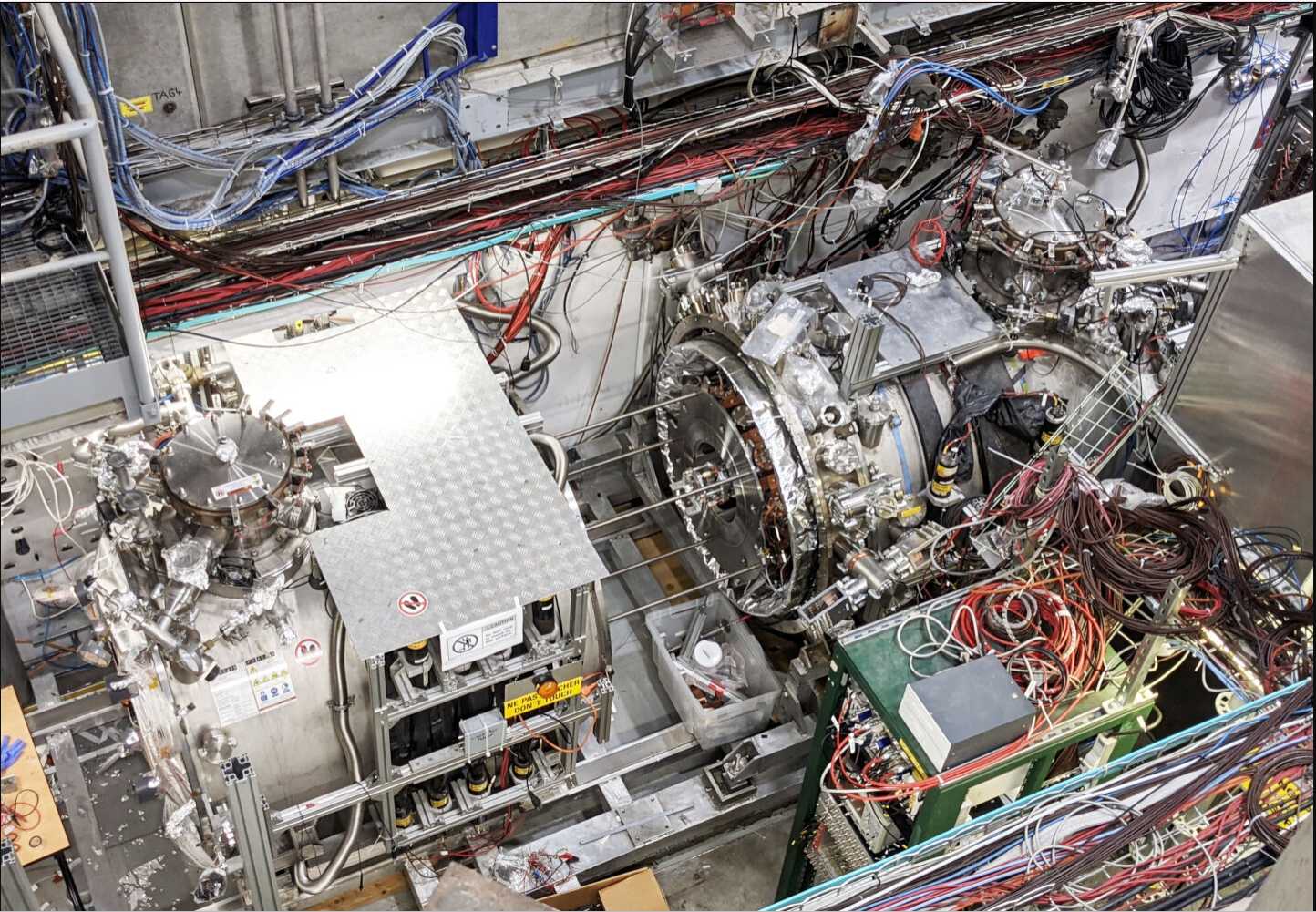
A view overlooking a large warehouse with various equipment scattered around.

A look inside CERN’s “antimatter factory,” where antimatter is produced through collisions of high-energy particles. (Image credit: Ana Prendes / CERN)

To test whether transport was possible, Ulmer and his team loaded 92 antiprotons, the antimatter equivalent of protons, into a portable trap and drove it about five miles (8 kilometers) around the CERN campus.

Get the world’s most fascinating discoveries delivered straight to your inbox.

Inside the device, the particles were suspended in a near-perfect vacuum and held in place by electric and magnetic fields, preventing them from touching the walls of the container. According to a statement from CERN, the research team monitored the particles throughout the trip and reported that they remained stable despite road vibrations and movement.

Even in the worst-case scenario, this experiment had little risk. The amount of antimatter involved would have been extremely small, and the energy released by its annihilation would have been negligible. According to CERN, even all the antimatter ever produced at this facility would only produce enough energy to power a single light bulb for just a few minutes.

Beyond the standard model

While the success of the experiment won’t immediately change the way antimatter is studied, it does demonstrate that transporting antimatter is technically feasible. This opens the possibility of moving the antiprotons to quiet labs across Europe, such as Germany’s Heinrich-Heine University of Düsseldorf, about an eight-hour drive from CERN, where more precise measurements could be made in quiet environments.

Such measurements could help scientists detect the subtlest differences between matter and antimatter. If these differences exist, they could point to why matter came to dominate the universe, provide clues to physics beyond the Standard Model, and ultimately explain why everything from stars to planets to humans exists.

“We are at the beginning of an exciting scientific journey that can further deepen our understanding of antimatter,” Gautier Hamel de Montcheneau, CERN’s director of research and computing, said in a statement.


Source link

#Biotechnology #ClimateScience #Health #Science #ScientificAdvances #ScientificResearch
Follow on Google News Follow on Flipboard
Share. Facebook Twitter Pinterest LinkedIn Tumblr Email Copy Link
Previous ArticleNew GPUBreach attack enables full CPU privilege escalation via GDDR6 bitflip
Next Article Germany’s quantum repeater project advances quantum internet

Related Posts

Deadly bright green blob spreads across South Africa’s reservoir — Earth seen from space

April 7, 2026

The Artemis II astronauts flew further from Earth than any human in history.

April 6, 2026

Biomedical researchers are using AI to write and run code. What are the risks?

April 6, 2026
Add A Comment
Leave A Reply Cancel Reply

Latest Posts

We can’t help but root for small open source AI model maker Arcee

Russian government hackers break into thousands of home routers and steal passwords

Chrome finally has a better way to deal with having too many tabs open

Russian state-affiliated APT28 exploits SOHO routers in global DNS hijacking campaign

Trending Posts

Subscribe to News

Subscribe to our newsletter and never miss our latest news

Please enable JavaScript in your browser to complete this form.
Loading

Welcome to Fyself News, your go-to platform for the latest in tech, startups, inventions, sustainability, and fintech! We are a passionate team of enthusiasts committed to bringing you timely, insightful, and accurate information on the most pressing developments across these industries. Whether you’re an entrepreneur, investor, or just someone curious about the future of technology and innovation, Fyself News has something for you.

Castilla-La Mancha Ignites Innovation: fiveclmsummit Redefines Tech Future

Local Power, Health Innovation: Alcolea de Calatrava Boosts FiveCLM PoC with Community Engagement

The Future of Digital Twins in Healthcare: From Virtual Replicas to Personalized Medical Models

Human Digital Twins: The Next Tech Frontier Set to Transform Healthcare and Beyond

Facebook X (Twitter) Instagram Pinterest YouTube
  • Home
  • About Us
  • Advertise with Us
  • Contact Us
  • DMCA
  • Privacy Policy
  • Terms & Conditions
  • User-Submitted Posts
© 2026 news.fyself. Designed by by fyself.

Type above and press Enter to search. Press Esc to cancel.