


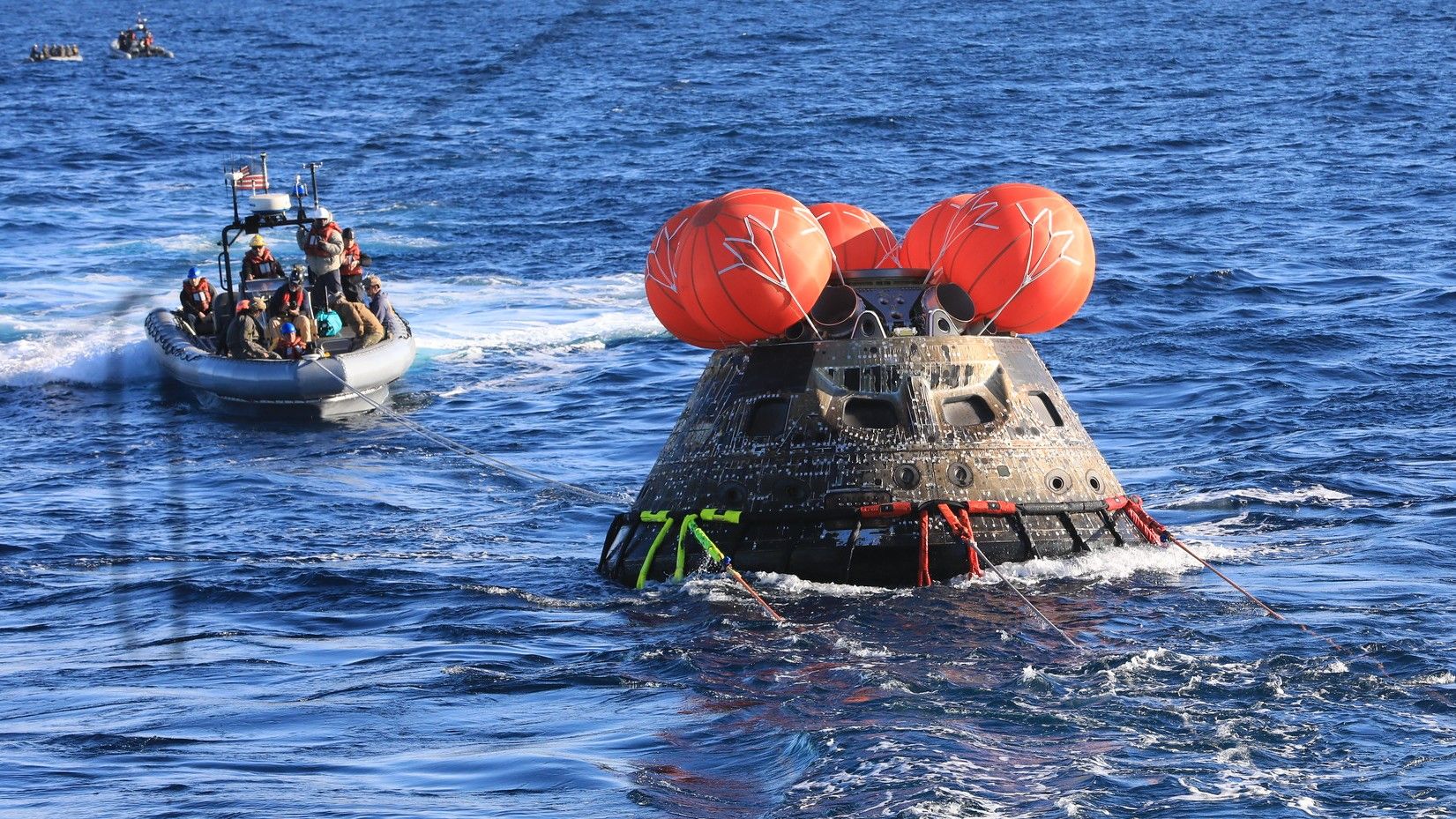
The Artemis II Orion spacecraft is expected to splash down later today (April 10) as the world awaits the return of the crew of the record-setting mission. So far, Artemis II’s lunar exploration has been a huge success, but some experts have concerns about the final leg of the journey.
There is a problem with the Artemis II heat shield, which protects astronauts from the intense heat during atmospheric re-entry. NASA is confident that tweaking the atmospheric reentry path will be enough to alleviate the heat shield problems observed during Artemis I’s test flights and keep astronauts safe today.
you may like
Patrick Pester: What is Orion’s heat shield and why is it important?
Ed Macaulay: The heat shield is an absolutely essential part of the Orion spacecraft. When the Orion spacecraft returns and re-enters Earth, it will be traveling at a speed of approximately 25,000 miles (40,000 km/h). This is just incredible speed. By the way, that speed would cover the distance of the London Marathon. [or the New York City Marathon] In about 4 seconds.
Because of its speed, the capsule’s temperature upon re-entry into the atmosphere will be approximately half that of the sun’s surface. [5,000 degrees Fahrenheit or 2,800 degrees Celsius]. The heat shield is essential to protect the capsule from the scorching heat during atmospheric reentry. Without this, the capsule will completely melt and burn out.
PP: Can you explain why some experts are concerned about heat shields?
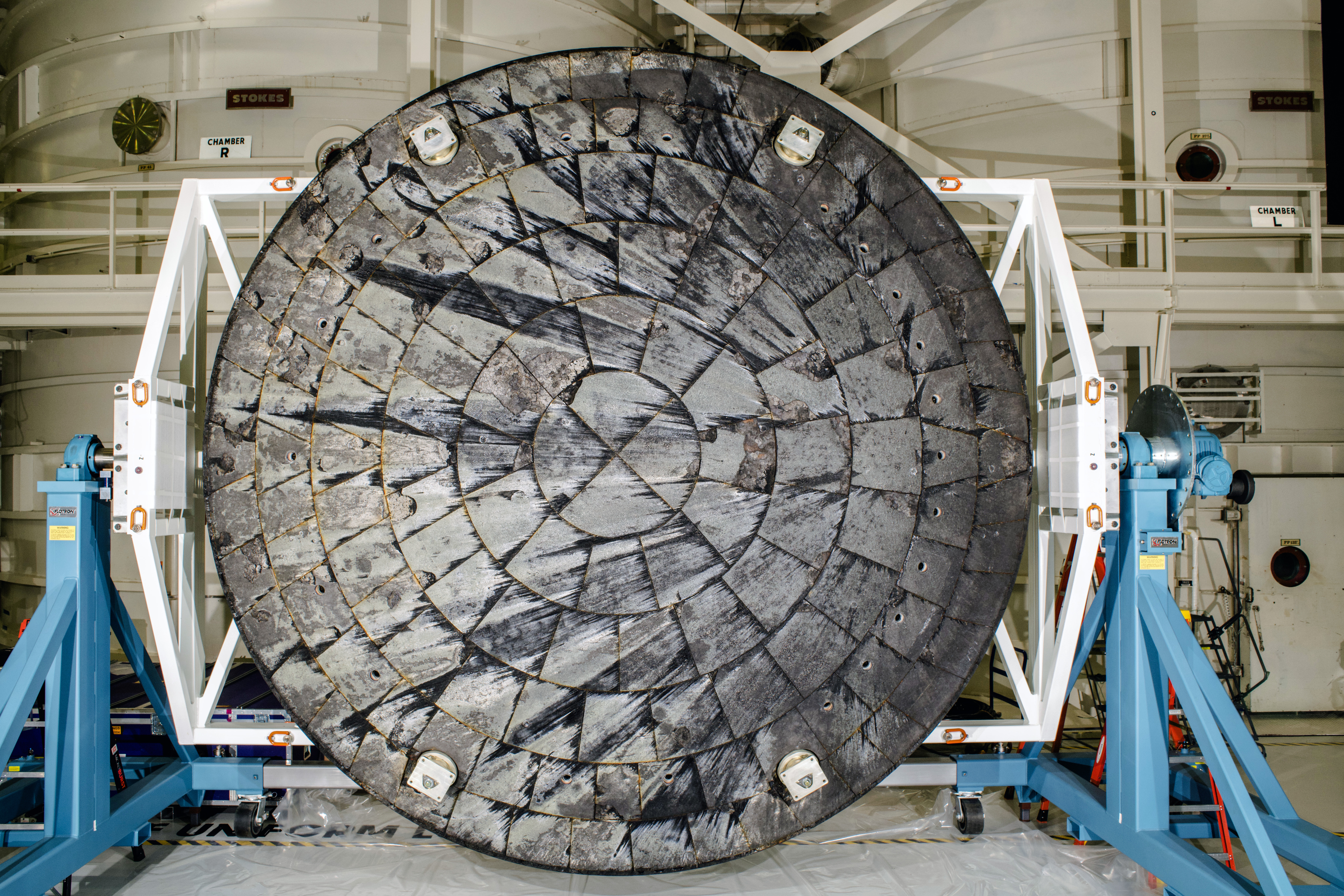
EM: Artemis II is a manned version of Artemis I, an unmanned mission that flew several years ago, so some concerns have been raised regarding the heat shield. This was designed to be the exact same mission profile, but without humans on board. When the Artemis I capsule returned to Earth, it was able to safely transit through the atmosphere, but the damage and impact to the heat shield was more severe than predicted by the models.
Heat shields are designed to burn out due to heat. It is not designed to remain completely intact and completely original. You can think of it like a crushable zone in a car, but for heat. Cars are designed to compress the crash zone during a collision to ensure the safety of occupants. The heat shield is designed to burn out and break into pieces, carrying away that heat.
What surprised me about Artemis I’s heat shield was that part of it was severely burnt off. It wasn’t worn out. [gradually eroding] It will move away evenly. This is likely caused by hot gases trapped within the heat shield. When heated, it expands, breaking the mass of the heat shield and causing damage.
What to read next
For Artemis II, NASA decided to keep the heat shield the same as Artemis I. Instead, NASA decided to change the reentry profile to reduce stress on the heat shield. So hopefully you’ll get an even ablation through the heat shield and not burn out in such large chunks.
PP: Is NASA correct that it intends to take a more direct approach rather than skip reentry, which may have caused the problem in the first place?
EM: In a nutshell, that’s exactly what they’re doing. The skip reentry profile was designed in principle to make reentry easier for the capsule and crew. It enters the atmosphere at 25,000 miles per hour and must consume all of that velocity and convert it into heat within minutes.
The idea of a skip reentry profile is that the capsule skims the surface of the atmosphere, burns off a bit of velocity, before flying directly back into the atmosphere, before exiting and then returning to the full atmosphere. In principle, there is less stress on the capsule in terms of temperature and gravitational loads. [gravitational force].
But in reality, the whole process seems to take longer, giving the gases trapped inside the heat shield more time to heat up and expand, causing damage. That’s why in Artemis II, the capsule will aim for a direct atmospheric entry profile. The same reentry profile used in the Apollo program.
We hope that the time it takes for gas damage to occur will be shortened. Another advantage of direct reentry is that it is easier to model. The NASA team and all involved engineers spent countless hours running computer simulations of these reentry profiles, trying to figure out how much the heat shield would heat up and what the damage would be.
Skip retyping makes the whole process more complicated. I’m trying to model how something bounces back. Using direct reentry is easier. It’s like the devil is better.
PP: So it might be a little uncomfortable for the crew, but it’s good for the heat shield?
EM: Well, I think it might be a trade-off. And the Artemis II crew are all consummate professionals when it comes to the G-Force experience. So if you’re talking about gravitational accelerations like 4 Gs, you’re not going to bat an eye. They train for much higher G-loads. A few G’s for a few minutes is no drama for the Artemis II crew.
PP: Is it okay to risk your life on that heat shield?
EM: Simply put, if you ask me, I wouldn’t. I think there’s reason to be confident about this, because even if a lot of Artemis I’s heat shield burned down, the crew would still be safe if there were humans there. I think what this shows is that there is an element of safety margin with this heat shield. Even if conditions are slightly “off-nominal,” as NASA puts it, it’s not completely normal, but there is some kind of reasonable safety margin in what the heat shield can withstand. That’s not quite the same as asking me personally. Will I be next in line to ride Artemis II?
The crew of Artemis II is clearly a very extraordinary group of astronauts. They all obviously have their place. And what they’re doing with this mission is truly extraordinary. They are far beyond the path humanity has been on for more than half a century.
I’m sure they’ve all researched all of these details because there’s no one more passionate about this heat shield than them. And I’m sure they’re confident in the work that all the scientists and engineers who worked on the thermal barrier did.
The Artemis II missions thus far have been exceptionally successful from a technical standpoint. I think this gives us reason to be confident about reentry, as there appears to be good reason to expect the orbit to be exactly nominally and exactly as designed. And hopefully that will give them the best ride to atmospheric re-entry.
PP: But do you personally not want to take the risk or do you not want to be an astronaut in general?
EM: Personally, I’m a nervous person. And I think it’s easy to forget how much risk there is in human spaceflight, and how much greater that risk is than anything we experience on a daily basis. Only a few hundred people have ever been to space. Less than 1,000 people have yet gone to space. And, very sadly, even with only a few hundred manned space missions, there have been some fatal missions.
PP: Is there anything you would like to add in closing?
EM: My personal view is that this mission has been an extraordinary success so far for all sorts of reasons. From a technical point of view, this mission was incredibly successful. space launch system [rocket]boosters, initial orbital injection, and menstrual injection, the performance of the system was incredible.
But more than that, these four astronauts were just amazing. They not only perform technical duties, but also provide a human connection, a human perspective, and take the rest of the planet on a voyage.
One of the reasons I’m so excited is that everything doesn’t end when Artemis II returns to the atmosphere. This is just the beginning of a whole new chapter. NASA recently announced highly ambitious plans for continued human presence on the moon, and exciting concrete plans for the next Artemis mission. So this is just the beginning of a whole new chapter.
Editor’s note: This interview has been edited and condensed for clarity.