
Using bubbles to remove PFAS from landfills
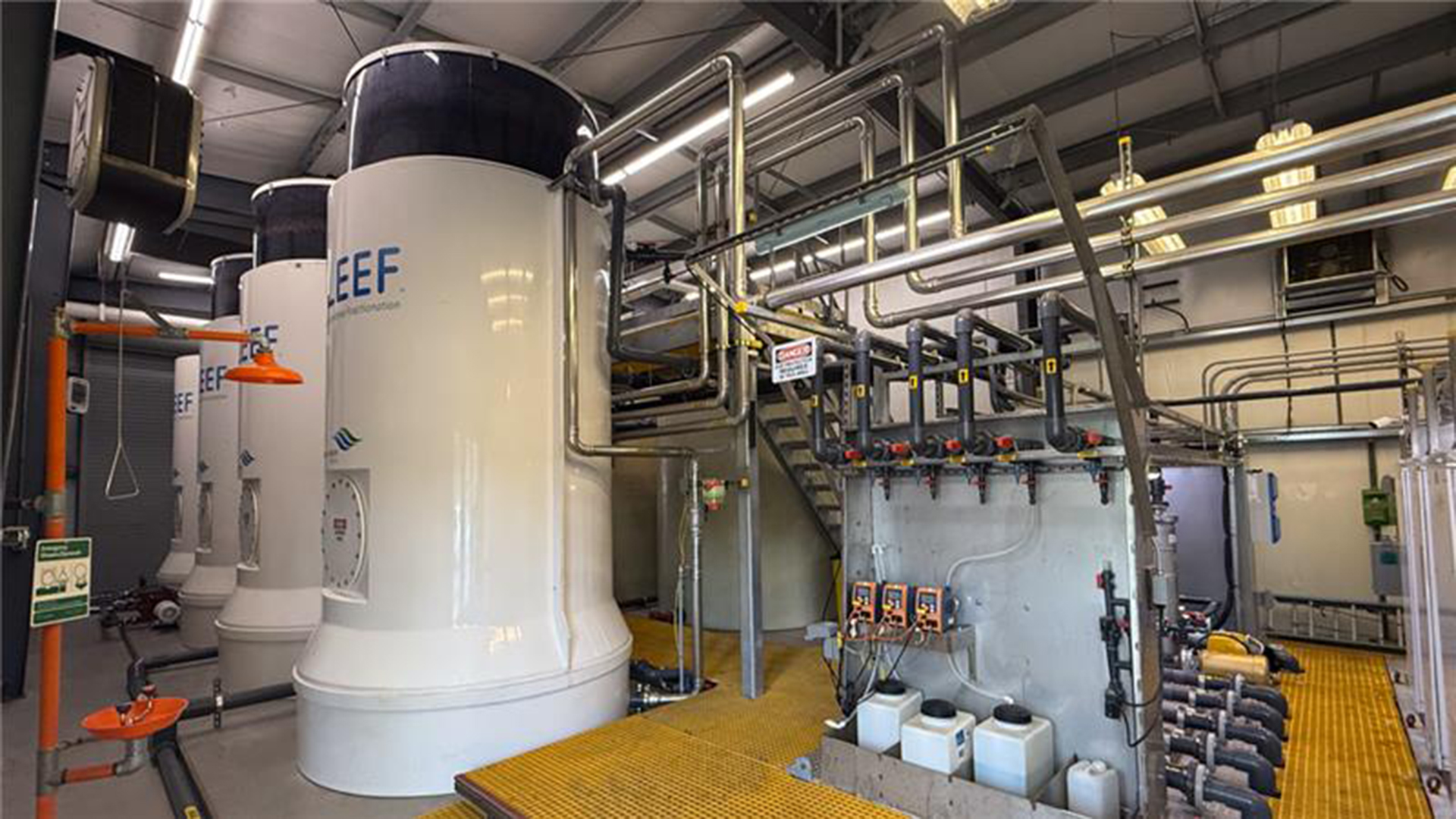
Engineer air and foam to recover PFAS from landfills.
High concentrations of per- and polyfluoroalkyl substances (PFAS) have been found in landfills around the world. These chemicals can migrate off-site and contaminate downstream water treatment plants and the surrounding environment. Foam separation – the process of blowing air into contaminated water to lift PFAS into removable foam – provides landfill operators with a practical and scalable method to stop PFAS at the source before they enter municipal treatment systems or the environment.
PFAS challenges in waste management
PFAS are a group of synthetic compounds characterized by carbon-fluorine bonds, the strongest covalent bonds in organic chemistry. This structure makes it extremely resistant to heat, biological degradation, and chemical degradation. As a result, PFAS persist in the environment long after consumer products containing them are disposed of.
Landfill leachate is a liquid that is formed when water seeps through the decomposition of organic waste. As this liquid moves through landfill cells, it becomes a highly concentrated mixture of dissolved metals, organics, and PFAS.

Historically, municipal wastewater treatment plants (WWTPs) have managed increasing levels of total dissolved solids (TDS) and chemical/biological oxygen demand (COD/BOD) characteristic of leachate waters. However, the emergence of PFAS has brought additional challenges to wastewater treatment plants, revealing critical gaps in the treatment capacity of this traditional infrastructure, which typically consists of sedimentation and biological processes. While wastewater treatment plants are great at removing nutrients and organic loads, they are essentially incapable of handling the unique chemistry of PFAS.
“Precursor trap” in wastewater treatment
Of further concern is the role of PFAS precursors. Industrial products can contain complex PFAS species that can undergo chemical reactions during processing. Rather than being removed, they can transform into dangerous bioaccumulative species such as PFOA and PFOS. This means that treated water leaving a wastewater treatment plant may contain higher levels of regulated PFAS species than the water coming in.

If not effectively stopped at the source, these terminal PFASs enter the environment through wastewater discharged into waterways or by adsorption onto biosolids. When these biosolids are applied to land as fertilizer, PFAS can leach into the soil and groundwater, creating a continuous cycle of contamination.
Pitfalls of forced preprocessing
To address these new contaminants, the industry has often focused on pre-treating leachate before it enters the wastewater treatment plant system. Traditional approaches include reverse osmosis (RO), granular activated carbon (GAC), or ion exchange (IX). Unfortunately, these traditional approaches face significant physical and economic hurdles when used as a primary pretreatment of raw leachate.
Scaling and fouling: RO membranes are highly susceptible to mineral scaling and organic fouling. GAC and IX systems often experience biofouling and hydraulic channeling under high load conditions. Competitive adsorption: Dissolved organics and other components can also be adsorbed to GAC and IX media, significantly reducing PFAS removal efficiency. Operating costs: Increased remanufacturing requirements and service intervals increase maintenance frequency and lifecycle costs.
These technologies can help achieve target emission PFAS levels as a final “polishing” step, but durability and lifecycle cost become limiting factors when treating raw leachate containing high concentrations of organics.
LEEF System: Foam separation for PFAS removal
To solve this, Water & Carbon Group developed the LEEF System®: Foam Fractionation for PFAS Rem. This is a foam separation system specifically designed for the harsh chemical environment of landfill leachate.
Foam fractionation is a physicochemical separation process based on interfacial adsorption. Depending on the surface-active properties of the target compound, it preferentially adsorbs at the air-water interface of the rising bubble. Many PFAS compounds exhibit this surface-active behavior, making them an ideal separation technique.
Why use LEEF for leachate?
Unlike media-based systems, foam fractionation does not rely on fixed adsorption sites. Instead, it takes advantage of the surfactant properties of PFAS, which naturally bind to the air-water interface of rising bubbles.
Synergistic effects of co-contaminants: Leachate components such as humic substances, fulvic acids, salts, and other organic compounds can improve the fractionation performance of foam. TDS tolerance: Increased total dissolved solids (TDS) can actively increase PFAS removal without compromising separation.
How the system works
The LEEF process utilizes a continuous flow, multi-pass configuration with the following major steps:
Aeration: Fine air bubbles are introduced at the bottom of the rectification column. Adsorption: PFAS molecules naturally adsorb to bubble surfaces as they rise through the leachate. Extraction: The rising bubbles form a stable foam at the surface that is extracted and collapses into a liquid “foam”.
This process produces a highly concentrated waste stream (typically only 0.025% to 0.25% of the total influent) that is ideal for coagulation and immobilization or for transition to permanent destruction techniques.
LEEF in full swing
The Water & Carbon Group designs, constructs and operates full-scale facilities in landfill environments. The two installations provide multiple years of operational data.
Shoal Bay Landfill (Darwin, Australia): In operation since 2022, the system has demonstrated durability and stable operation. Bethlehem Landfill (Bethlehem, Pennsylvania, USA): In operation since 2024, designed for 50,000 GPD and consistently reducing target PFAS including PFOS, PFOA, PFNA, PFHxS, PFHpA, and PFDA to target levels.
Even with unpredictable leachate chemistry and ppb to ppm PFAS loads, a full-scale LEEF installation ensures non-detection of PFOS and PFOA. LEEF systems are one of the few air-based PFAS separation technologies that can provide regulatory-grade results at landfill scale.
The Water & Carbon Group has conducted dozens of pilot studies on various leachate chemistries. The company is developing a full-scale installation of the LEEF system at the Senekamedowes Landfill in New York state this year. With the capacity to treat 300,000 gallons of leachate per day, this facility is one of the largest PFAS treatment systems currently under development.
Field tested and designed for operators
Field operations have allowed us to refine the LEEF system into a robust, operator-centric platform.
Variable chemical reactions: Performance remains stable as seasons change and waste cell composition changes. Scaling resistance: Mineral scaling is minimized due to the absence of membrane surfaces within the primary separation mechanism. Flexibility: Parameters can be adjusted to accommodate changes in incoming species. If enhanced short chain removal is required, site-specific process modifications are implemented.
Landfill preparation for PFAS management
As regulations evolve, emphasis shifts to source controls that limit the redistribution of PFAS through municipal infrastructure. Foam separation provides a scalable and technically grounded route for landfill operators seeking a durable and practical upstream strategy. As PFAS regulations accelerate, discharge processing is no longer an option. Water & Carbon Group’s LEEF system provides a proven path for landfill operators who are ready to implement practical, full-scale PFAS management today.
Please note: This is a commercial profile
This article will be published in an upcoming PFAS Special Focus Publication in April.
Source link

