
The science of getting there
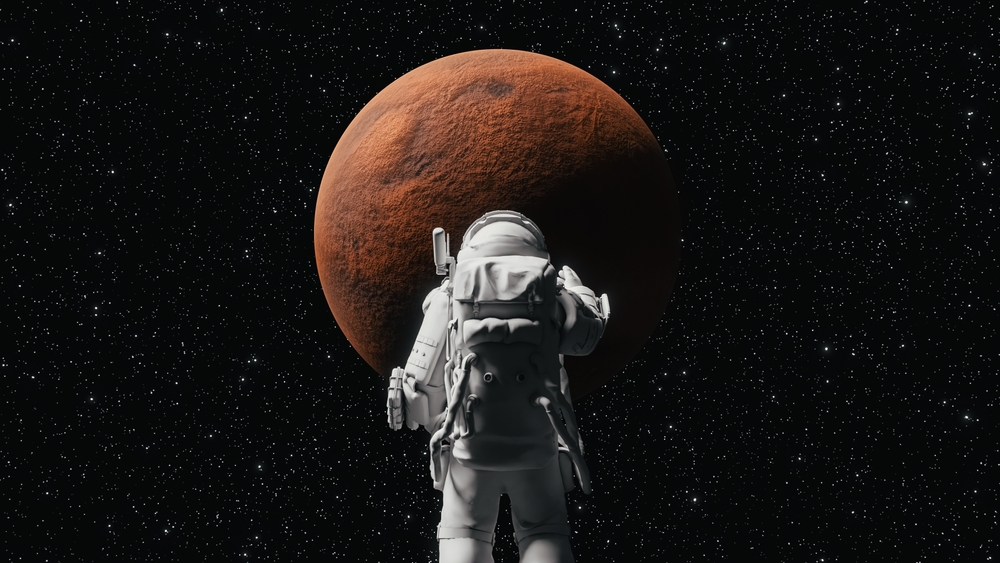
The idea of sending humans to Mars is often framed as a matter of ambition and funding.
In reality, future missions to Mars are a logistical problem shaped by physics. Distance, energy, time, and mass define what is possible long before politics and budget matter.
Mars is on average about 225 million kilometers from Earth. This number alone cannot explain the difficulty. What matters is how you move people and equipment over that distance, how long it takes, and how much cargo you need to carry to survive during the journey.
At the heart of this is propulsion. Not only are there ways to leave Earth, but there are also ways to travel through space, slow down on the other side, and potentially return home. All decisions about Mars missions (crew size, safety margins, costs) are driven by those constraints.
half year problem
Using current technology, a trip to Mars typically takes six to nine months. The limits of orbital mechanics and chemical propulsion will determine that schedule.
This period presents a series of challenges. Astronauts will be exposed to space radiation for long periods of time, increasing long-term health risks. Life support systems must operate continuously without replenishment. Food, water, and oxygen all add weight, so every kilogram counts.
There is also a psychological aspect. The crew was trapped in a relatively small spacecraft with no option of evacuation. Communication delays (up to 20 minutes each way) mean real-time assistance from Earth is not possible.
Reducing travel distance is not just desirable. This directly reduces risk and simplifies nearly every other aspect of the mission.
Why are chemical rockets still mainstream?
For now, missions to Mars rely on chemical rockets. These engines generate thrust by burning fuel and oxidizer, generating the force needed to escape Earth’s gravity and set a trajectory toward Mars.
Its advantage is straightforward: high thrust. It can lift heavy payloads and accelerate quickly, which is essential for launches and initial operations.
But they are inefficient. The bulk of a spacecraft’s mass is fuel, which cannot be recovered once used. This limits both speed and payload.
In fact, chemical propulsion defines the baseline for Mars travel. This works reliably, but it locks the mission into long transit times and strict mass trade-offs.
Mass equation: fuel and survivability
All Mars missions are governed by fundamental constraints. That is, the more fuel you carry, the less capacity you have for everything else.
“Everything else” includes:
Life support systems Food and water Radiation shielding Scientific equipment Habitat and repatriation fuel
This trade-off is why propulsion efficiency is as important as raw thrust. More efficient engines require less fuel and free up mass for systems essential to survival.
The difficulty is that efficiency and thrust tend to move in opposite directions. High thrust systems consume more fuel. Efficient systems generate less immediate force. Balancing the two is central to mission design.
Electric propulsion: efficiency over speed
Electric propulsion systems, such as ion thrusters and Hall effect thrusters, use electricity to accelerate charged particles and generate thrust. They are much more efficient than chemical rockets and use much less propellant.
The tradeoff is lower thrust. These engines cannot lift the spacecraft off Earth and are not suitable for rapid acceleration. Instead, provide a slow, continuous push over a long period of time.
This makes them suitable for transporting cargo on missions to Mars. Supplies, habitat, and fuel could be sent in advance and arrive in Mars orbit before the crew departs.
This approach changes the structure of the mission. Rather than starting everything at once, planners can execute missions in stages over time, reducing both risk and mass constraints.
Nuclear thermal propulsion: short-term progress
Nuclear thermal propulsion (NTP) is widely considered to be the most practical upgrade to current systems.
Instead of burning fuel, NTP engines use a nuclear reactor to heat a propellant (usually hydrogen) and release that propellant to produce thrust. This approach generates significant thrust while being more efficient than chemical propulsion.
A research program led by NASA and DARPA is working toward a demonstration mission within the next decade.
The potential impact is significant. The transit time to Mars could be reduced to approximately three to four months. That reduction reduces radiation exposure, reduces demand on life support equipment, and increases mission flexibility.
Importantly, NTP systems can be integrated into existing mission architectures, making them a realistic candidate for early manned missions.
Nuclear electric propulsion: building durability
Nuclear electric propulsion (NEP) combines a nuclear reactor with an electric thruster. Nuclear reactors generate electricity, which is used to power highly efficient propulsion systems.
This provides two advantages: long energy supply and high efficiency. The disadvantage is low thrust, which makes the NEP unsuitable for high-speed crew transport.
However, it is suitable for cargo transport and continuous operations. In the Mars context, NEPs could support the continued flow of material between Earth and Mars and enable long-term infrastructure development.
Experimental system
More advanced propulsion concepts are being investigated, but are still in the early stages.
Plasma-based engines aim to provide tunable performance and have the potential to bridge the gap between thrust and efficiency. Fusion propulsion could provide extremely high energy output and dramatically shorten travel times.
Other concepts, such as solar sails and laser-driven propulsion, completely eliminate the need for onboard propellant and rely on external energy sources.
These systems are unlikely to play a role in the first manned mission to Mars, but they point to a future where deep space travel will be faster and less constrained by fuel.
Timing and trajectory constraints
Even with advanced propulsion, Mars missions are constrained by orbital adjustments. Earth and Mars reach travel-friendly positions approximately every 26 months.
These launch windows are important. Missing one can delay the mission for years. Cargo missions, crewed launches, and returns all depend on precise timing.
Although improved propulsion provides some flexibility, it does not eliminate these constraints. Mission plans must still be consistent with how the solar system works.
From mission to infrastructure
Reaching Mars is not a single event, but a series of coordinated operations.
Possible approaches include sending cargo ahead of a crewed mission to deliver habitat, power systems, and fuel production equipment. Only once the major systems are in place will the crew follow suit.
A return mission could rely on producing fuel using local resources on Mars, reducing the amount that would have to be launched from Earth.
This transforms Mars exploration from a one-off mission to a logistics network that relies heavily on reliable and efficient propulsion every step of the way.
Problems defined in physics
The challenge of reaching Mars is not a lack of ambition. It’s a matter of working within physical limits.
Although chemical rockets have enabled everything that has been accomplished to date, they impose constraints that shape mission design. Electric power and nuclear systems offer ways to alleviate these constraints, each addressing different parts of the problem.
Future Mars missions will likely combine multiple propulsion methods, including high-thrust systems for launch, efficient engines for transportation, and advanced technologies for long-term expansion.
The journey to Mars is often described as a leap. In reality, it is an incremental progression, defined by engineering trade-offs and incremental improvements.
The core of the problem has not changed. It’s a faster, more efficient way to move mass across space, carrying everything you need to survive the journey and return.
Source link

