


Close Menu
  • Home
  • Identity
  • Inventions
  • Future
  • Science
  • Startups
  • Spanish
What's Hot

Researchers have discovered a critical GitHub CVE-2026-3854 RCE flaw that can be exploited via a single Git push

Google expands access to Pentagon AI after Anthropic rejection

Brazil’s LofyGang resurfaces after 3 years with Minecraft LofyStealer campaign

Facebook X (Twitter) Instagram
  • Home
  • About Us
  • Advertise with Us
  • Contact Us
  • DMCA
  • Privacy Policy
  • Terms & Conditions
  • User-Submitted Posts
Facebook X (Twitter) Instagram
Fyself News
  • Home
  • Identity
  • Inventions
  • Future
  • Science
  • Startups
  • Spanish
Fyself News
Home » The universe may end trillions of years sooner than we thought.
Science

The universe may end trillions of years sooner than we thought.

By April 28, 2026No Comments3 Mins Read
Share Facebook Twitter Pinterest Telegram LinkedIn Tumblr Email Copy Link
Follow Us
Google News Flipboard
Share
Facebook Twitter LinkedIn Pinterest Email Copy Link

Scientists have long thought our universe would last trillions of years, but new research shows that the universe has a much shorter lifespan. Our universe may only last 33 billion years.

It’s just a cosmic blink of an eye before it all comes crashing down. This is a process called the “Big Crunch,” in which expansion is reversed and all matter and space-time collapse into a very dense state similar to the conditions of the Big Bang. Possibilities about the fate of the universe were long thought to be abandoned as the universe’s expansion accelerates, but this new research has reopened a surprising and slightly disturbing option.

The journey to this dramatic conclusion began with our quest to map the universe, where we focused on dark energy, a mysterious force that is pulling the universe apart at an accelerating rate. Recent data from the Dark Energy Survey (DES) and the Dark Energy Spectroscopy Instrument (DESI) have mapped hundreds of millions of galaxies to investigate this expansion. These important tools suggest with great confidence that dark energy’s “equation of state” – the relationship between pressure and energy density that determines its influence on expansion – is not just a static number. Rather, its influence appears to be changing over time.

you may like

This strange dynamic opens the door to an alternative explanation of what dark energy is made of. This led to the axion dark energy (aDE) model. This model proposes that dark energy is composed of both an axion field, an ultralight form of dark matter flying around the universe, and a cosmological constant, or fixed background expansion, baked into the fabric of spacetime.

In a new paper uploaded to the preprint server arXiv, the researchers applied this hybrid model to DES measurements. They found that this combination likely explains the DES and DESI results, but with a twist. In the distant future of the universe, the interaction between the axion field and the cosmological constant will actually actively pull the universe back, leading to the ultimate Big Crunch.
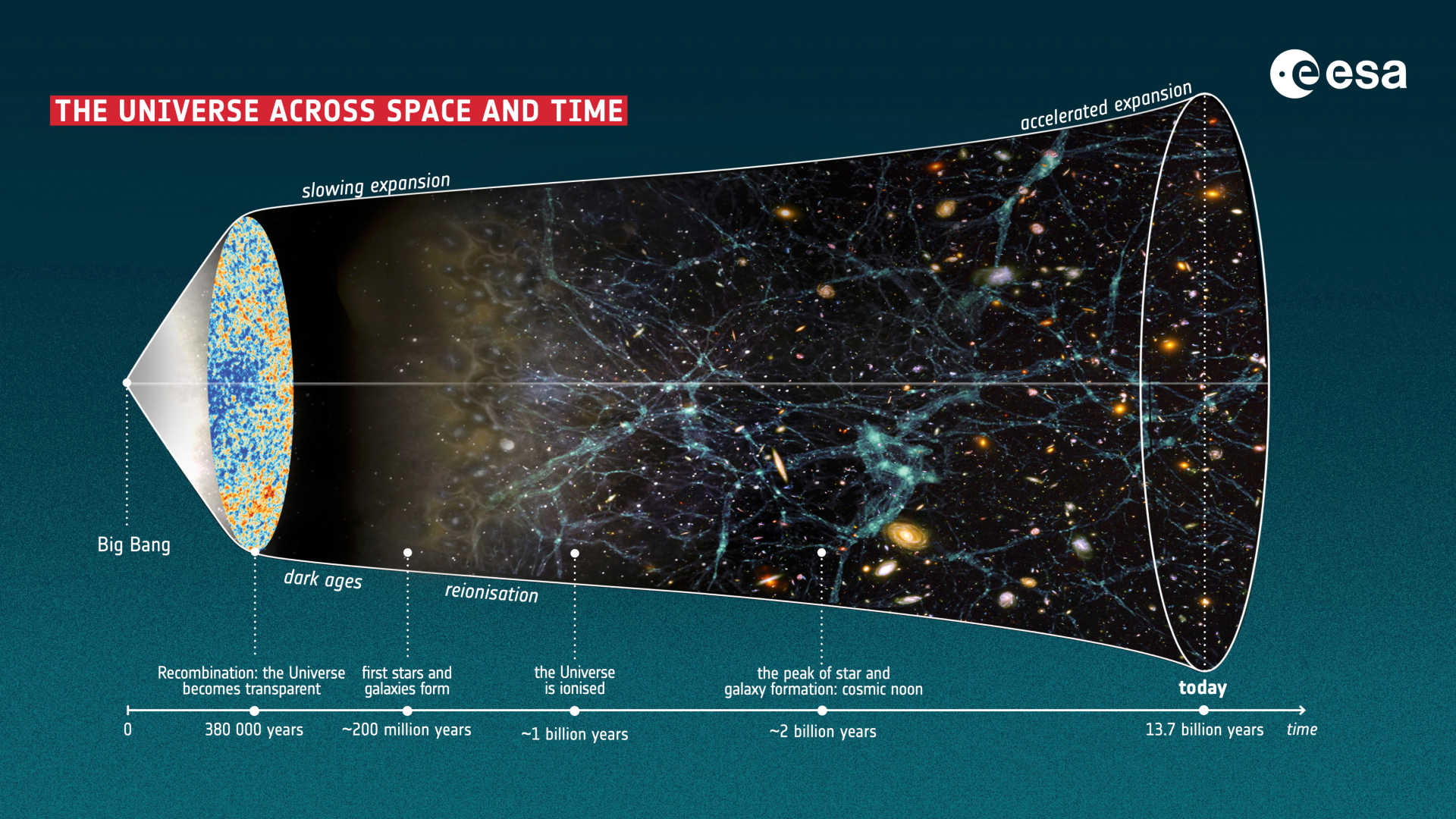
Scientific illustration showing the sides of a cylindrical shape. There are various stars and images inside, and a label at the bottom showing the timeline of the evolution of the universe.

The standard model of cosmology suggests that the expansion of the universe continues to accelerate over time. But if dark energy is dynamic, as some recent research suggests, the universe could someday change direction and collapse. (Image credit: ESA, CC BY-SA 3.0 IGO)

By taking the model that best matched observations and running simulations over time, the researchers calculated the exact moment the universe would end, 33.3 billion years from now. This dramatically short future is in sharp contrast to the traditionally thought-of 1 trillion-year lifespan. Instead of a cosmic expansion where the universe stretches out like a lonely, eternal highway, we make a cosmic U-turn and return to the beginning of our journey.

This is new territory, and while the evidence persuades us, science always comes with caveats. The DES and DESI observations, which suggest that the cosmological constant is not static, are interesting but still require verification. This model depends on many variables, and although several different combinations of them could potentially explain the observations, a negative cosmological constant and the resulting big crunch remain the most likely in our analysis.

Get the world’s most fascinating discoveries delivered straight to your inbox.

More data are needed to rigorously test this model. The universe is a complex creature. Our understanding continues to evolve. In our pursuit of increasing data streams, we piece together the best stories ever told. But that story may end sooner than we expected.


Source link

#Biotechnology #ClimateScience #Health #Science #ScientificAdvances #ScientificResearch
Follow on Google News Follow on Flipboard
Share. Facebook Twitter Pinterest LinkedIn Tumblr Email Copy Link
Previous ArticleA new shield material that is thinner than a hair and blocks electromagnetic waves and radiation from space
Next Article A new handbook for the zero window era

Related Posts

NASA Curiosity rover discovers rocks containing seven new organic molecules on Mars

April 27, 2026

New study suggests Neanderthals’ brains weren’t to blame for their deaths

April 27, 2026

The mystery of the golden orb discovered in the deep sea off the coast of Alaska has finally been solved: “Guys, what the heck is it?” What is it? ‘

April 27, 2026
Add A Comment
Leave A Reply Cancel Reply

Latest Posts

Researchers have discovered a critical GitHub CVE-2026-3854 RCE flaw that can be exploited via a single Git push

Google expands access to Pentagon AI after Anthropic rejection

Brazil’s LofyGang resurfaces after 3 years with Minecraft LofyStealer campaign

US Supreme Court appears divided over use of controversial ‘geofence’ search warrants

Trending Posts

Subscribe to News

Subscribe to our newsletter and never miss our latest news

Please enable JavaScript in your browser to complete this form.
Loading

Welcome to Fyself News, your go-to platform for the latest in tech, startups, inventions, sustainability, and fintech! We are a passionate team of enthusiasts committed to bringing you timely, insightful, and accurate information on the most pressing developments across these industries. Whether you’re an entrepreneur, investor, or just someone curious about the future of technology and innovation, Fyself News has something for you.

Castilla-La Mancha Ignites Innovation: fiveclmsummit Redefines Tech Future

Local Power, Health Innovation: Alcolea de Calatrava Boosts FiveCLM PoC with Community Engagement

The Future of Digital Twins in Healthcare: From Virtual Replicas to Personalized Medical Models

Human Digital Twins: The Next Tech Frontier Set to Transform Healthcare and Beyond

Facebook X (Twitter) Instagram Pinterest YouTube
  • Home
  • About Us
  • Advertise with Us
  • Contact Us
  • DMCA
  • Privacy Policy
  • Terms & Conditions
  • User-Submitted Posts
© 2026 news.fyself. Designed by by fyself.

Type above and press Enter to search. Press Esc to cancel.