
Strengthening Europe’s hydrogen storage infrastructure
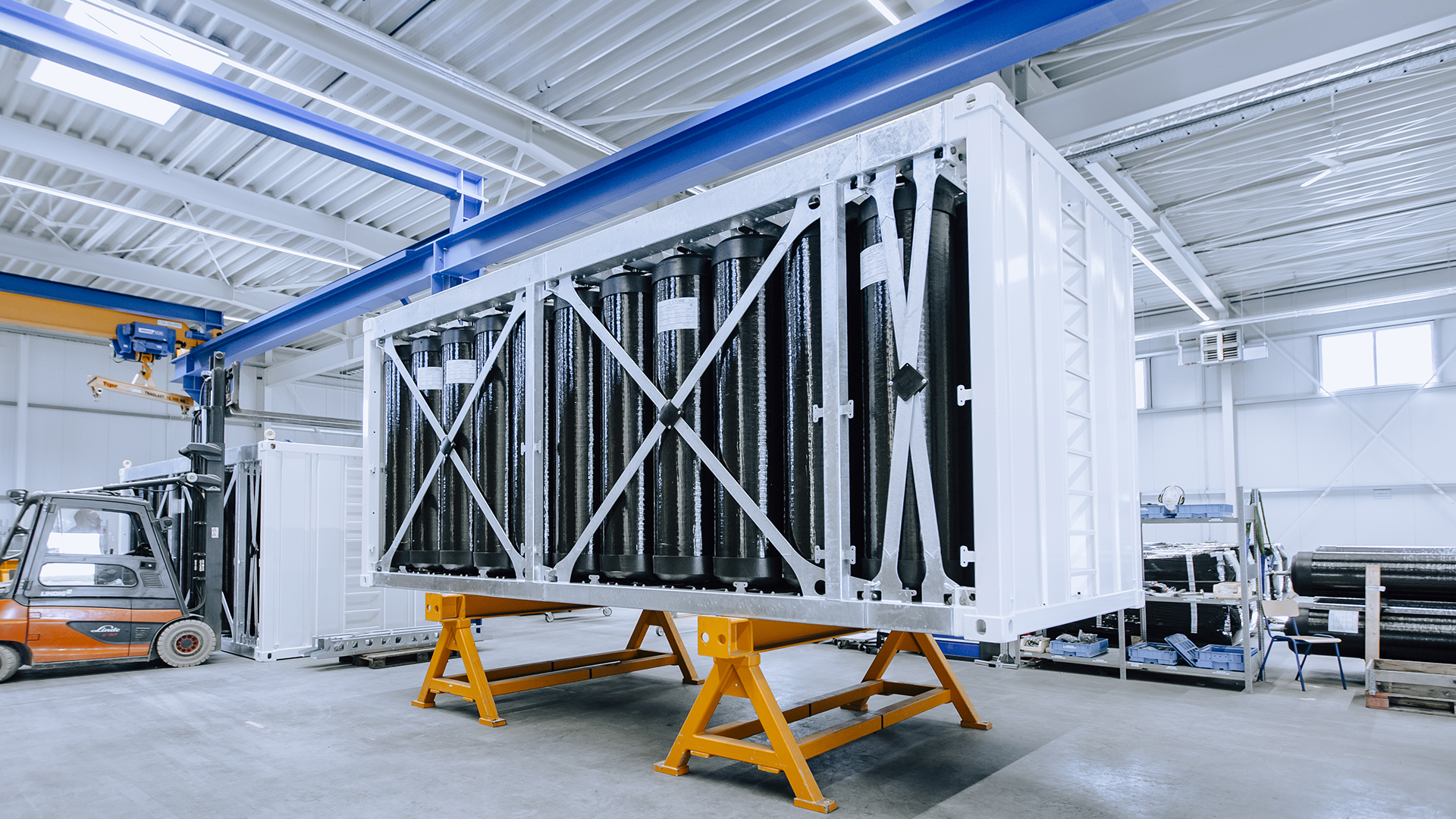
Hexagon Purus has a proven track record in hydrogen storage across Europe, serving a variety of industries.
From hydrogen supply systems serving European industry to emerging marine fuel solutions, Hexagon Purus leverages decades of high pressure gas expertise.
Hydrogen storage and distribution track record
Hexagon Purus has 60 years of experience in carbon fiber composite pressure vessels, and based on this foundation, we provide high-pressure gas storage and supply systems for a wide range of applications, from hydrogen infrastructure and transit buses to maritime and rail.
At the core of all these solutions is a hydrogen tank, also known as a cylinder, which Hexagon Purus designs and manufactures in-house. These high-pressure Type 4 cylinders are the foundation upon which infrastructure and mobility products are built. Unlike traditional steel cylinders, Type 4 cylinders use a polymer liner wrapped in carbon fiber composite, making them significantly lighter while maintaining the strength needed to contain hydrogen at high pressures. The result is a cylinder that is non-corrosive, leak-free, and has excellent fatigue strength. This is a very important property in applications where reliability and safety are non-negotiable. The lightweight properties are particularly valuable in both logistics and mobility applications where payload and weight efficiency directly impact operational economics.
Having delivered and operated more than 650 high-pressure distribution systems, known as multi-element gas containers (MEGCs), around the world, Hexagon Purus has developed a detailed operational understanding of what it takes to reliably move compressed gases at scale. The fact that the company has repeatedly delivered products to major industrial gas companies such as Air Liquide over many years is a testament to its proven technology. As a result, many startups in the renewable energy space have followed suit, including Lhyfe and Norwegian Hydrogen, to name a few.
The challenge of hydrogen distribution is not simply a matter of moving gas from one place to another. This requires engineered systems that integrate with existing and new refueling infrastructure, maintain consistent pressure and purity throughout the supply chain, and operate reliably under harsh conditions. The Hexagon Purus distribution system is designed to address each of these requirements, with a lightweight, high-capacity container that makes hydrogen distribution more economical for operators.
Hydrogen infrastructure in practice: The Norwegian example
Norway is a good example of how integrated hydrogen infrastructure is being built today. In Hellesylt, a small community on the edge of a fjord in western Norway, Norwegian Hydrogen operates a green hydrogen production and distribution facility using local hydroelectric power. Some of it is stranded, unable to be exported due to limited transmission capacity on the power grid, and ends up being scrapped. The facility will integrate electrolyzers, compressors, high-pressure storage and refueling stations for hydrogen-fueled vehicles to produce up to 1.3 tons of hydrogen per day.
Hexagon Purus’ distribution technology is central to the facility’s operations, allowing hydrogen to be efficiently transported from the production point to regional customers. High capacity containers of over 1 ton make it commercially possible to supply local as well as long distance customers.
The Hellesylt project is a real-world example of how hydrogen storage and supply systems, when properly integrated, can support the functioning of a regional hydrogen economy, from green production at the source to delivery at the point of use.
Extending expertise to ocean hydrogen
In 2021, Hexagon Plus established a specialized maritime division. It is located in Devoldfabrikken, on the outskirts of Ålesund, with office and workshop facilities in one of the world’s most complete high-tech maritime equipment and shipbuilding clusters. The division combines Hexagon Purus’ decades of experience in hydrogen pressure systems with employees with deep shipbuilding expertise. These systems and solutions go far beyond the fuel tank and provide a complete hydrogen fuel system, including control and safety systems that are fully integrated into the ship’s onboard systems and can be operated from the bridge or engine control room. This approach enables comprehensive in-house testing before the commissioning phase in the yard, reducing project risk and supporting timely and cost-effective delivery.
From shore to ship
Although the marine hydrogen market is still developing, Hexagon Purus Maritime is already delivering. We have obtained port acceptance tests approved by relevant authorities for the complete hydrogen fuel system onboard Moen Marine’s aquaculture vessels, which are vessels used for transportation to and from farms. Hydrogen can help extend the range of ships’ batteries, enabling zero-emission operations in remote coastal areas where access to charging infrastructure is limited. The benefits extend beyond emissions, eliminating noise and pollution from ships, with positive effects on both worker and animal welfare.

Hydrogen is produced close to where ships operate. At the dock, compressed hydrogen is stored in 20-foot Hexagon Purus containers and is available for cascade filling when needed. This arrangement demonstrates how the company covers key parts of the maritime hydrogen value chain, from onshore storage to shipboard fuel systems.
Growing role in Europe’s ocean decarbonization
Until now, offshore hydrogen has generally been stored in tanks installed on the deck. Hexagon Purus Maritime also has Class Approved Factory Approval for hydrogen fuel systems designed to be installed below deck on large vessels, providing great flexibility for zero-emission operations on vessels where deck space is limited or required for other purposes.
Final investment decisions have been made for several compressed hydrogen offshore projects along the Norwegian coastline, with refueling infrastructure expected to be available at ports along the coast within the next few years. Across Europe, the decarbonization of the maritime industry is a key part of the energy transition.
Hexagon Purus enters this transition not as a newcomer, but as a company with decades of experience in hydrogen storage and supply systems.
Please note: This is a commercial profile
This article will also be published in the quarterly magazine issue 26.
Source link

