
EuroQCS – Spain’s quantum computer goes live in Barcelona
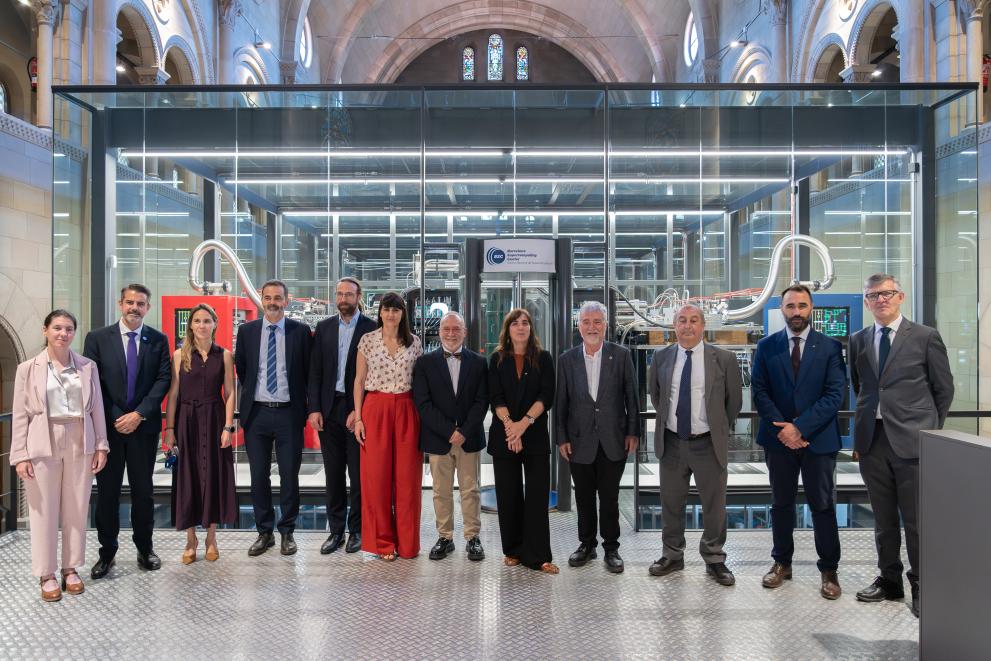
EuroQCS-Spain, a new quantum computer owned by the European High Performance Computing Joint Venture (EuroHPC JU), was officially launched in Barcelona, marking another milestone in Europe’s efforts to build a continent-wide quantum computing ecosystem.
The system is hosted and operated by the Barcelona Supercomputing Center – Central Supercomputing Center (BSC-CNS) and was unveiled at a ceremony attended by senior representatives of the Government of Spain, the Government of Catalonia, the European Commission and EuroHPC JU.
The newly launched EuroQCS-Spain is an analog quantum computer designed to perform quantum annealing, a specialized approach to solving complex optimization problems.
Developed by Spanish companies Qilimanjaro Quantum Tech and Do IT Now, the system will be integrated with the MareNostrum 5 supercomputer to create a hybrid classical-quantum computing platform available to researchers, industry and public sector users across Europe.
As a result, Europe’s quantum computing infrastructure has expanded significantly. After final tuning and testing at BSC, the first generation system will begin onboarding users soon.
EuroQCS-Spain provides access to advanced optimization capabilities that benefit sectors ranging from logistics and finance to artificial intelligence and scientific research.
Quantum annealing system integrated with MareNostrum 5
EuroQCS-Spain in Barcelona is designed as an analog quantum annealer capable of implementing quantum annealing routines.
Unlike universal gate-based quantum computers, quantum annealers focus on optimization tasks by gradually evolving a quantum system toward the most efficient solution to a problem.
The first version of the machine has 10 physical qubits. Future upgrades are planned to improve coherence time, increase the number of data qubits, increase performance, and expand potential use cases.
The main feature of this project is its integration with MareNostrum 5, one of Europe’s leading pre-exascale supercomputers.
This hybrid architecture combines traditional high-performance computing with quantum processing capabilities, allowing users to leverage both technologies within a single research environment.
Applications across science, industry, and AI
Quantum annealing is of increasing interest because it can tackle optimization challenges that are difficult to perform with traditional computing systems.
This technology is particularly effective when searching for optimal solutions within highly complex problem spaces containing many local optima.
Potential applications for EuroQCS-Spain include molecular modeling, physical systems simulation, supply chain and logistics optimization, financial modeling, quantum machine learning, and AI training workloads.
The researchers expect this platform to support experiments in areas where hybrid classical-quantum workflows offer advantages over traditional methods.
€8.5 million investment by Spain, Portugal and EuroHPC
The total cost of acquiring EuroQCS-Spain is EUR 8.5 million. The funding will be split equally between the EuroHPC joint venture and Spain’s Ministry of Digital Transformation and the Civil Service, with additional support from Portugal.
The system is expected to remain operational for at least three years and will contribute to Europe’s broader strategy to develop sovereign quantum computing capacity and reduce dependence on non-European technologies.
Part of Europe’s growing quantum ecosystem
With the launch of EuroQCS-Spain, the number of quantum computers procured by EuroHPC JU will be six. Four other systems have already entered service across Europe, including PIAST-Q in Poland, VLQ in the Czech Republic, Euro-Q-Exa in Germany and Lucy in France.
EuroHPC’s deployment strategy focuses on creating a diverse portfolio of quantum technologies spanning neutral atoms, trapped ions, superconducting circuits, photonics and quantum annealing systems.
By supporting multiple technology approaches, this initiative aims to provide European users with access to complementary quantum platforms and accelerate innovation in the emerging field of quantum computing.
Additional EuroHPC quantum systems are now being procured for deployment in the Netherlands and Luxembourg, demonstrating continued investment in Europe’s next-generation computing infrastructure.
Source link

