
Josh Johnson is looking for the ‘good parts of the internet’
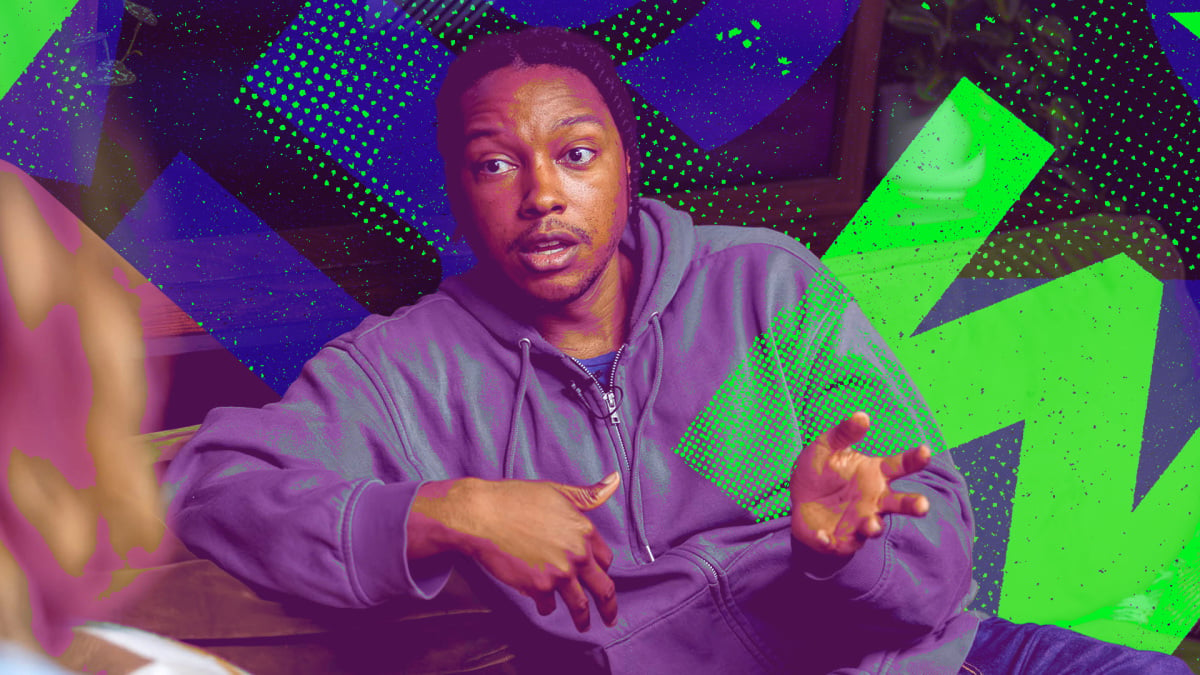
It’s no wonder the gray hoodie has become almost synonymous with comedian Josh Johnson. The look is approachable and unpretentious, a casual aesthetic choice that instantly puts you at ease. The same can be said about his comedy. The story branches into another story, then a small observation, then a small detail that doesn’t seem important until it suddenly becomes important. He takes his time to get to the point, but never feels like he’s wandering. Every turn feels intentional.
That’s why it’s hard to believe him that Parker was a coincidence.
“You’re about to be disappointed,” the 36-year-old, understandably wearing a gray hoodie, told Mashable. After a taxi ride through gridlocked Manhattan traffic, he lounges on the couch in Mashable’s studio, resting his head on one hand and maintaining eye contact as he settles into the story.
The hoodies started out as comfortable, most of them vintage and second-hand finds that Johnson collected over the years, before fans started gifting him more, including customized ones, tour-inspired ones, and even a cashmere version that he jokes is “too scary to sweat.” Somewhere along the way, without Johnson realizing it, the gray hoodie became part of his persona that people recognized at first glance.
“People see me on the street and they’re like, ‘Oh, are you really wearing this?’ That’s the good and bad part of doing things. If you really love it, that’s always how you look.”
Johnson, who once became famous for joking that “the internet is a bad idea,” is now one of the most famous comedians on the internet. It’s not just his clothes. His stand-up clips regularly rack up millions of views on TikTok, Instagram, and YouTube, where his meandering stories and observational humor somehow thrive on a platform designed to reward speed, anger, and immediacy. But Johnson doesn’t talk about the internet like someone trying to beat an algorithm. If anything, he sounds like someone trying to save the version of the internet he once wanted.
Asked if he still believed the internet was a bad idea, Johnson said: “It depends on the day.” “I think there’s an incredible amount of goodness and connection that has come out of that. But there’s also this level of brutality online, and it’s very hard to do that in person. It’s hard for people to be hateful face-to-face, eye-to-eye, like they can do online.”
He then launches into a vast meditation on the strange contradictions of modern internet culture: misinformation, algorithms, performance, loneliness, and the way people online retreat deeper into themselves rather than towards each other. Talking to Johnson, it becomes clear that his comedy is shaped by the fact that he reads widely and thinks deeply. Some people are chronically online. Johnson is thoughtful online.

Credit: Image credit: Ian Moore/Mashable
“Back in the day, arguments meant something,” he says. “Now it feels like everyone is saying the most outrageous things imaginable about clicks. There are people who don’t even try to argue anymore. They’re going to get clipped.”
Johnson makes some astute observations about the economics of online attention. There, longer forms such as podcasts, live streams, interviews, and comedy sets are increasingly being mined for viral snippets designed to spread as quickly as possible. Entire social distribution strategies now revolve around clipping, extracting the most provocative or outrageous moments and repackaging them for algorithms.
Some people are chronically online. Johnson is thoughtful online.
But even at his most critical, Johnson speaks about the Internet with the cautious optimism of someone who believes a better version of the Internet is still possible.
“I think we’re getting pretty close,” he says, describing the potential of the Internet to feel truly connected rather than extractive. “It’s crazy how close we are.”
After starting his career in stand-up in Louisiana and then honing his voice on the Chicago comedy scene, Johnson, now based in Brooklyn, has built a reputation as an inquisitive storyteller with an unusually patient comedic style. He wrote for The Tonight Show Starring Jimmy Fallon before joining The Daily Show in 2017, eventually becoming a writer and regular host correspondent alongside Jon Stewart, Desi Riddick, Ronnie Chen, Jordan Klepper and Michael Costa. But outside of traditional late-night TV, Johnson has steadily built one of comedy’s most loyal digital audiences. Looking at his follower count, he has 2.5 million subscribers on YouTube, 2.7 million followers on TikTok, and 2.4 million followers on Instagram.
Mashable Trend Report
His stand-up weaves together politics, internet culture, personal stories, and observational perspectives. Some of his most famous stories — stories about catfishing the Ku Klux Klan as a teenager, proving to a blind man that he was black, explaining the Drake-Kendrick beef to white people, unraveling celebrity scandals and presidential debates — have spread online as viewers seem willing to follow Johnson around every detour. Call it performance to get there. The raised eyebrows, the perfectly timed pauses, the slight disbelief in his voice as he steps back to clarify details, even the moments in between feel calibrated toward laughter.
Johnson tells the story in the loose rhythm of someone thinking out loud, but beneath that sense of freedom is a controlled, resourceful performer who knows exactly when to tighten up and when to slow down. It’s a style he’s honed through a variety of projects, including the Peacock special “Up Here Killing Myself,” several comedy albums, and now the HBO special “Symphony,” which premiered on May 22.
In some ways, the storytelling instincts that make Johnson so compelling online have been shaped by the internet itself.

Credit: Image credit: Ian Moore/Mashable
Long before he found an audience on social media, Johnson spent his afternoons as a child waiting for his mother to finish work at the local library. While waiting for new episodes to air on Cartoon Network’s late-night Toonami block, he killed time on his computer by reading Dragon Ball Z fan fiction, wandering message boards, and reading short story contests on obscure Web sites.
He speaks fondly of online writing contests in the early 2000s and remembers submitting his stories, even if he didn’t win. He also wrote fan fiction himself. Mostly Dragon Ball Z, and he even tried Yu-Gi-Oh at least once, although by his own admission he had little understanding of the actual plot. “A bad story isn’t just a bad structure,” he jokes. “I didn’t know what you were talking about.”
While other kids were customizing MySpace pages or talking with classmates on AIM, Johnson was primarily interested in the forums and imaginary worlds online strangers built together.
“The whole thing on the internet was engaging with other people and learning about other people,” he says.
It’s hard not to hear the echoes of the internet in Johnson’s current approach to comedy. His storytelling style feels deeply shaped by early online communities, where conversation was natural and individuality was valued over sophistication. Even the structure of his jokes often resemble message board threads. One observation leads to another, details pile up, and larger emotional truths slowly come into focus.
That curiosity about people still drives much of Johnson’s work. During our conversation, he repeatedly returned to the concept of “connection.” Rather than the vague, overused way that creators often talk about “community,” it’s something specific and deeply necessary. When asked how he decides what to cut between TikTok and Instagram and YouTube, he almost completely ignored the question, despite the fact that his stand-up work is constantly and regularly uploaded to YouTube. Full hour-long episodes are posted weekly. “It’s for everyone,” he says simply.
Live shows come first. In his mind, the internet is just an extension of the conversations already happening in the room. Johnson is much more passionate about connecting with his fans in YouTube’s comments section than he is about metrics or growth strategies. He lights up as he explains how viewers check in on strangers who are having a rough day in the comments, and recounts small interactions that remind him of his first encounter with the internet as a child.

Credit: Image credit: Ian Moore/Mashable
“The more we can build that out, the better the internet will be overall,” he says.
There’s a refreshing honesty to the way Johnson talks about all this, especially in an age when sarcasm feels like the dominant language online. Even his skepticism about the Internet comes from the belief that people deserve better benefits from it. Similarly, Johnson’s sentiments toward AI are less anti-technology than anti-humanity. He is fascinated by the potential of artificial intelligence, especially in medicine and scientific research, but is very wary of industries that often frame automation as an innovation while relying almost entirely on human labor to function.
“You scoured the internet and stole from us just to say we’re worthless and you’re going to replace us,” he says. “If we have no value, why didn’t the AI make everything for itself?”
It’s a joke, but it’s also not a joke. At the heart of Johnson’s humor is a very genuine belief in the value of human perspective and the importance of lived experience. That belief gives his comedy weight. Details matter because people matter.
In a way, this brings it all back to Parker.
Johnson’s signature clothing works because it reflects the same qualities that the audience responds to in Johnson himself. Despite being instantly recognizable, it doesn’t feel overly selective. As with his comedy, Johnson’s casual hoodie gives the impression that you’re watching a real person rather than a polished performance.
And perhaps that’s why his work resonates so deeply online. At a time when everything on the internet feels driven by optimization and anger, Johnson approaches storytelling as if he were trying to talk to another person on the other side of the screen.
“I want to be a part of the good parts of the internet,” he says. Some would argue that he already is.
Source link

