

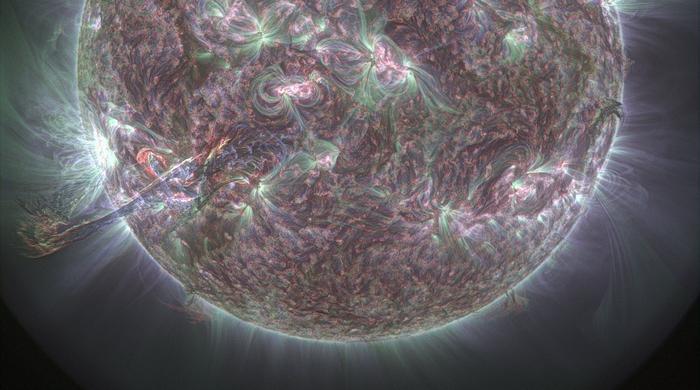
Researchers at Aberystwyth University are leading a new effort to enhance space weather forecasting by addressing one of the field’s most persistent gaps: our limited understanding of the Sun’s outer atmosphere.
The project, known as “CorMag: Magnetic Model of the Corona with Upper Observational Constraints,” focuses on improving the way scientists model the Sun’s magnetic field, specifically the corona’s magnetic field.
This region plays an important role in driving solar activity, but it remains difficult to observe directly. More accurate modeling of this region is expected to improve predictions of solar phenomena that can interfere with satellites, communications systems, and power infrastructure on Earth.
This research was funded by the Science and Technology Facilities Council and reflects a broader effort in the field to fill critical knowledge gaps that have long limited predictive accuracy.
What is space weather? How does it affect us here on Earth?
Space weather refers to changes in the conditions of the universe mainly caused by the activity of the sun. This includes phenomena such as solar flares, high-velocity streams of charged particles, and coronal mass ejections, which are large eruptions of plasma and magnetic fields from the solar atmosphere.
When these phenomena are directed toward Earth, they can interact with Earth’s magnetic field and cause geomagnetic storms.
The effects can be significant. Satellite operations may be disrupted, GPS accuracy may be reduced, power grid voltage may become unstable, and in extreme cases, power outages may occur.
Air routes through polar regions are also vulnerable to increased radiation exposure and communication failures.
With increasing reliance on satellite-based systems and interconnected infrastructure, improving space weather forecasting has become a priority for both the scientific and operational communities.
Beyond surface-based observations
Most existing models of the Sun’s magnetic behavior rely heavily on measurements taken from its visible surface. Although these datasets are well established, they only provide a partial picture of the processes that cause solar eruptions.

The Aberystwyth team is working to integrate data from coronagraphs, instruments designed to block out the sun’s bright disk and reveal the faint structure of the corona.
By analyzing patterns in this data, researchers aim to create a more detailed and reliable representation of the Sun’s magnetic environment.
This approach allows scientists to better understand how magnetic fields evolve within the corona, potentially providing a more complete picture of the mechanisms behind solar flares and coronal mass ejections.
Impact on solar activity predictions
Improved modeling of the corona has a direct impact on predicting solar activity, particularly in determining when destructive events will occur.
Timing remains a major challenge in space weather forecasting, and current systems are often limited in their ability to provide accurate warnings.
It is hoped that the enhanced models being developed through this project will reduce uncertainties and allow forecasters to more confidently identify potential impacts on Earth.
This is particularly relevant for organizations responsible for managing critical infrastructure that is vulnerable to geomagnetic disturbances.
Business relationship with forecasting agencies
The research, led by Professor Hugh Morgan from the university’s Department of Physics, is designed with practical application in mind.
A more accurate representation of the sun’s magnetic field could be fed directly into operational systems used by agencies such as the Met Office.
Improved predictive capabilities will allow infrastructure operators to take preventive measures, reducing the likelihood of critical services being disrupted during periods of high solar activity.
As our reliance on technology increases, advances in space weather forecasting are becoming central not only to scientific research but also to protecting modern infrastructure from the effects of solar fluctuations.
Source link
