
Close Menu
  • Home
  • Identity
  • Inventions
  • Future
  • Science
  • Startups
  • Spanish
What's Hot

Exclusive: Positron raises $230 million in Series B to take on Nvidia’s AI chips

EU releases new cancer prevention guidelines on World Cancer Day

Microsoft warns that Python Infostears is targeting macOS via fake ads and installers

Facebook X (Twitter) Instagram
  • Home
  • About Us
  • Advertise with Us
  • Contact Us
  • DMCA
  • Privacy Policy
  • Terms & Conditions
  • User-Submitted Posts
Facebook X (Twitter) Instagram
Fyself News
  • Home
  • Identity
  • Inventions
  • Future
  • Science
  • Startups
  • Spanish
Fyself News
Home » AI tool reveals hundreds of ‘anomalies’ in Hubble telescope archive – some defy classification
Science

AI tool reveals hundreds of ‘anomalies’ in Hubble telescope archive – some defy classification

userBy userJanuary 29, 2026No Comments3 Mins Read
Share Facebook Twitter Pinterest Telegram LinkedIn Tumblr Email Copy Link
Follow Us
Google News Flipboard
Share
Facebook Twitter LinkedIn Pinterest Email Copy Link

Artificial intelligence (AI) tools have discovered more than 1,000 strange cosmic objects in the Hubble Space Telescope image archive, some of which cannot be explained by science.

After just two days of searching with the tool, researchers discovered 1,300 strange objects, including chaotic merging galaxies, gas-trawl stars, and even objects that have yet to be classified. Of these, 800 have never been discovered before, European Space Agency (ESA) officials said in a statement on January 27. The results of this research were published in the academic journal Astronomy & Astrophysics on December 16, 2025.

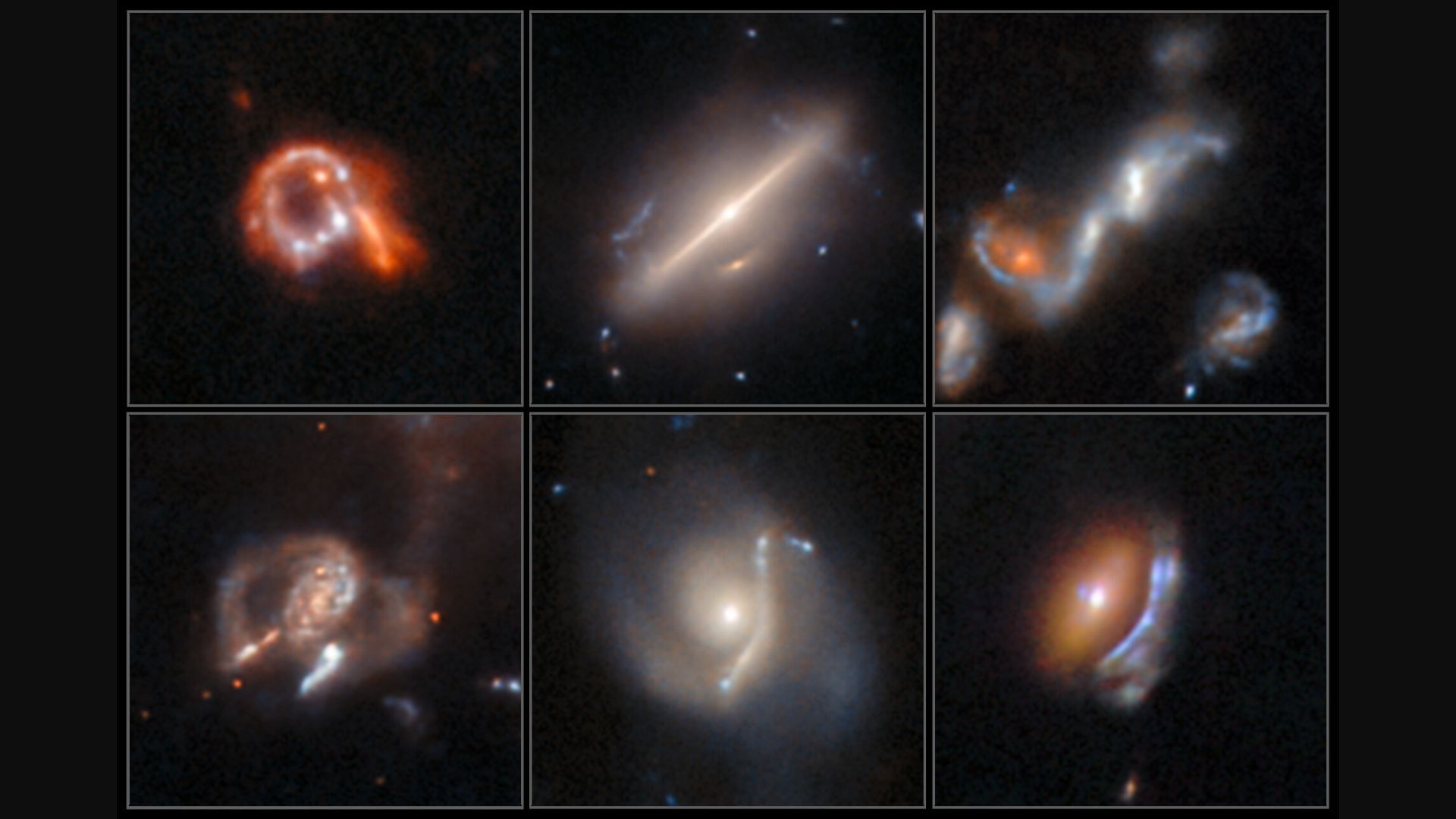
“Additional discoveries include galaxies with massive star-forming clumps, jellyfish-like galaxies with gaseous ‘tentacles,’ and a planet-forming disk at the edge of our galaxy that resembles a hamburger,” NASA officials said in a separate statement. “Surprisingly, dozens of objects completely defied existing classification schemes.”

you may like

space jelly and sky burger

For the new study, ESA researchers David O’Ryan and Pablo Gomez developed an AI tool that examined 100 million image clippings from the Hubble Legacy Archive, which covers the telescope’s observations since its launch in 1990. Each image is just a few dozen pixels on a side and represents a narrow slice of the sky, just 1/1000th of a degree wide.

“Archive observations from the Hubble Space Telescope, which now date back 35 years, represent a treasure trove of data from which astrophysical anomalies can be discovered,” O’Ryan said in the paper.

In addition to the “jellyfish galaxy” and the cosmic “hamburger”, the survey also discovered various other phenomena. “Most of the anomalies are galaxies merging or interacting, exhibiting unusual morphologies and elongated streams of stars and gas,” NASA said in a statement. “Others are gravitational lenses, where the gravity of foreground galaxies distorts space-time, bending light from background galaxies into arcs or rings.”
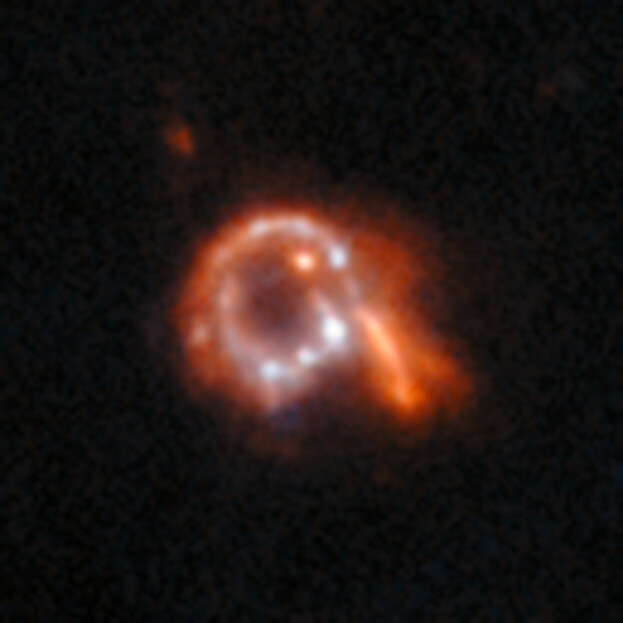
A small image of an almost red galaxy. Unusually, it has the shape of a ring with a dot of light around the ring, a protruding arm on one side, and a dark hole in the center.

One of the new Hubble anomalies is “collision ring” galaxies, which form when one galaxy collides with the center of another. (Image credits: ESA/Hubble & NASA, D. O’Ryan, P. Gomez (European Space Agency), M. Zamani (ESA/Hubble))

The researchers’ AI tool, called AnomalyMatch, detected these features after learning patterns from a training dataset. Such tools speed up traditional methods of spotting strange things in the sky, which usually require manual inspection or lucky observations.

Get the world’s most fascinating discoveries delivered straight to your inbox.

“While professional astronomers are adept at identifying unusual features, the sheer volume of Hubble data makes a comprehensive manual examination impractical,” NASA officials said in a statement. “Citizen science efforts have helped expand the scope of data analysis, but these efforts fall short in the face of extensive archives like Hubble.”

“This is a powerful demonstration of how AI can enhance the scientific return of archival datasets,” Gomez added. “The discovery of many previously undocumented anomalies in the Hubble data highlights the potential of this tool for future investigations.”

Other datasets where AI could be useful include those from the Euclid Space Telescope, which is surveying billions of galaxies to create the largest 3D map of the universe in history, and the Nancy Grace Roman Telescope and Vera C. Rubin Observatory, which will search for exoplanets and moving objects across vast swaths of the night sky. AI could help researchers sort through “large amounts of data” from these large-scale surveys, possibly allowing them to discover new objects faster than ever before, according to a statement from NASA.

O’Ryan, D., and Gomez, D. (2025). Use AnomalyMatch to identify astrophysical anomalies in 99.6 million sources carved out of Hubble’s legacy archive. Astronomy and Astrophysics, 704, A227. https://doi.org/10.1051/0004-6361/202555512


Source link

#Biotechnology #ClimateScience #Health #Science #ScientificAdvances #ScientificResearch
Follow on Google News Follow on Flipboard
Share. Facebook Twitter Pinterest LinkedIn Tumblr Email Copy Link
Previous ArticleThe LHC currently powers nearby homes through a heat exchange system
Next Article Current space debris problem could cost industry up to $42 billion
user
  • Website

Related Posts

‘Groundbreaking’ elephant bones discovered in Spain may date from Hannibal’s war against Rome

February 3, 2026

‘System in flux’: Scientists reveal what happened when wolves and cougars returned to Yellowstone

February 3, 2026

In their search for bees, Mozambique’s honey hunters and birds share a language with regional dialects.

February 3, 2026
Add A Comment
Leave A Reply Cancel Reply

Latest Posts

Exclusive: Positron raises $230 million in Series B to take on Nvidia’s AI chips

EU releases new cancer prevention guidelines on World Cancer Day

Microsoft warns that Python Infostears is targeting macOS via fake ads and installers

Eclipse Foundation requires pre-publication security checks for open VSX extensions

Trending Posts

Subscribe to News

Subscribe to our newsletter and never miss our latest news

Please enable JavaScript in your browser to complete this form.
Loading

Welcome to Fyself News, your go-to platform for the latest in tech, startups, inventions, sustainability, and fintech! We are a passionate team of enthusiasts committed to bringing you timely, insightful, and accurate information on the most pressing developments across these industries. Whether you’re an entrepreneur, investor, or just someone curious about the future of technology and innovation, Fyself News has something for you.

Castilla-La Mancha Ignites Innovation: fiveclmsummit Redefines Tech Future

Local Power, Health Innovation: Alcolea de Calatrava Boosts FiveCLM PoC with Community Engagement

The Future of Digital Twins in Healthcare: From Virtual Replicas to Personalized Medical Models

Human Digital Twins: The Next Tech Frontier Set to Transform Healthcare and Beyond

Facebook X (Twitter) Instagram Pinterest YouTube
  • Home
  • About Us
  • Advertise with Us
  • Contact Us
  • DMCA
  • Privacy Policy
  • Terms & Conditions
  • User-Submitted Posts
© 2026 news.fyself. Designed by by fyself.

Type above and press Enter to search. Press Esc to cancel.