

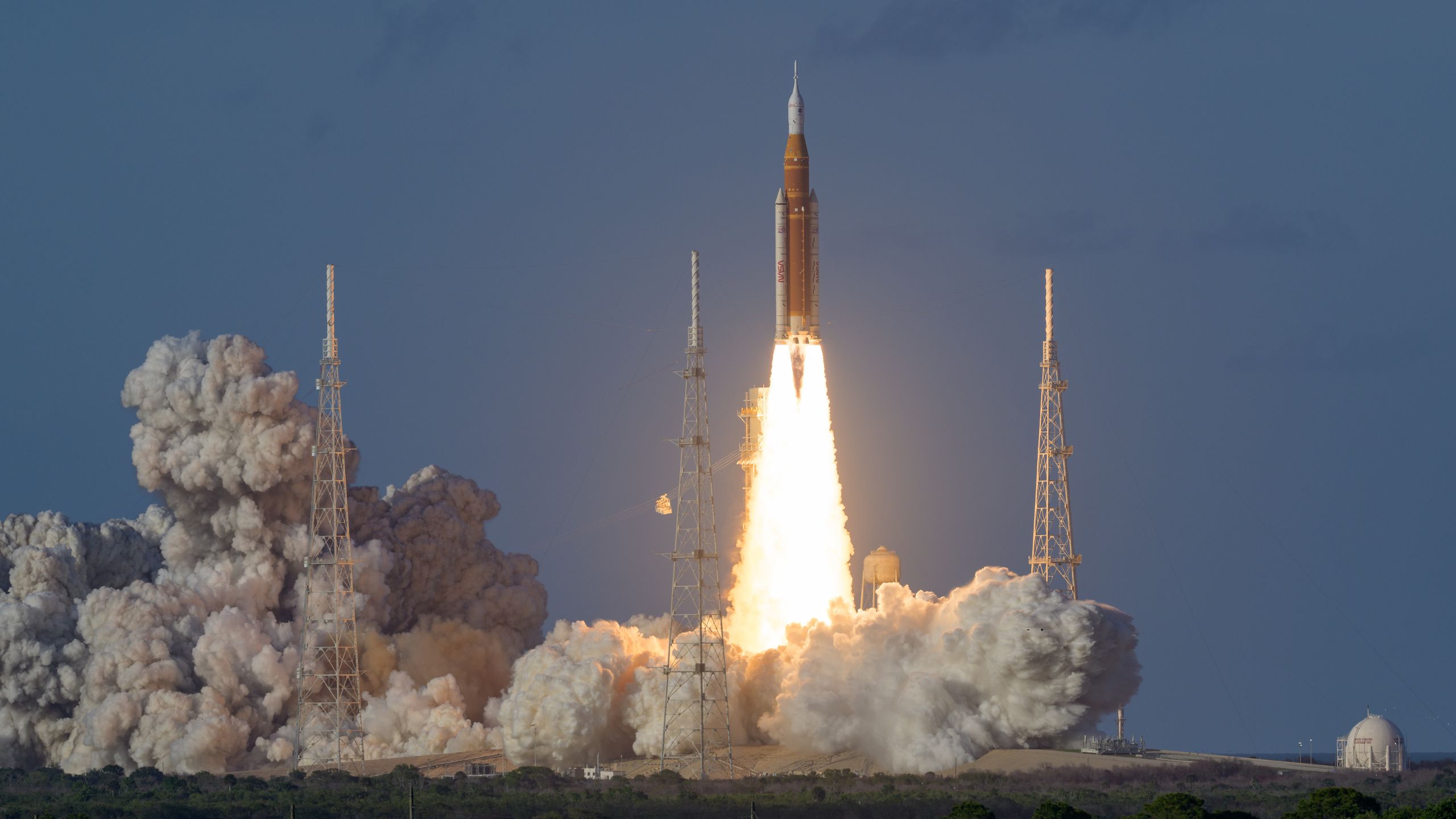
The Artemis II crew departed for the moon in a historic rocket launch at NASA’s Kennedy Space Center in Florida.
Captain Reed Wiseman, pilot Victor Glover, mission specialist Christina Koch, and mission specialist Jeremy Hansen are currently aboard the Orion spacecraft, becoming the first humans to return to the moon in more than 50 years.
The rocket launched on April 1 at 6:35 p.m. EDT. This is one of the last launch slots available to meet NASA’s April 30 mission deadline.
you may like
Artemis II has been delayed in recent months, but on April Fools’ Day, NASA’s giant Space Launch System (SLS) rocket and Orion capsule took off without any major problems. Hundreds of thousands of people flocked to Florida’s Space Coast to watch the launch in person, and millions more watched NASA’s live broadcast around the world.
Mission to set records
The Artemis II crew is currently embarking on a 10-day spaceflight around the far side of the moon, traveling farther and faster than any human in history before returning to Earth.
This record-breaking mission is set to establish a number of historic firsts. NASA’s Ms. Koch is on track to become the first woman to go beyond low Earth orbit to visit the lunar environment, and NASA’s Mr. Glover is on track to become the first black astronaut to go beyond low Earth orbit to visit the lunar environment.
Hansen of the Canadian Space Agency aims to become the first non-American to visit the moon. Finally, Wiseman turns 50 in November and is on his way to becoming the oldest astronaut to visit the moon.
In recent months, Artemis II mission staff have been grappling with hydrogen leaks and helium flow issues that occurred during the first Artemis II refueling rehearsal on February 3, forcing NASA to return the rocket to the factory for emergency repairs weeks later. However, there were no such problems with today’s refueling.
smooth countdown
The launch team encountered no significant technical problems filling SLS with more than 700,000 gallons of ultra-cold liquid oxygen and liquid hydrogen, and the countdown went smoothly as planned.
The crew departed at approximately 2:00 p.m. EDT, suited up at Launch Complex 39B, and entered the Orion spacecraft at 2:31 p.m.
What to read next
The Artemis II launch team had to deal with unusual range issues. NASA cleared the launch corridor in the airspace along the rocket’s flight path, but there was some problem with parts of this system, particularly the Flight Termination System (FTS), which sends a destruction signal if the rocket goes off course.
Engineers eventually obtained “some of the heritage equipment” used during the Space Shuttle program and finally solved the problem to clear range and operate the FTS system.
There were occasional clouds and rain showers over Kennedy Space Center, but the launch was not interrupted and wind speeds remained within acceptable levels.
This launch is just the beginning of NASA’s historic lunar orbit, all about testing systems and building capabilities ahead of a lunar mission planned for as early as 2028. Sending astronauts into space also gives NASA a unique opportunity to study how deep space flight affects the human body.
In addition to live conversations with astronauts and daily mission briefings, NASA will provide live coverage of the mission in real time on its YouTube channel.
Live Science will share important information from NASA coverage in a dedicated Artemis II live blog.
Source link
