

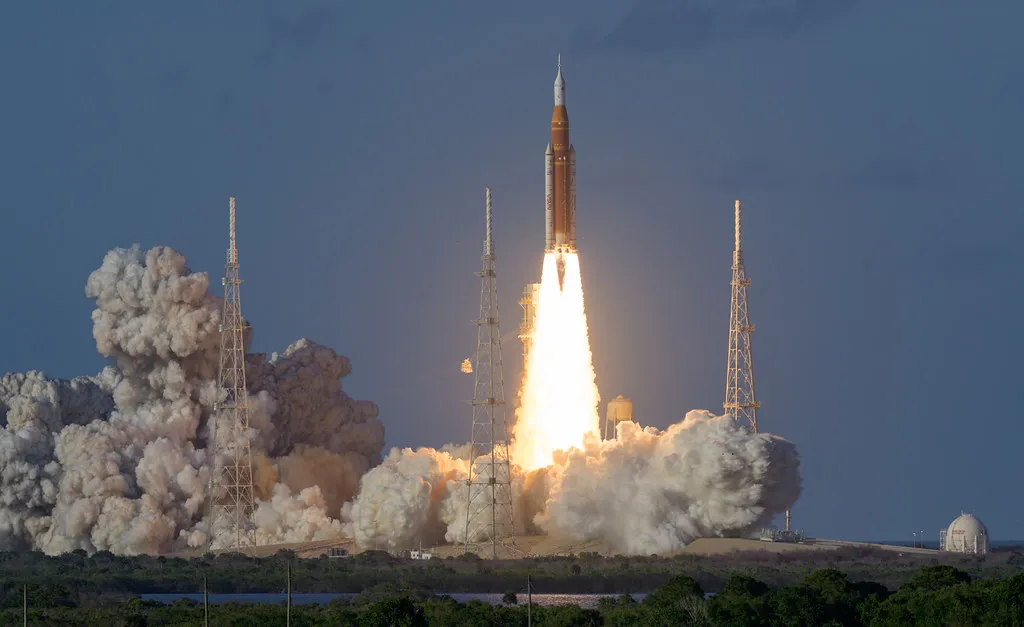
The Artemis II mission successfully launched, marking the first time humans have entered lunar orbit in more than half a century.
This milestone flight marks an important step in NASA’s broader strategy to establish a sustained human presence beyond low Earth orbit.
NASA’s Space Launch System (SLS) rocket lifted off from Kennedy Space Center in Florida at 6:35 p.m. EDT on Wednesday, carrying four astronauts aboard the Orion spacecraft.
The mission is designed as a full-scale test of systems needed for future moon landings under the Artemis program.
Commenting on the successful launch, NASA Administrator Jared Isaacman said, “This launch is a defining moment for our country and everyone who believes in exploration, returning humans to the Moon for the first time in more than 50 years and opening the next chapter in lunar exploration beyond Apollo.”
“Aboard Orion, four brilliant explorers are preparing this rocket and spacecraft for its first manned flight, a true test mission that will take us faster and further than any human in a generation.
“Artemis II is the beginning of something bigger than any mission. It marks our return to the Moon, not just to visit, but ultimately to stay at a lunar base, and lays the foundation for our next great leap forward.”
The high-stakes test flight begins
Artemis II is a 10-day mission involving NASA astronauts Reed Wiseman, Victor Glover, and Christina Koch, and Canadian Space Agency astronaut Jeremy Hansen.
Unlike its unmanned predecessor, Artemis I, this mission will introduce a human operator to the system, greatly increasing the risk of validating onboard technology.
Shortly after reaching orbit, Orion deployed its solar array and transitioned from launch configuration to operational status. Flight controllers and crew members immediately began checking the systems, focusing on life support, navigation, propulsion, and other areas critical to the long mission.
The primary objective of this mission is to verify that Orion can safely maintain its crew in a deep space environment. This includes testing environmental control systems, communication links, and manual flight capabilities.
Orbital maneuvering and deep space orbit
About 49 minutes after liftoff, the rocket’s upper stage burned up, sending Orion into an elliptical orbit around Earth. The subsequent burnup is planned to thrust the spacecraft into high-Earth orbit, extending some 46,000 miles from Earth.
Once that maneuver is complete, Orion separates from the upper stage and operates independently. This phase is essential for validating the spacecraft’s systems before beginning its lunar passage.
Several hours after separation, four CubeSats are deployed from the upper stage. These small satellites, provided by international partners such as Argentina, Germany, South Korea and Saudi Arabia, will carry out scientific experiments and technology demonstrations.
Testing human control in space
The spacecraft will remain in high Earth orbit for about 24 hours. During this time, the crew will demonstrate manual controls and evaluate Orion’s handling characteristics under real-world flight conditions.
This test is especially important because future missions will require direct control by astronauts in emergency scenarios. The data collected here will inform both training protocols and spacecraft design adjustments.
The Houston-based control team will work closely with the crew throughout this phase, monitoring system performance and preparing for the next major operation.
Menstrual ejaculation and lunar flight
If all systems remain nominally operational, the mission controller will initiate menstrual injection combustion. This maneuver, which lasts about six minutes, puts Orion in orbit toward the moon.
Artemis II will conduct a flyby rather than enter lunar orbit. The spacecraft would orbit the moon and use its gravity to direct the moon back toward Earth. This is a technique known as free return trajectory.
The lunar flyby is scheduled for April 6 and is expected to last several hours. During this period, astronauts will take images and assess the lunar surface, including areas on the far side that humans have rarely seen.
Lighting conditions during flight can produce significant shadows across the landscape, increasing the visibility of geological features such as ridges, crater rims, and slopes.
Scientific and operational goals
Beyond navigation and propulsion, the Artemis II mission will support a variety of scientific investigations. Among them is AVATAR, a study focused on understanding how human physiology responds to the deep space environment.
These discoveries are expected to contribute to mission planning for future Artemis flights, especially those involving extended stays on the lunar surface.
The mission will also serve as a systems integration test, connecting hardware, software and human operators in a way that cannot be fully replicated on Earth.
Preparing for continued lunar exploration
Artemis II is positioned as a foundational mission on NASA’s long-term exploration roadmap.
Although this does not include a lunar landing, the results will have a direct impact on the next stages of the program, including Artemis III, which aims to return astronauts to the moon’s surface.
Broader objectives extend beyond short-term exploration. NASA and its partners are working to establish infrastructure that can support continued human presence on the Moon, including potential surface habitats and orbital platforms.
This approach reflects a shift from the short visitation model of the Apollo era to a more sustained and scalable exploration framework.
return to earth
After passing the moon, Orion will begin its return trajectory, culminating in a splashdown in the Pacific Ocean. Recovery operations recover both the spacecraft and its crew, ending the mission.
Data collected throughout Artemis II will undergo extensive analysis to shape design decisions and operational strategies for subsequent missions.
Transition period of space exploration
The Artemis II mission represents a transition point in human spaceflight. It bridges the gap between experimental test flights and operational missions aimed at long-term exploration.
By successfully integrating human operations and next-generation spacecraft systems, Artemis II will set the stage for more ambitious goals, including an eventual mission to Mars.
For now, the focus remains on execution. In the coming days, engineers and mission planners will be closely monitoring performance metrics, knowing that the success of future missions will depend heavily on the results of this mission.
Source link
