


Close Menu
  • Start
  • Celebrities
  • Music
  • Influencers
  • Tendencies
  • Exclusives
  • Business & Brands
  • TwinH
  • Spanish
What's Hot

President Trump to headline America’s 250th anniversary celebration after artist declines

Taylor Swift completed ‘Toy Story 5’ song in ‘hectic’ 8 hours

Hot rivalry crushes competition in 13 categories at Canadian Screen Awards

Facebook X (Twitter) Instagram
  • Home
  • About The FYMOUS
  • Advertising / Promotion
  • Contact
  • DMCA
  • Privacy Policy
  • Terms
  • Publish News
Facebook X (Twitter) Instagram
FYMOUS News
  • Start
  • Celebrities
  • Music
  • Influencers
  • Tendencies
  • Exclusives
  • Business & Brands
  • TwinH
  • Spanish
FYMOUS News
Home » Astronomers detect first ‘heartbeat’ of newborn star hidden inside powerful cosmic explosion
Tendencies

Astronomers detect first ‘heartbeat’ of newborn star hidden inside powerful cosmic explosion

By October 18, 2025No Comments3 Mins Read
Share Facebook Twitter Pinterest Telegram LinkedIn Tumblr Email Copy Link
Follow Us
Google News Flipboard
Share
Facebook Twitter LinkedIn Pinterest Email Copy Link

Gamma-ray bursts are the brightest explosions in the universe, momentarily outsmarting entire galaxies with intense flashes of high-energy radiation. These (excuse the joke) astronomical explosions release more energy in a few seconds than the sun produces in its entire 10 billion year lifespan, sending jets of gamma rays into space. Despite their incredible brightness, gamma-ray bursts are fleeting events, lasting anywhere from a few milliseconds to several minutes before disappearing.

On March 7, 2023, the satellite detected one of these gamma-ray bursts. This was designated GRB 230307A. This is the second brightest burst ever recorded and was caused by the collision and merger of two compact stars (possibly neutron stars) located in distant galaxies. What made this event particularly interesting was that it had an unusually long duration of one minute, despite theoretical predictions that this type of merging event would last less than two seconds.
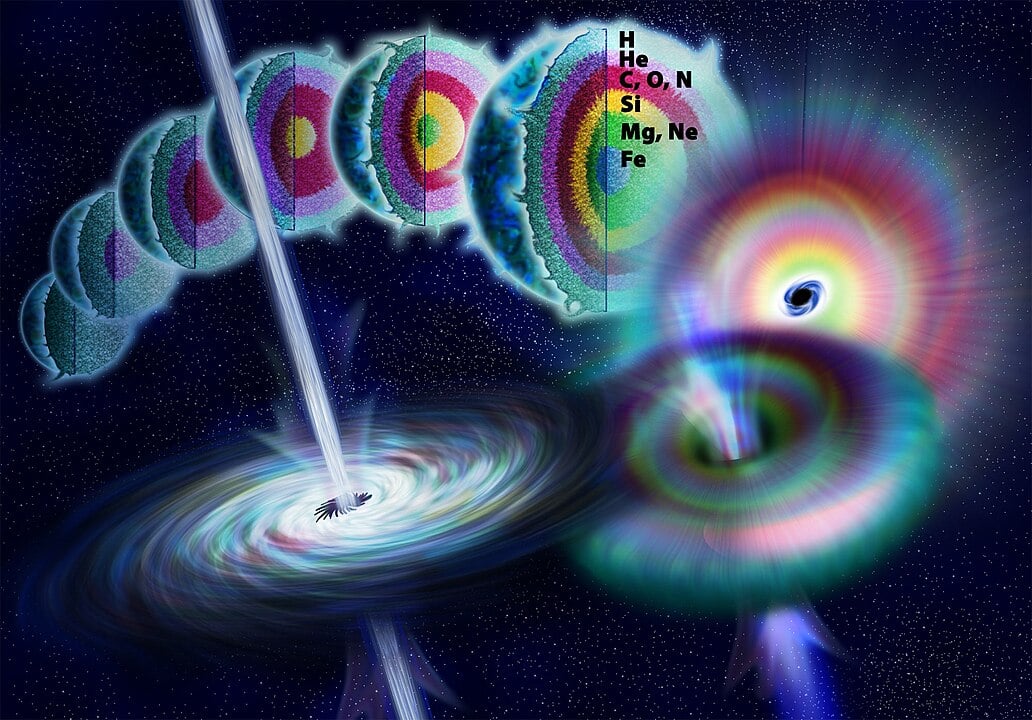
Diagram showing the life of a massive star

Artist’s illustration showing the life of a massive star: Nuclear fusion converts lighter elements into heavier elements. When nuclear fusion no longer creates enough pressure to counteract gravity, the star collapses into a black hole. During this collapse, energy can be released as an instantaneous burst of gamma rays along the axis of rotation. (Image provided by: National Science Foundation)

“This event gave us a rare opportunity. By uncovering their hidden ‘heartbeats’, we can finally confidently say that some GRBs are powered by newborn magnetars rather than black holes.”

Professor Bing Zhang, Chair Professor in the Department of Physics at the University of Hong Kong and co-author of the study;

An international team led by researchers from the University of Hong Kong, Nanjing University, and the Chinese Academy of Sciences decided to investigate this event in more depth. They searched more than 600,000 datasets collected by China’s GECAM satellite and NASA’s Fermi satellite, looking for hidden patterns within the bursts. What they discovered was a repeating signal that maintained a very consistent rhythm over time, revealing that the star was rotating 909 times per second. This rapid pulsation represents the first direct detection of a periodic signal from a millisecond magnetar within a gamma-ray burst.

To my surprise, I realized why the signal was so short. The researchers theorize that the magnetar’s fast rotation imprints periodic signals into the gamma-ray jet through its magnetic field, but because the jet evolves so rapidly, this beating becomes visible only when the emission becomes temporarily asymmetric. The periodic pulses were detectable for only 160 milliseconds before being obscured again by the symmetry of the jet.
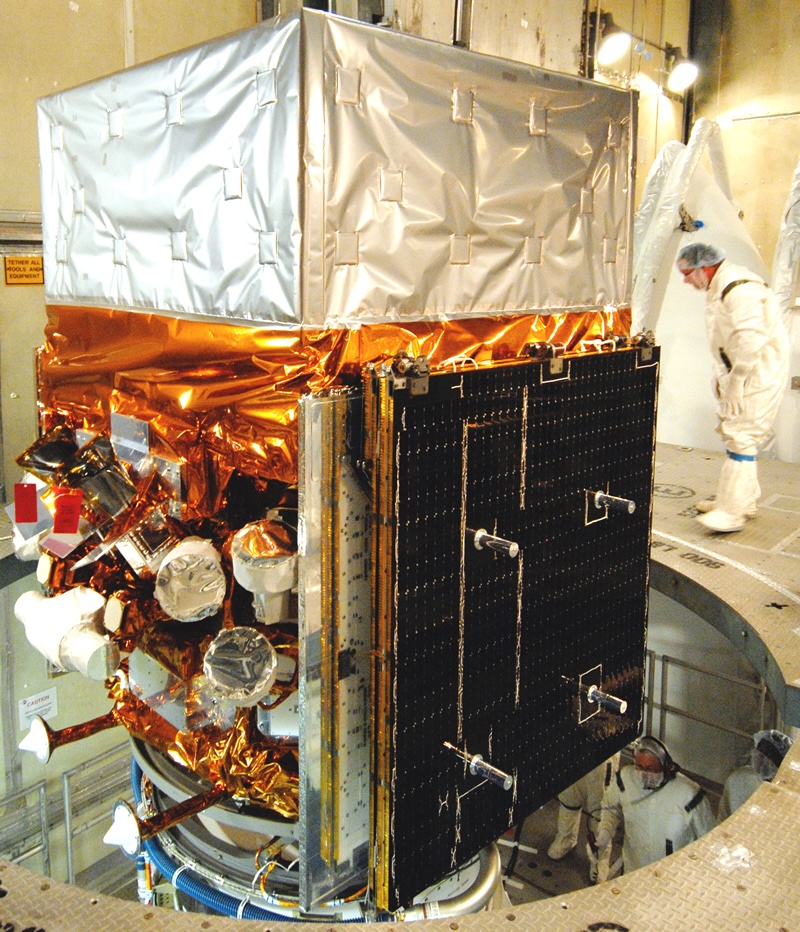
Photo of the Fermi spacecraft being assembled by lab personnel

Fermi satellite on Earth before launch. (Image credit: NASA/DOE/Fermi LAT collaboration)

The discovery forever changed our understanding of the universe’s most extreme explosions, showing that newly formed magnetars can survive even compact stellar mergers. This research opens up fascinating new avenues in astronomy by combining gamma rays, gravitational waves, and the physics of compact stars under the most extreme conditions imaginable.

A version of this article originally appeared on Universe Today.


Source link

#Biotechnology #ClimateScience #Health #Science #ScientificAdvances #ScientificResearch
Follow on Google News Follow on Flipboard
Share. Facebook Twitter Pinterest LinkedIn Tumblr Email Copy Link
Previous ArticleMethane ‘switch’ discovered in Arctic Ocean that promotes rapid global warming
Next Article NASA mission to visit ‘God of Chaos’ asteroid saves $20 million from budget cuts in last-minute decision

Related Posts

President Trump to headline America’s 250th anniversary celebration after artist declines

June 18, 2026

Hot rivalry crushes competition in 13 categories at Canadian Screen Awards

June 18, 2026

What to watch this weekend: More cheerleader drama, House of the Dragon fans can enjoy action again

June 18, 2026
Add A Comment
Leave A Reply Cancel Reply

Latest Posts

President Trump to headline America’s 250th anniversary celebration after artist declines

Taylor Swift completed ‘Toy Story 5’ song in ‘hectic’ 8 hours

Hot rivalry crushes competition in 13 categories at Canadian Screen Awards

Rama Dowaj Styles Upcycled Knicks Shirt by Claire Sullivan

Trending Posts

Taylor Swift completed ‘Toy Story 5’ song in ‘hectic’ 8 hours

June 18, 2026

Rama Dowaj Styles Upcycled Knicks Shirt by Claire Sullivan

June 18, 2026

Knicks parade ends with Alicia Keys singing “Empire State of Mind”

June 18, 2026

Subscribe to News

Subscribe to our newsletter and never miss our latest news

Please enable JavaScript in your browser to complete this form.
Loading

Welcome to The FYMOUS, a modern digital media platform dedicated to celebrities, artists, influencers, brands, entertainment culture, and the growing TwinH ecosystem.

We bring audiences closer to the people, stories, trends, and collaborations shaping today’s culture. From exclusive celebrity news and music releases to influencer highlights, brand partnerships, and TwinH activations, The FYMOUS delivers engaging content designed for the next generation of digital audiences.

Castilla-La Mancha Ignites Innovation: fiveclmsummit Redefines Tech Future

Local Power, Health Innovation: Alcolea de Calatrava Boosts FiveCLM PoC with Community Engagement

The Future of Digital Twins in Healthcare: From Virtual Replicas to Personalized Medical Models

Human Digital Twins: The Next Tech Frontier Set to Transform Healthcare and Beyond

Facebook X (Twitter) Instagram Pinterest YouTube
  • Home
  • About The FYMOUS
  • Advertising / Promotion
  • Contact
  • DMCA
  • Privacy Policy
  • Terms
  • Publish News
© 2026 news.fyself. Designed by by fyself.

Type above and press Enter to search. Press Esc to cancel.