


BIOSAFIRE uses lignin and tannins to improve fire resistance, following a Safe and Sustainable by Design (SSbD) approach.
BIOSAFIRE takes inspiration from nature and fortifies natural flame-retardant compounds, lignin and tannin, making it suitable for industrial applications. The project will build on the existing pilot plant and expand production to a broader range of bio-based feedstocks, delivering flame retardants for five specific use cases across four sectors: naval, railway, consumer electronics and wood coatings. BIOSAFIRE represents a major collaborative effort to transform natural additives into innovative, high-performance materials, with 22 partners working across Europe.
The project combines high performance and sustainability, maintaining a bio-based content of around 80% while achieving flame retardant levels comparable to traditional toxic benchmarks. In addition to demonstrating its effectiveness in multiple use cases, BIOSAFIRE is developing a comprehensive materials portfolio and practical processing guidelines to help industry adopt safer bio-based flame retardants. This approach is expected to open up a substantial market opportunity, estimated at €8 billion by 2028, with Europe holding around 25% share and the targeted sectors accounting for around 65% of the market.
Project scope
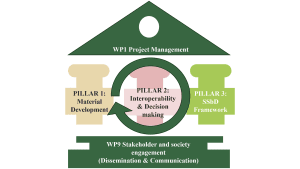
BIOSAFIRE is built around three interconnected pillars that work together to ensure project success. The first pillar focuses on materials development, creation and optimization of flame retardant formulations. The second pillar acts as a central hub, coordinating communication and collaboration between technical and sustainability teams. The third pillar is dedicated to the implementation of the SSbD framework and ensures that safety, sustainability and social inclusion are integrated into every stage of development.
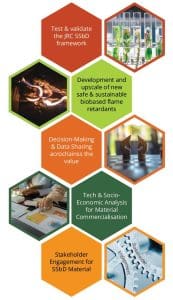
Additionally, the project investigates both thermoset and thermoplastic systems to support applications ranging from composites and wood coatings to consumer electronics. By bridging multiple industries, this project ensures that innovations can be widely applied and scaled effectively.
A central pillar of this project is the implementation of the SSbD framework by the EU Joint Research Center. BIOSAFIRE uses an iterative, step-by-step approach to integrate SSbD principles into early conceptual design. In addition to technological innovation, BISOAFIRE also incorporates a social sciences and humanities (SSH) perspective to strengthen societal acceptance, while providing training materials to support the introduction of sustainable flame retardant solutions into industry.
The future of biosapphire
Looking to the future, BIOSAFIRE designs industrial pilot plants to address value chain challenges and perform robust techno-economic evaluations. These initiatives aim to accelerate market adoption and provide stakeholders with the technical and economic evidence needed to implement biobased technologies at scale.
By combining natural innovation, industrial expertise and SSbD principles, BIOSAFIRE is demonstrating that lignins and tannins can meet stringent fire safety standards while increasing sustainability and paving the way for greener materials across multiple sectors.

This project received funding from the European Union’s Horizon Europe research and innovation program under grant agreement number 101178218.
This article will also be published in the quarterly magazine issue 25.
Source link
