



Many chickens meet their end from a severe blow to the neck. But legend has it that chickens can run around without their heads, and there was even a news report that a chicken called Miracle Mike lived for 18 months after a farmer unsuccessfully tried to kill him by chopping off his head.
So, can chickens really survive without their heads?
The reality is that you won’t survive long like this — less than a minute, experts told Live Science.
you may like
Sign up for newsletter

Sign up for our weekly Life’s Little Mysteries newsletter to get the latest mysteries before they’re posted online.
Dr. Marcy Logsdon, a veterinarian in the Exotic Wildlife Division at Washington State University Veterinary Teaching Hospital in Pullman, Washington, said it is common for chickens to flap their wings and move their legs after being decapitated. But “I think it’s pretty rare to actually run around,” Logsdon said. “It’s usually just strong muscle contractions in both the wings and legs, and that’s very common,” she said. These movements usually last less than a minute, she added.
But the answer to whether a chicken is alive or dead within seconds of being decapitated depends on how death is defined. In a decapitated chicken, brain death occurs first, followed by cardiac death a few seconds later. Therefore, in the moments before brain death and cardiac death, the chicken can be considered alive or dead, depending on the definition of death used.
Brain death is a state of unconsciousness in which the entire brain is permanently damaged and the person is unable to breathe on their own. Electrical activity in chicken brains stops within 30 seconds after a cervical dislocation (neck fracture), according to a 2019 study published in the journal Animals. Because decapitation involves breaking the bones in the neck, according to the framework of brain death or loss of brain activity, chickens can survive for several seconds after being decapitated.
“It’s not like the animals are consciously aware of what’s going on in those few seconds, but there’s residual electrical activity happening,” Andrew Ivaniuk, a comparative neuroscientist at the University of Lethbridge in Alberta, Canada, who specializes in bird brains, told Live Science.
Sometimes it’s shaky. In the case of chickens, it seems highly exaggerated.
Dr. Marcy Logsdon, veterinarian, Department of Exotic Wildlife, Washington State University Veterinary Teaching Hospital
Cardiac death, when the heart permanently stops beating, tends to occur seconds after brain death, Ivaniuk said. “The time difference will probably be less than 10 seconds,” he said.
As a result of these different definitions of death, Logsdon considers the chicken’s movements after it has been decapitated as “reflexes after death,” whereas Ivaniuk considers the chicken to be alive while making its final movements.
Chickens move after being decapitated because “there’s still some neural activity in the spinal cord,” Ivaniuk said. The continued breathing is also due to residual neural activity. Heart muscle, on the other hand, can continue to contract and release without input from nerves until it runs out of energy and oxygen, he said.
What to read next
Additionally, the brain typically sends signals telling muscles to relax when they don’t need to, Logsdon said. Cutting a chicken’s neck stops those signals, and when it does, “sometimes it causes convulsions,” Logsdon said. “That seems to be greatly exaggerated when it comes to chickens.”
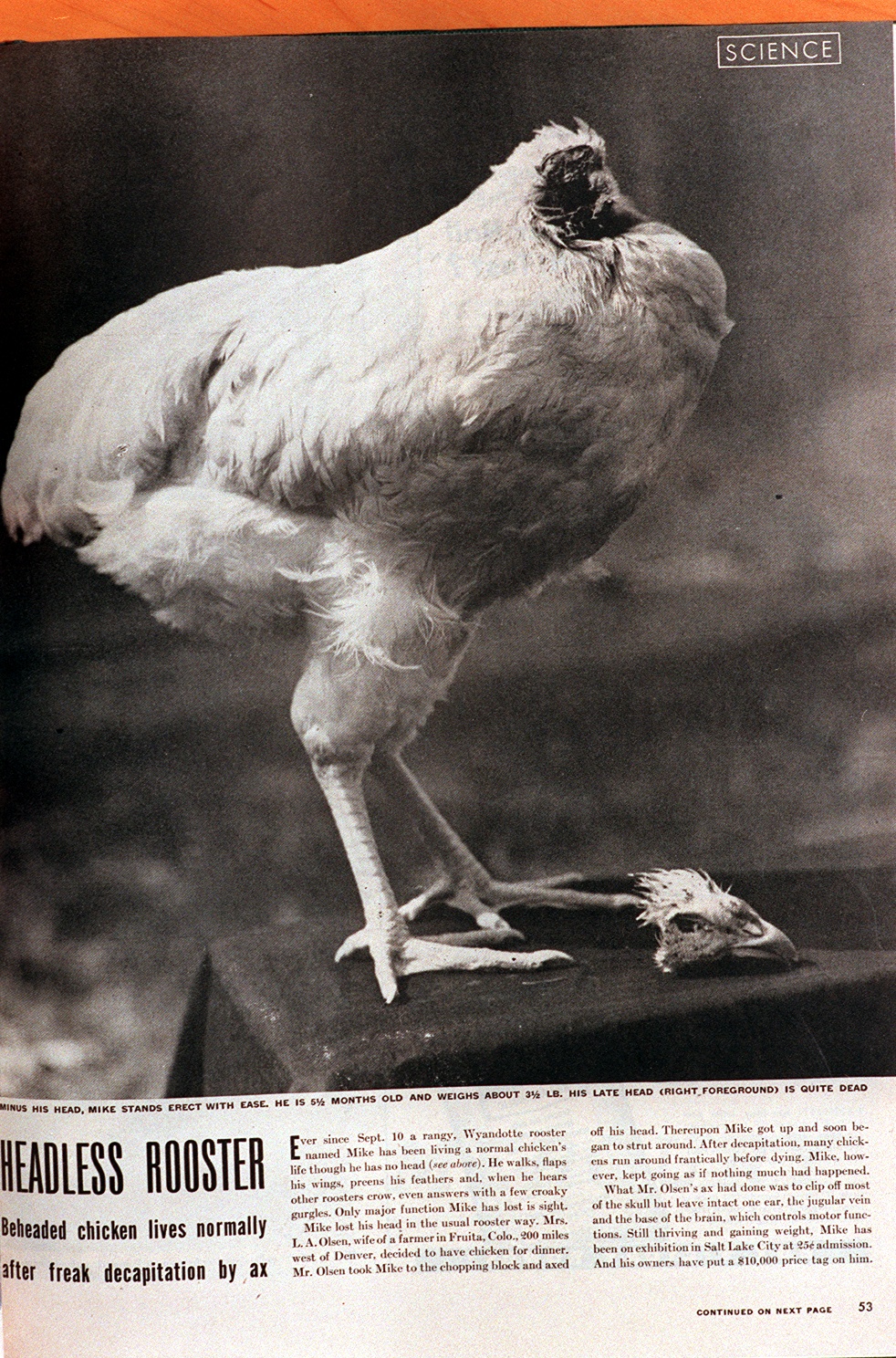
miracle microphone
In the case of Miracle Mike, something completely different happened. The BBC reported in 2015 that in September 1945, Wisconsin farmer Lloyd Olsen decapitated a flock of chickens to sell for market, but none of them died. Rooster, who became known as Miracle Mike, toured the United States as a sideshow for 18 months. The Olsens tried to keep the chicken from choking by feeding it through its esophagus and opening its airway, but in 1947 the chicken ended up suffocating because the Olsens left behind a syringe to clear its throat, the BBC reported.
This story may seem to show that chickens can survive without heads. In reality, however, there is only one widely known case of a chicken living without part of its head. Logsdon explained that instead of decapitating Mike by making a straight cut through his neck, the farmer “cut out part of Mike’s brain and basically most of his face.”
Mike’s head was cut off, leaving him with the back of his brain and one ear, the BBC reported. Ivaniuk said the animal likely retained its brainstem, which is located at the back of the brain and controls basic physiological functions such as breathing and regulating heart rate. Mike probably also had a cerebellum that helped him coordinate his movements, Logsdon said.
“That’s probably why he was able to actually stand up and walk instead of just running around and flopping around,” Logsdon said.
How much do you know about our feathered friends? Test your knowledge with our bird quiz!