

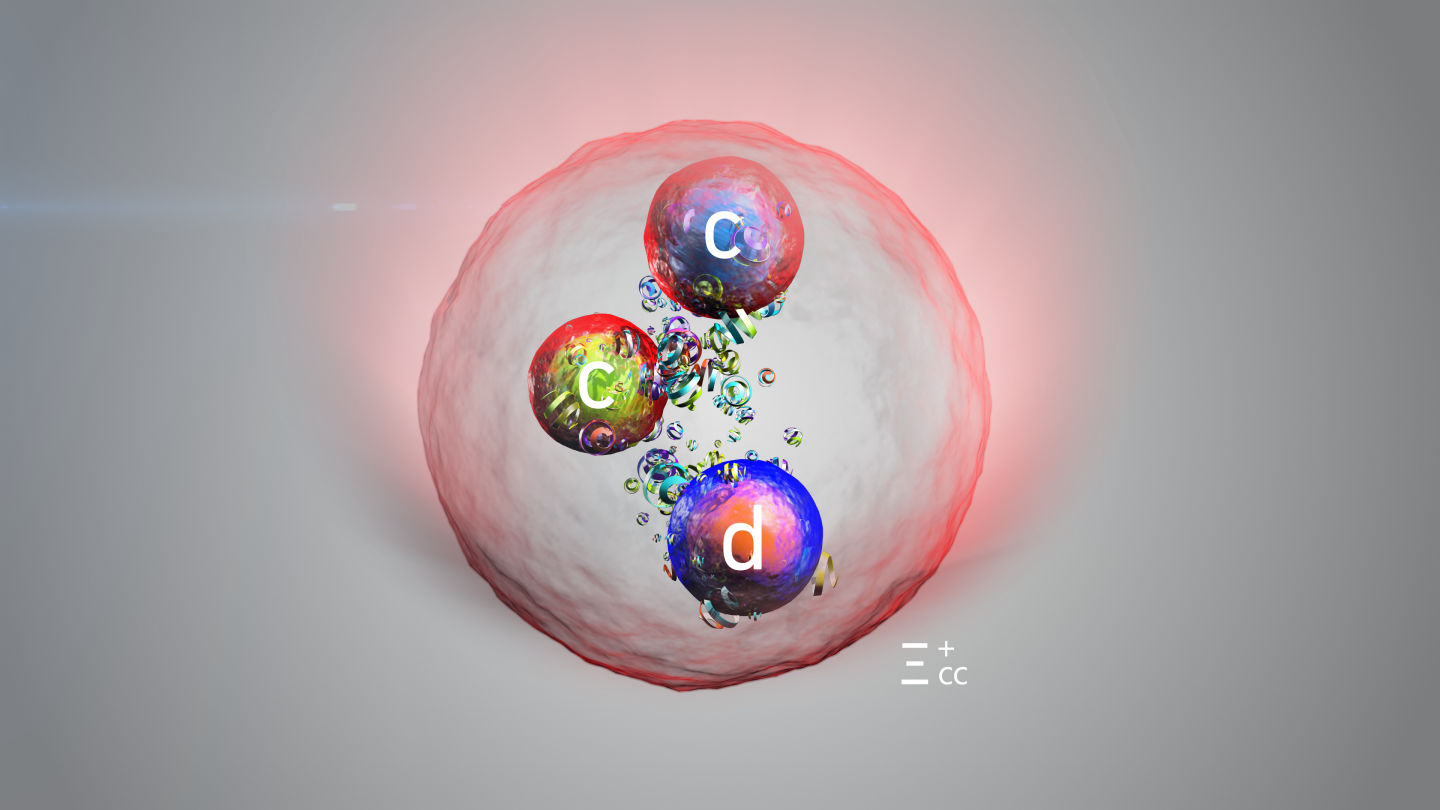
CERN physicists have reported the observation of a new, previously unknown particle detected during an experiment at the Large Hadron Collider (LHC).
The discovery, announced at the Moriondo conference, represents an important addition to the growing catalog of exotic hadrons and provides a new test case for theories explaining the strong nuclear force.
This particle is classified as a baryon and has a structure broadly comparable to a proton. But unlike the familiar proton, which consists of two up quarks and one down quark, this newly identified state contains two heavier charm quarks alongside one down quark.
Replacing a light quark with a heavier charm quark produces a particle about four times the mass of a proton.
rare proton-like particles
This proton-like particle belongs to a category of matter known as hadrons, which are composite particles made of quarks bound together by strong forces.
There are six types of quarks: up, down, charm, strange, top, and bottom, which combine in specific configurations to form baryons (three quarks) or mesons (quark and antiquark pairs).
While protons and neutrons are stable, most hadrons are highly unstable and decay almost immediately after their creation. This makes their detection indirect. Researchers reconstruct its existence by analyzing the cascade of more stable particles produced during decay.
The newly observed baryons are particularly noteworthy because systems containing two heavy quarks are rarely seen. According to the LHCb collaboration, this is only the second observation in which such a configuration has been confirmed.
Experimental methods and statistical significance
The discovery was made using data collected by the LHCb detector during the Large Hadron Collider’s third operation.
High-energy proton-proton collisions have produced a wide range of short-lived particles, including the newly identified baryons.
The researchers identified the new particle by tracing its decay products and reconstructing its properties. This signal reached a statistically significant 7 sigma. This is far above the five-sigma threshold typically required in particle physics to establish a discovery.
This level of certainty indicates that the result is very unlikely to be due to random variation.
Building on previous discoveries
This finding builds on previous work from the LHCb experiment. In 2017, this collaboration reported a closely related baryon consisting of two charm quarks and one up quark. The only difference between the newly observed particles is that the up quark has been replaced with a down quark.
Despite minimal structural differences, the two particles exhibit markedly different behavior. The latest measurements show that the new baryons can decay significantly faster than their predecessors, up to six times faster.
This contrast is thought to be due to complex quantum effects that affect how quarks interact within the particle.
Quantum chromodynamics and implications for future research
The discovery adds to a body of experimental data related to quantum chromodynamics (QCD), a theory that explains how strong forces bind quarks.
Although QCD is well established, it remains difficult to predict the behavior of multiquark systems, especially those containing heavy quarks.
By extending the known spectrum of hadrons, this result provides theorists with new data points to refine their models of quark interactions. It also helps reveal how different quark combinations affect particle stability and decay dynamics.
This addition brings the number of hadrons identified through experiments at the Large Hadron Collider to approximately 80 and highlights the facility’s continued role in probing the substructure of matter.
The upgraded LHCb detector, completed in 2023, is expected to yield further discoveries as data collection continues. Researchers expect even rarer and more exotic particles to emerge, providing greater insight into the forces governing the fundamental building blocks of the universe.
For now, the identification of this new particle represents another incremental but meaningful step in mapping the complex landscape of particle physics.
Source link
