

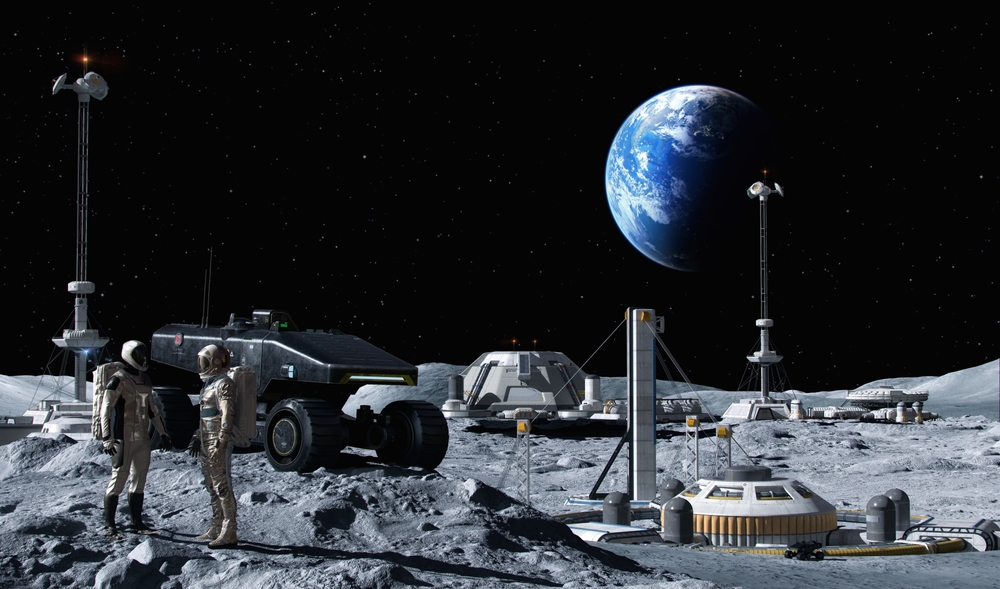
An unprecedented digital analysis of lunar material suggests that more robust regolith could shape plans for the International Lunar Research Station (ILRS).
When China’s Chang’e 6 mission delivered material from the far side of the moon to Earth in mid-2024, planetary scientists knew they were looking at something historic. For the first time, researchers were able to examine soil collected from the moon’s permanently hidden hemisphere.
Now, for the first time, a team led by Beihang University scientists has published detailed non-destructive physical analysis of these samples, providing new insights into how the topography may influence plans for future lunar bases.
Their findings suggest that the soil on the moon’s far side may be mechanically stronger and more entangled than material previously studied from the near side, and this difference could have implications for the proposed ILRS engineering strategy.
First look at material behind Chang’e 6
The samples brought back by Chang’e 6 originated in the Aitken Basin on the moon’s south pole. The basin is a vast backside impact structure that is geologically distinct from the areas explored during NASA’s Apollo mission and China’s earlier Chang’e 5 mission.
This material is rare and limited in quantity, making traditional destructive testing impossible. Instead, the researchers utilized high-resolution X-ray microcomputed tomography combined with machine learning to digitally reconstruct individual particles in the lunar regolith.
This approach allowed them to create a three-dimensional model of more than 349,000 particles without physically modifying the sample.
The research team used a semi-supervised deep learning system to process large amounts of image data to identify dense particles and model their detailed shapes. The result is, in effect, a “digital twin” of the underlying soil, allowing its mechanical behavior to be simulated.
Sharper, angular particles
The analysis found that the particles on the moon’s far side are significantly more angular than soil previously collected on the moon’s near side. The researchers report that the average sphericity is low, around 0.74, indicating that the particles are jagged and irregular.
This morphology is thought to reflect the impact environment unique to the Aitken Basin in Antarctica and the effects of long-term space weathering.
Unlike Earth’s round grains of sand, which are formed by wind and water, the Moon’s grains are formed by repeated impacts of micrometeorites and lack the smoothing process of erosion.
These differences are not just superficial. Shape affects soil behavior under load.
Impact on lunar base engineering
The team used discrete element method (DEM) simulations based on a reconstructed particle model to calculate important geotechnical properties of the backside regolith.
The simulated internal friction angle reached 47.96 degrees, and the cohesive force was measured to be 1.08 kilopascals. This value exceeded many previous estimates of the soil on the moon’s far side from Surveyor and Apollo mission data.
In fact, angular particles create stronger geometric bonds and increase resistance to shear forces.
For engineers planning infrastructure, this could lead to increased load-bearing capacity, a potential benefit when designing landing pads, habitat foundations, and ground platforms for lunar bases.
At the same time, higher shear strengths can complicate drilling operations and rover maneuverability, as the rover may encounter greater resistance when traversing or excavating the terrain.
ILRS engineering data
This discovery provides the first benchmark dataset describing the physical and mechanical properties of backside regolith.
Such data will inform structural design, anchoring systems, and surface construction methods as China and its partners advance plans for the International Lunar Research Station.
Beyond immediate engineering considerations, this research shows how advanced imaging and artificial intelligence can expand scientific insights while preserving irreplaceable extraterrestrial material.
As there is only a limited amount of contralateral samples available, digital reconstruction provides an avenue for future analysis.
For space agencies pursuing a continued human presence on the moon, understanding how the ground behaves beneath structures is just as important as the structures themselves.
The other side looks like it could provide a more solid foundation than once envisaged, although it is not without new technological hurdles to overcome.
Source link
