Close Menu
  • Home
  • Identity
  • Inventions
  • Future
  • Science
  • Startups
  • Spanish
What's Hot

China-linked DKnife AitM framework, routers targeted for traffic hijacking and malware distribution

Backlash over OpenAI’s decision to deprecate GPT-4o shows how dangerous AI companions can be

CISA orders removal of unsupported edge devices to reduce risk to federal networks

Facebook X (Twitter) Instagram
  • Home
  • About Us
  • Advertise with Us
  • Contact Us
  • DMCA
  • Privacy Policy
  • Terms & Conditions
  • User-Submitted Posts
Facebook X (Twitter) Instagram
Fyself News
  • Home
  • Identity
  • Inventions
  • Future
  • Science
  • Startups
  • Spanish
Fyself News
Home » China planted so many trees that the entire country’s water distribution changed
Science

China planted so many trees that the entire country’s water distribution changed

userBy userDecember 3, 2025No Comments4 Mins Read
Share Facebook Twitter Pinterest Telegram LinkedIn Tumblr Email Copy Link
Follow Us
Google News Flipboard
Share
Facebook Twitter LinkedIn Pinterest Email Copy Link

China’s efforts to slow land degradation and climate change by planting trees and restoring grasslands are moving water around the country in huge and unexpected ways, a new study finds.

From 2001 to 2020, vegetation changes reduced the amount of freshwater available to humans and ecosystems in the eastern monsoon region and northwestern arid region, which account for 74% of China’s land area, according to a study published in the journal Earth’s Future on October 4. During the same period, scientists found that water availability increased in China’s Tibetan Plateau region, which makes up the remaining landmass.

“We found that land cover change redistributes water,” study co-author Arie Staal, assistant professor of ecosystem resilience at Utrecht University in the Netherlands, told Live Science via email. “China has carried out large-scale greening over the past few decades, actively restoring thriving ecosystems, especially on the Loess Plateau. This has also revitalized the water cycle.”

you may like

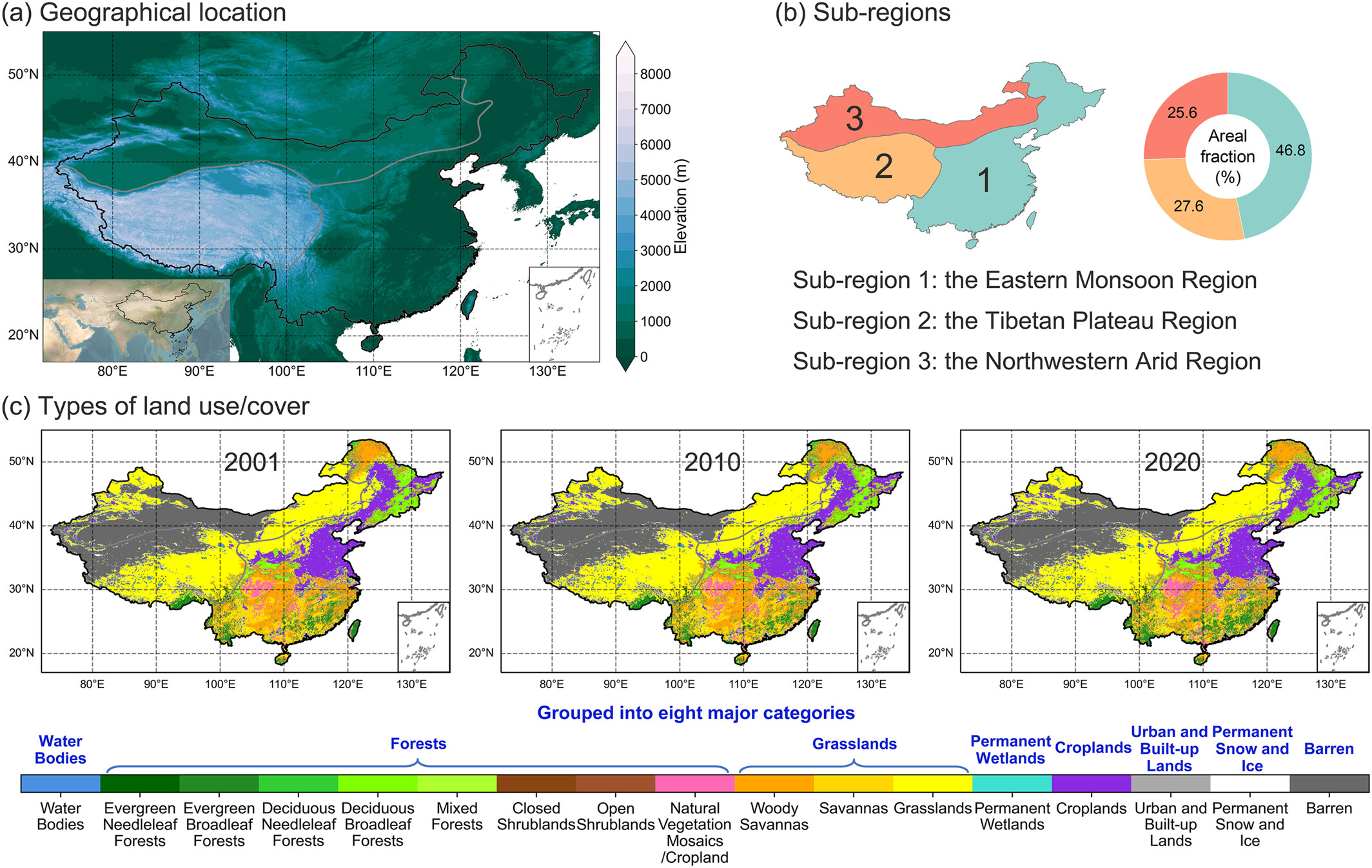
Survey diagram showing land use changes in China from 2001 to 2020. You will also see a map showing the three main regions of China.

The figures in this study show three major regions of China and land cover changes over the past two decades. (Image credit: An et al. (2025) Earth’s Future, Creative Commons CC BY-NC 4.0)

There are three main processes that move water between Earth’s continents and atmosphere. Evaporation and transpiration bring water up, and precipitation brings water back down. Evaporation removes water from the surface and soil, and transpiration removes water absorbed by plants from the soil. Together, these processes are called evapotranspiration, which varies depending on plant cover, water availability and the amount of solar energy reaching the land, Stahl said.

“Both grasslands and forests generally tend to experience increased evapotranspiration,” he says. “This trend is particularly pronounced in forests, as trees can develop deep roots that access water in moments of dryness.”

China’s largest afforestation effort is on the Great Wall of China, in the arid and semi-arid regions of the country’s north. The Great Wall of China, begun in 1978, was built to slow the expansion of the desert. Over the past 50 years, forest area has expanded from about 10% of China’s area in 1949 to more than 25% today, an area comparable to Algeria. Last year, government representatives announced that they had completed vegetating the country’s largest desert, but would continue planting trees to prevent desertification.

Other large-scale greening projects in China include the Grain for Green Program and the Natural Forest Protection Program, both launched in 1999. The Grain for Green Program encourages farmers to convert farmland into forests and grasslands, while the Natural Forest Protection Program prohibits the logging of old-growth forests and encourages afforestation.

Get the world’s most fascinating discoveries delivered straight to your inbox.

In total, China’s ecosystem restoration efforts accounted for 25% of the world’s net increase in leaf area from 2000 to 2017.

However, green regeneration has dramatically changed China’s water cycle, increasing both evapotranspiration and precipitation. To investigate these effects, the researchers used high-resolution evapotranspiration, precipitation, and land use change data from a variety of sources, as well as atmospheric moisture tracking models.

The results showed that evapotranspiration increased overall more than precipitation, which means some water is lost to the atmosphere, Stahl said. However, this trend was not consistent across China. Wind can carry water up to 4,350 miles (7,000 kilometers) from its source, meaning evapotranspiration in one place often affects precipitation elsewhere.

you may like
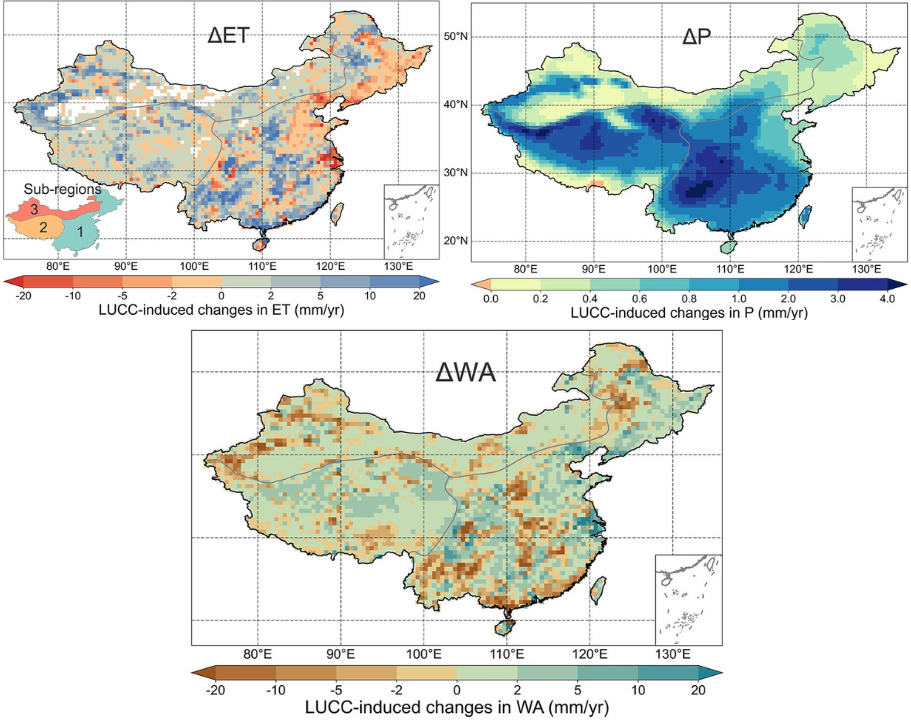
Map showing changes in evapotranspiration, precipitation, and water availability across China from 2002 to 2020.

China’s greening caused significant changes in evapotranspiration (top left), precipitation (top right), and water availability (bottom) from 2001 to 2020. (Image credit: An et al. (2025) Earth’s Future, Creative Commons CC BY-NC 4.0)

The researchers found that while forest expansion in China’s eastern monsoon region and grassland restoration in other regions increased evapotranspiration, precipitation increased only in the Tibetan Plateau region, thereby reducing water availability in other regions.

“Even though the water cycle is becoming more active, on a local scale we are losing more water than ever before,” Stahl said.

This has important implications for water management, as China’s water is already unevenly distributed. According to the study, the north has about 20% of the country’s water, but is home to 46% of the population and 60% of the arable land. The Chinese government is trying to address this. However, Stahl and colleagues argued that this measure is likely to fail if water redistribution through greening is not taken into account.

Ecosystem restoration and afforestation in other countries may also have an impact on the country’s water cycle. “From a water resources perspective, we need to consider on a case-by-case basis whether certain land cover changes are beneficial,” Stahl said. “It depends, among other things, on how much and where water that enters the atmosphere falls back down as precipitation.”


Source link

#Biotechnology #ClimateScience #Health #Science #ScientificAdvances #ScientificResearch
Follow on Google News Follow on Flipboard
Share. Facebook Twitter Pinterest LinkedIn Tumblr Email Copy Link
Previous ArticleBrazil Hit by Banking Trojan Spread via WhatsApp Worm and RelayNFC NFC Relay Scam
Next Article Fyself Revolutionizes Digital Health Communication with Interactive Doctor TwinH Storymap for FiveCLM Initiative
user
  • Website

Related Posts

7,500-year-old deer headdress discovered in Germany shows hunter-gatherers shared sacred objects and ideas with the region’s first farmers

February 5, 2026

How well can AI and humans work together? Scientists are looking to Dungeons & Dragons to find out.

February 5, 2026

Saltwater crocodiles crossed the Indian Ocean to the Seychelles before humans arrived and made them extinct.

February 5, 2026
Add A Comment
Leave A Reply Cancel Reply

Latest Posts

China-linked DKnife AitM framework, routers targeted for traffic hijacking and malware distribution

Backlash over OpenAI’s decision to deprecate GPT-4o shows how dangerous AI companions can be

CISA orders removal of unsupported edge devices to reduce risk to federal networks

Combat antimicrobial resistance with McGill rapid tests

Trending Posts

Subscribe to News

Subscribe to our newsletter and never miss our latest news

Please enable JavaScript in your browser to complete this form.
Loading

Welcome to Fyself News, your go-to platform for the latest in tech, startups, inventions, sustainability, and fintech! We are a passionate team of enthusiasts committed to bringing you timely, insightful, and accurate information on the most pressing developments across these industries. Whether you’re an entrepreneur, investor, or just someone curious about the future of technology and innovation, Fyself News has something for you.

Castilla-La Mancha Ignites Innovation: fiveclmsummit Redefines Tech Future

Local Power, Health Innovation: Alcolea de Calatrava Boosts FiveCLM PoC with Community Engagement

The Future of Digital Twins in Healthcare: From Virtual Replicas to Personalized Medical Models

Human Digital Twins: The Next Tech Frontier Set to Transform Healthcare and Beyond

Facebook X (Twitter) Instagram Pinterest YouTube
  • Home
  • About Us
  • Advertise with Us
  • Contact Us
  • DMCA
  • Privacy Policy
  • Terms & Conditions
  • User-Submitted Posts
© 2026 news.fyself. Designed by by fyself.

Type above and press Enter to search. Press Esc to cancel.