

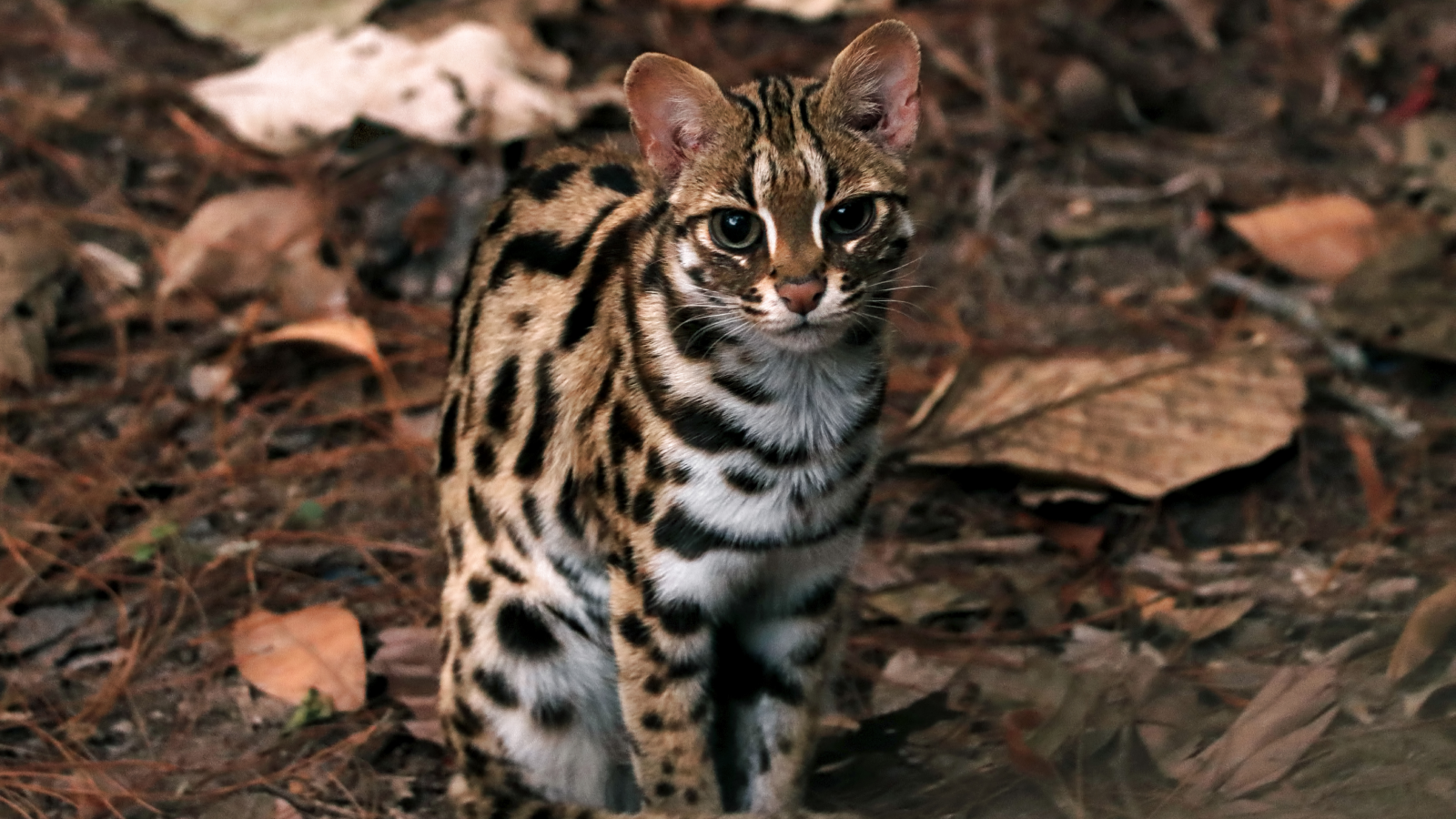
More than 3,500 years before the arrival of domestic cats, humans coexisted with leopard cats in ancient Chinese settlements, a new study has found.
The findings reveal that people in the region had an enduring and complex relationship with these animals for thousands of years, until domestic cats arrived on the Silk Road with merchants 1,400 years ago.
you may like
The study was published Thursday (November 27) in the journal Cell Genomics.
The modern domestic cat (Felis catus), a descendant of the African wildcat (Felis lybica), has adapted so well to coexist with humans that it is now found on every continent except Antarctica.
But it’s unclear when and where they were first domesticated, with researchers previously suggesting the Levant 9,500 years ago and Egypt about 3,500 years ago. One of the main hypotheses is that it spread to Europe with Neolithic farmers around 2,500 years ago and was eventually brought to China along the Silk Road through Eurasia.
But in 2013, evidence that cats coexisted with humans in western China thousands of years earlier, around 3300 BC, cast doubt on that idea.
In 2022, cat DNA analysis revealed that these ancient Chinese cats were not domestic cats, but leopard cats (Prionailurus bengalensis), a small wild cat native to South, Southeast Asia, and East Asia.
As a result, more questions were raised than everything was clarified. How long did the wildcat live with humans? When and how did the domestic cat arrive in China? What drama unfolded when the domestic cat showed up and found out it wasn’t the only cat in town?
To find out more, the researchers in the new study performed radiocarbon dating and DNA sequencing of the nuclear and mitochondrial genomes of 22 ancient feline bone samples excavated at 14 sites across China, dating from about 3500 BC to 1800 AD. The scientists then compared their results to previously published genomes of ancient and modern cats from around the world.
you may like
Fourteen of the 22 cats date from around 730 to 1800 AD and were domestic cats. The oldest domestic cat was unearthed in the city of Dongwan, an important hub along the Silk Road in western China. Previous research has identified other domestic cats further west along the Silk Road in Kazakhstan, dating them to between 775 and 940 AD.
The earliest known depictions of domestic cats in China are motifs painted on two tombs in central China around 820 and 830 AD, and there are also written accounts of empresses gifting domestic cats to ministers around the same time.
These records suggest that domestic cats came to China via the Silk Road relatively recently, around 700 AD, and as a recent introduction, they were considered exotic pets and were likely kept among ancient China’s elite, Luo told Live Science. The color of most cats is white, which was thought to be a sacred color for animals.
The earliest remains were all of leopard cats and dated from about 5,400 years ago to about 150 AD.

When researchers studied wildcats, they found that the close relationship between humans and wildcats is not a temporary, temporary thing, but a shared history that stretches back more than 3,500 years, Luo said.
He added that ancient Chinese leopard cats may have once occupied a similar status to domestic cats, entering into a symbiotic relationship with humans by preying on small rodents in villages and fields.
“I think ancient people were trying to keep and raise these young to catch rodents. I don’t think they were fully domesticated, but it was definitely a more intimate relationship than we have today with ocelots,” Luo said.
Eva Maria Geigl, a paleogeneticist at the Jacques Monod Institute at France’s National Center for Scientific Research (CNRS) who was not involved in the study, told Live Science that the discovery reflects the domestication process of cats around the Mediterranean. “This is a mutually beneficial relationship that takes advantage of a human niche, and this was very welcome to Neolithic farmers who actually had to contend with rodents and poisonous animals,” she told Live Science. “Such cats were not domesticated in the sense that we see them today. These couch potatoes were still true wild cats.”
Records compiled in China between the 5th and 3rd centuries BC provide further evidence of this relationship, showing that people welcomed wild cats onto their farms to control pests, Luo said. This means leopard cats may have had a relationship with humans that lasted about 3,500 years, she said.
But this relationship eventually came to an end, with nearly 600 years separating the last wildcat discovered and the first domestic cat in China.
Luo said this cat shortage coincides with the period of schism (220-589 AD) after the fall of the Han dynasty and before the rise of the Tang dynasty. At that time, there was war, agricultural yields were low, there was social unrest, the population was decreasing, and conditions were cold and dry. After the fall of the Roman Empire, a similar temporary population decline was observed in European black rats (the brown rat).
This means the wildcats have likely lost their hunting grounds, Luo said. After the establishment of the Tang Dynasty in 618 AD and the restoration of agriculture and population, wildcats became less welcome as more people kept chickens.
Leopard cats still have a bad reputation for killing chickens, which would have made them unwelcome animals, she said. In southern China, leopard cats have the nickname “chicken-killing tiger,” Luo said.
Domestic cats took their place, Luo suggested, because they are cute and docile and typically hunt small prey like mice and rats rather than chickens.
Geigl said the decisive change that led to the widespread acceptance of domestic cats probably occurred in Egypt in the first millennium B.C., when people kept cats in temples, fed many cats together, and genetic mutations led to changes in behavior. “This is not normal behavior for cats. Cats are territorial and solitary animals, the complete opposite of Egyptians,” she pointed out.
Cat Quiz: Can you purr?
Source link
