

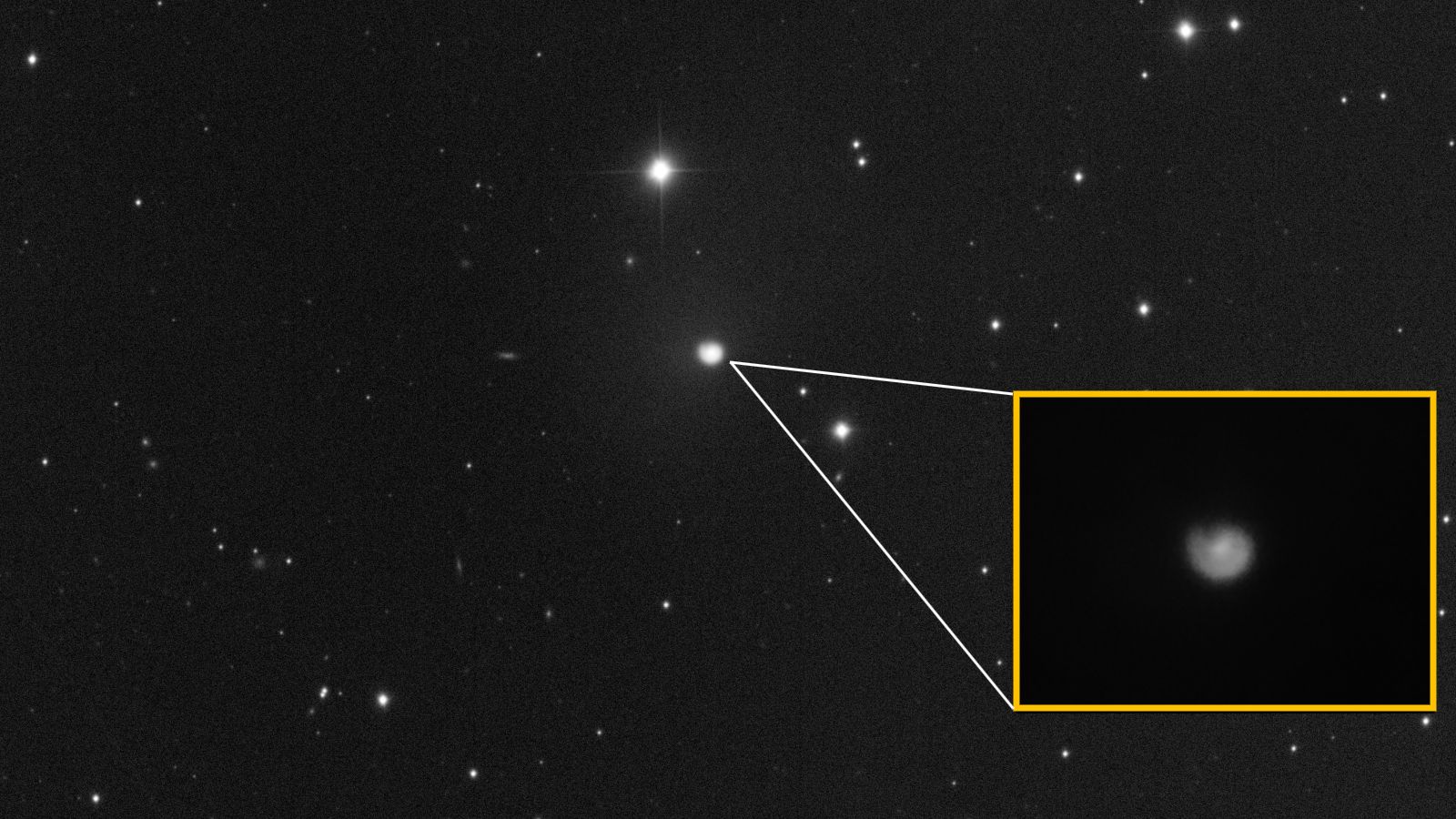
A mysterious volcanic comet has transformed into a giant “fossil-like” spiral of light after its most violent explosion in years, new photos have revealed. This amazing sight is a reminder of how puzzling this particular planetary debris really is.
This unusual comet, known as 29P/Schwassmann-Wachmann (29P), is a gigantic ball of ice about 60 kilometers long (roughly three times the size of Manhattan). It’s part of a rare group of about 500 objects called centaurs that spend their lives orbiting the inner solar system. This comet also belongs to an even more special club known as cryovolcanic comets, which occasionally spew gas and ice throughout our neighborhood of space.
A cryovolcanic comet’s top is blown off when its icy shell or core absorbs too much solar radiation. This extra radiation superheats the mixture of frozen gas and dust (called cryomagma) inside the comet, causing the ice mixture to sublimate. The resulting gas builds pressure in the comet’s core, eventually cracking the core and allowing its icy guts to fly into space. When this happens, the fuzzy cloud of material surrounding the comet known as a coma expands significantly, allowing it to reflect more sunlight and making it shine brighter in the night sky.
you may like
According to Spaceweather.com, on February 10, Comet 29P experienced a sudden brightening event, increasing its brightness by approximately 100 times, indicating a large-scale eruptive event.
This eruption is one of the comet’s “top five” eruptions of the past 25 years, experts told Spaceweather.com. This is the most powerful event since four eruptions in October 2024, which caused Comet 29P to shine 300 times brighter than usual.
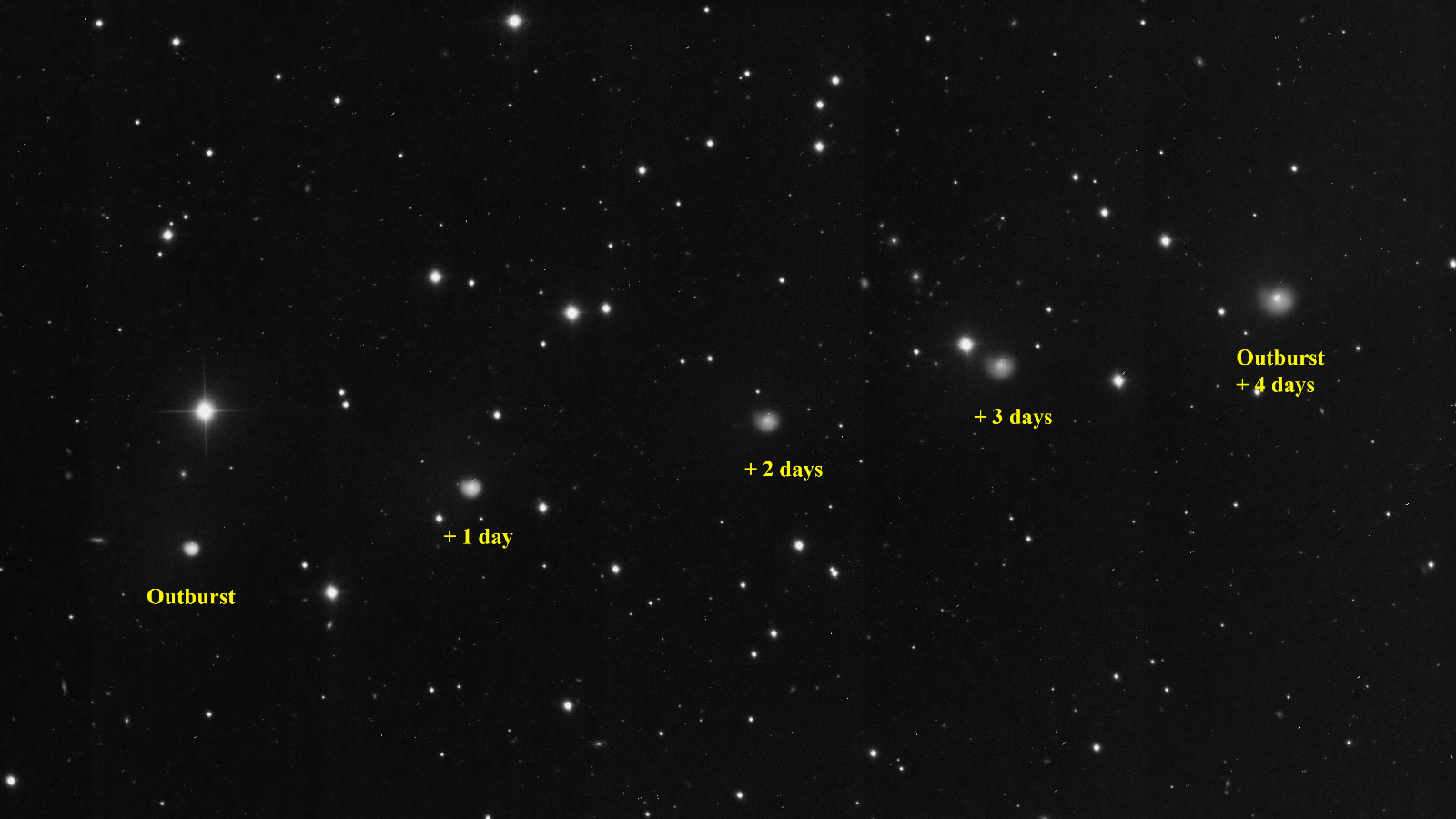
But days after the explosive explosion, researchers began to notice something unusual about 29P’s growing coma. That means the reflective clouds aren’t evenly distributed around the comet like they usually are. Instead, the clouds seemed to stretch out in an unusual spiral pattern.
Amateur astronomer and astrophotographer Elliot Harman photographed the lopsided coma in Chile’s Rio Hurtado Valley (see above) and said it resembled fossils of extinct shelled cephalopods known as ammonoids. Fellow photographer Anthony Crouse also took stunning photos of the spiral in Wisconsin, describing its “snail shell-like appearance.”
According to Spaceweather.com, the unusual shape is likely due to internal rotation relative to the comet’s core, which causes frozen magma to eject unevenly from newly formed vents on the icy surface.
It is very similar to the “devil’s comet” 12P/Ponsbrooks, which appeared to have devilish horns during its early solar approach eruption in late 2023, perhaps because notches in its surface partially blocked the outflow of frozen magma, experts said at the time.
The interstellar comet 3I/ATLAS, which made headlines last year for its rapid approach through the inner solar system, also showed evidence of cryovolcanic activity and may have leaked icy magma through multiple jets.
you may like
Unexplained outbreak
Most cryovolcanic comets, such as Comet 12P/Ponsbrooks and the recently discovered Comet Swan, are long-period comets that exist outside the Solar System and drift toward the Sun every few hundred or thousand years. They erupt only when they approach our home star, absorb additional radiation, and then become inactive and quietly return to the edge of our universe.
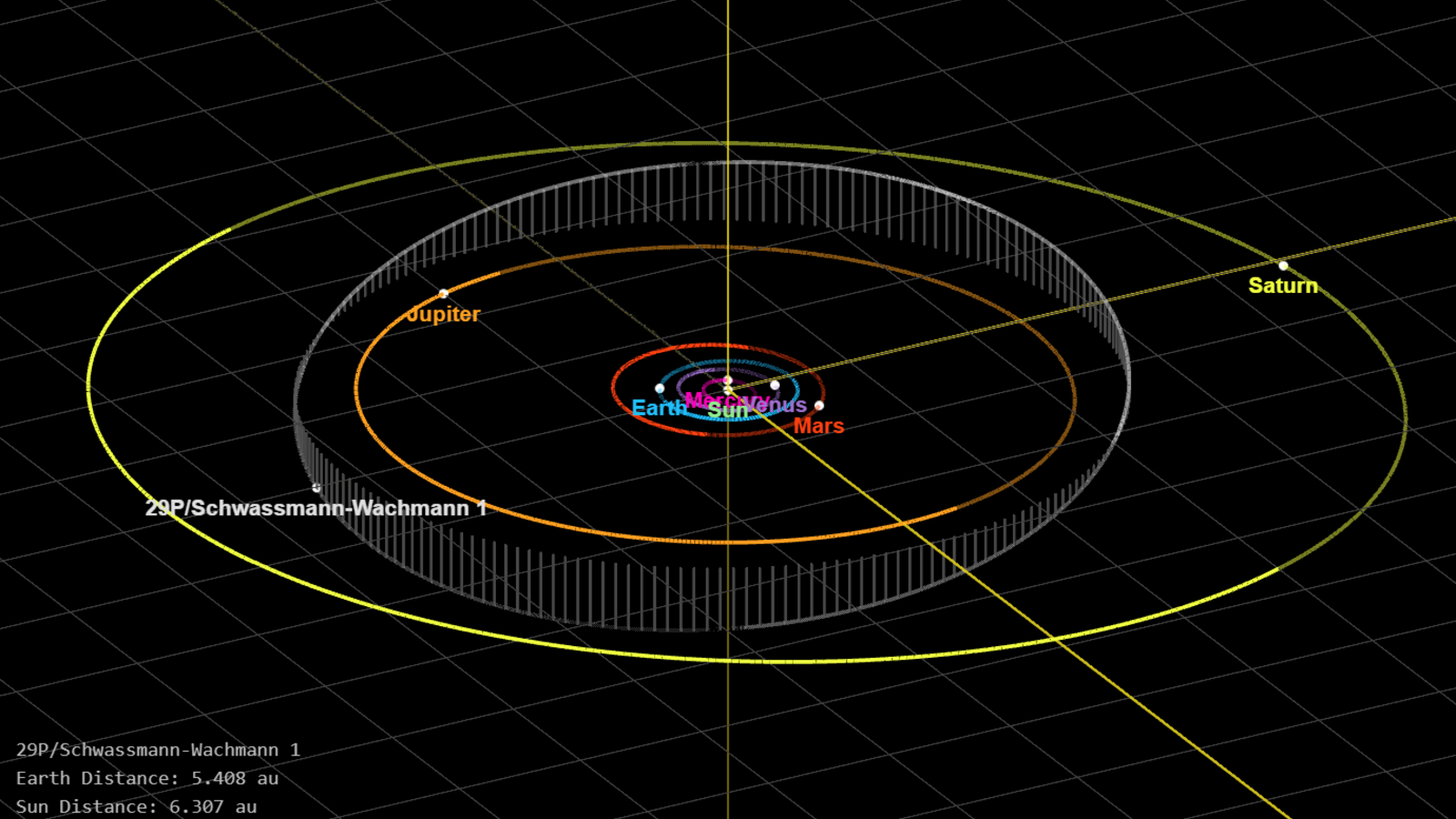
However, Comet 29P orbits the Sun in a nearly circular orbit, so its distance from the Sun is always about the same. It is located between Jupiter and Saturn and is about six times further away from our home planet than Earth, so it receives less sunlight.
Still, Comet 29P experiences an average of 20 eruptions per year. Most of them are small, but occasionally larger explosions occur, like the one we just saw, releasing up to a million tons of frozen magma into space.
This is frustrating for researchers, as they don’t have a clear idea of what causes these larger explosions, even though the comet’s conditions appear to be fairly stable.
In April 2023, researchers predicted one of these major eruptions in advance thanks to a small dimming event just before the comet’s top blew off. But I still didn’t know why it happened.
29P/Schwassman-Wachman’s perspective
Comet 29P has passed its peak brightness. But a second, smaller explosion on Sunday (February 15) pumped fresh frozen magma into the comet’s coma, keeping it unusually bright, according to Spaceweather.com. (It is currently unknown whether the reactivated coma will spiral.)
If you have a decent telescope or stargazing binoculars, you should be able to see the comet. According to TheSkyLive.com, it is currently located in the constellation Leo.
Large eruptions like this are often followed by multiple smaller eruptions, or “aftershocks,” meaning we could see more eruptions in the coming days or weeks, Richard Miles, an astronomer at the British Astronomical Society who studies Comet 29P, told Spaceweather.com.
If you decide to head out under the stars, you might also want to keep an eye out for comet C/2024 E1 (Vieszczosz), which is shining brightly after its closest approach to Earth on Tuesday (February 17). Researchers predict that this iceball, like 3I/ATLAS, could soon be kicked out of the solar system forever, so this may be our only chance to see it.
Two more interesting comets will appear in April. The newly discovered “sungrazer” comet C/2026 A1 (MAPS) may shine bright enough to be seen with the naked eye during the day, and the long-period comet C/2025 R3 (PanSTARRS) may be visible without a telescope at night.
Source link
