

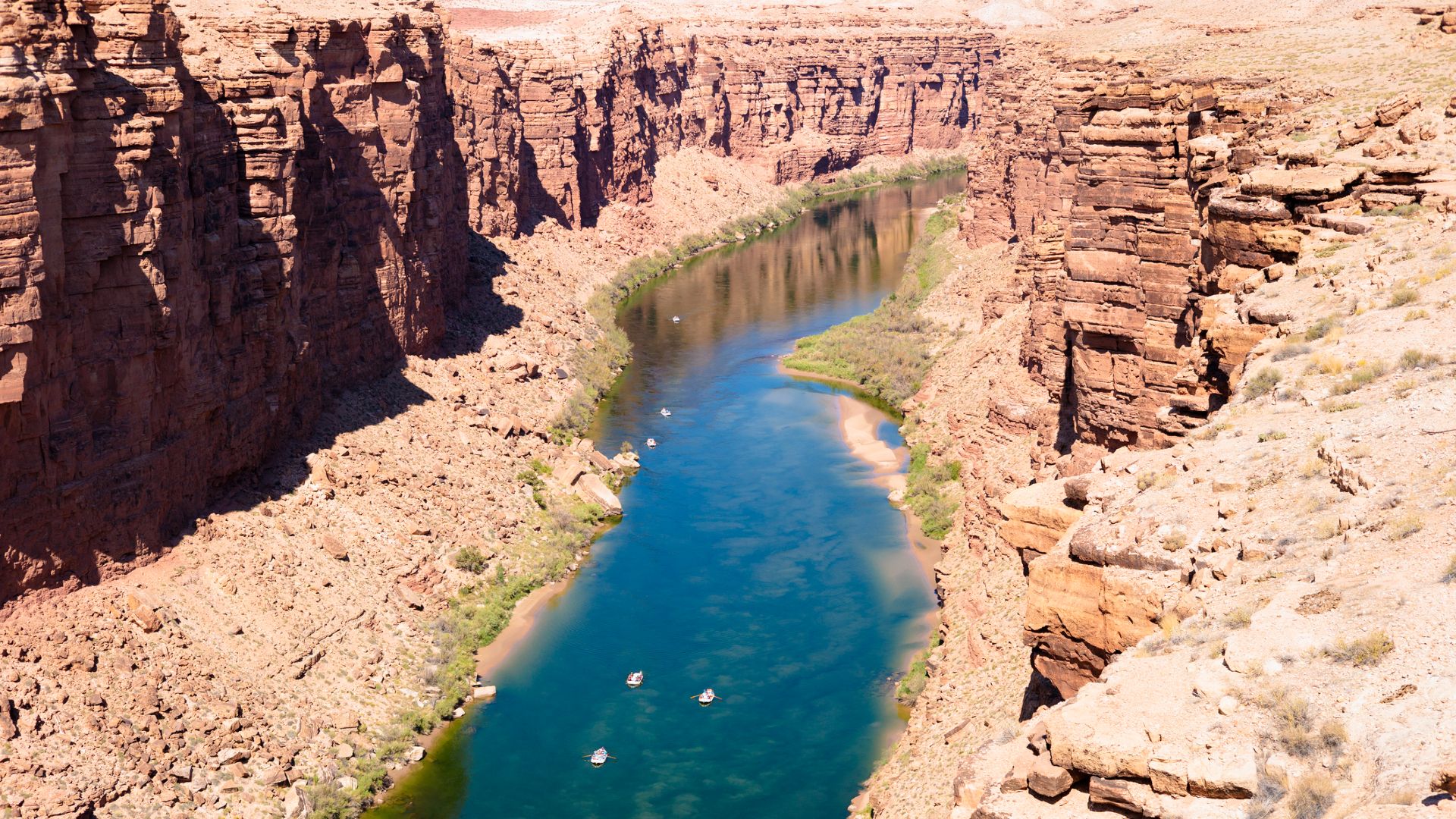
The seven U.S. states that make up the Colorado River Basin are struggling to agree on how best to manage river water as climate change and prolonged droughts cause the river to dwindle. Negotiations between the two sides were private and failed to meet a federal deadline of Feb. 14, 2026, after which federal officials said they would impose their own plan.
Although the federal government has not yet taken such action, the prospect of such action is not good news for the approximately 40 million people who depend on the Colorado River for water, energy, agriculture, and recreation, nor for the estimated $1.4 trillion in economic activity that the river supports.
Article continues below
you may like
The five most common sources of conflict between people are values, data, relationships, interests, and structure. Current Colorado River negotiations include all five. We believe that a process designed and facilitated by negotiation experts can help break the impasse.
We recognize that it is very difficult to reach an agreement when countless lives, vast sums of money, enormous amounts of hydropower, and barely enough water are at stake.
However, compromises on Colorado River management are possible, and in fact, compromises were achieved by curbing California’s water use in the 2000s, negotiating interim agreements to coordinate operations of Lake Mead and Lake Powell reservoirs in 2007, and enacting contingency plans to manage drought in 2019. However, things are different this time.
past negotiations
Negotiations leading to these agreements were often facilitated by U.S. Bureau of Reclamation officials who focused on reaching broad agreements on general principles and concepts before delving into details. Federal officials also actively guided key agreements and provided scientific and computational models for informed decision-making. And state negotiators knew that unless the states reached their own agreements, the Interior Department would act unilaterally and make harmful cuts to water supplies.
Negotiators from each state built long-standing relationships, communicated frequently outside of formal meetings, and built trust by listening and trying to understand other states’ perspectives, even when they disagreed.
The states also agreed to use the agency’s computer models to analyze climate change scenarios and business decisions. This means that all negotiators were considering the same data when considering possible options. And the political and social environment was not as polarized as it is today.
current situation
In this round of negotiations, the federal leadership has been slow to respond. The Home Office has not made clear what the consequences will be if the states fail to reach an agreement. The U.S. Bureau of Reclamation has been without a permanent commissioner since President Donald Trump took office in January 2025.
What to read next
And only recently have federal officials begun helping facilitate the discussion.
States are divided into subgroups based on whether they are located in the upper reaches of the river, such as Colorado, Wyoming, Utah, and New Mexico, or in the lower reaches, including Arizona, Nevada, and California. Each basin group holds a strong position and is generally unwilling to shift.
Each watershed group uses a different set of assumptions for the bureau’s computer model to consider options. And discussions often get bogged down in details, hindering progress toward a broader agreement.
Furthermore, issues have become increasingly polarized and politicized, and the political context has changed significantly, creating barriers to effective dialogue and deliberation. Today, compromise may seem unattainable.
But these relatively new challenges to the Colorado River Compromise are no excuse for failure.
What is the way forward?
All current negotiations are taking place behind closed doors. After speaking with people involved in the negotiations, we learned that there is no formal facilitator, and that negotiators are expected to set their own agendas and meeting plans, and conduct their own communications and follow-up.
It is reasonable to expect that negotiators will be prepared to navigate the incredibly complex landscape of hydrology, climate and management scenario modeling, water law and administration, and politics to represent their country’s interests. However, we believe it is unreasonable, unrealistic and unfair to expect them to be experts at designing and facilitating effective processes for sorting out disagreements.
Federal officials are also not necessarily the best people to carry out this process. And if the government agency that ultimately needs to approve the deal is the one leading the process, real or perceived bias regarding the state or key issues in the deal can further complicate the discussion.
We believe that an agreement among the seven states is still possible. However, bringing in a third-party facilitator at this stage of the negotiation process may be less effective due to diminished trust, hardened positions, and lack of time.
One possible outcome is for the Bureau of Reclamation to select and implement one of five management alternatives outlined in January 2026. But that could lead to decades of litigation all the way to the Supreme Court. No one wins in this scenario.
A more hopeful possibility is for the agency to adopt short-term rules and give states an opportunity to negotiate long-term agreements, preferably with the assistance of an impartial third-party mediator.
As a Washington state official told the New York Times, the collaborative and consensual planning process in Washington state’s Yakima River Basin in the early 2010s is proof that while no one gets everything they want in a negotiated agreement, “if[everyone]gets something, that’s really the basis of planning.”
This edited article is republished from The Conversation under a Creative Commons license. Read the original article.
Source link
