

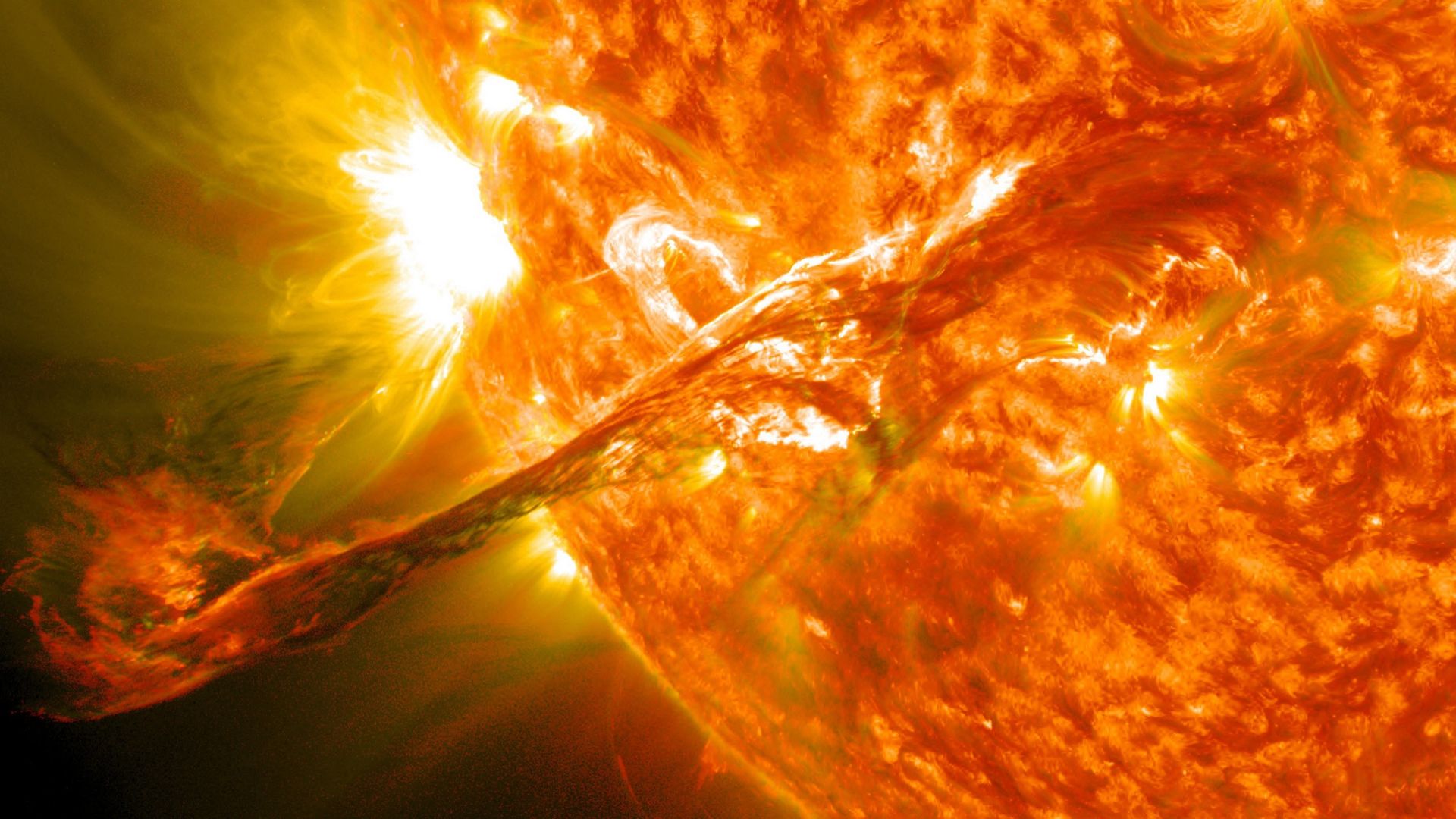
Solar flares often disrupt Earth’s upper atmosphere and help produce spectacular aurora borealis. Now, scientists suggest that the same burst of solar energy could also affect earthquakes.
When solar flares erupt toward our planet, they can subtly rearrange the charged particles in Earth’s ionosphere, a region of the upper atmosphere filled with electrically charged gases. In a new study, researchers suggest that these changes could slightly alter the electrical forces in the Earth’s crust, affecting the stability of faults where earthquakes can occur.
you may like
Planet-sized electrical circuit
Our planet is buzzing with naturally generated electricity. In particular, highly stressed cracks in the Earth’s crust contain pockets of extremely hot, pressurized water that is neither liquid nor gas. This supercritical fluid is filled with charged ions, and the cracks act like capacitors, storing electrical energy.
These cracks, or faults, in the Earth’s crust are also important areas for causing earthquakes, because they mark where tectonic plates collide and move, storing mechanical energy that can cause earthquakes.
In a new study, researchers created a model that treats the Earth’s crust and ionosphere, an electrically charged layer 250 miles (402 kilometers) above Earth, as two ends of a giant, leaky battery.
Next, they connected a “capacitor” in the Earth’s crust to the ionosphere using an electric field.
Using those models, the scientists predicted that when charged particles from a solar flare hit Earth, electrons in the ionosphere would move downward, concentrating them at lower altitudes and forming a layer of negative charge. The model showed that this charge increases the electrostatic forces acting on the charge in the Earth’s crust, creating a pressure change. The researchers argue that these pressure changes are comparable to other forces that affect fault stability, such as gravity and tides.
Essentially, an increase in electrostatic forces within the Earth’s crust leads to increased pressure on the surrounding crust, moving faults and causing earthquakes.
difficult to test
The researchers suggest that the 2024 earthquake on Japan’s Noto Peninsula corroborated the model’s results because it coincided with strong solar flare activity. However, it is difficult in practice to verify the connection between the earth’s crust and the ionosphere.
you may like
First, the U.S. Geological Survey has long emphasized that earthquakes do not clearly and repeatedly follow the sun’s 11-year solar cycle.
There is also the matter of chance. Because solar flares and earthquakes are fairly common, it is possible that by chance there will be some overlap between these two types of phenomena, even if they do not necessarily affect each other.
Other researchers noted that the study’s model did not fully reflect the complexity of the Earth’s crust.
“The proposed model is significantly simplified,” said Viktor Novikov, a geophysicist at the Russian Academy of Sciences who was not involved in the study. He added that researchers have not fully accounted for the resistance of many rock layers to conducting electricity, which could suppress electric fields before they lead to earthquakes. “The observations do not support the proposed idea,” Novikov told Live Science via email.
Nevertheless, researchers continue to explore connections, however subtle, between space weather and plate tectonics.
For now, the researchers noted, the study is best viewed as a proposed pathway that can be tested with better observations and deeper analysis.
Whether the sun can reliably hit Earth’s faults is an open question, reminding us of the basic scientific rule that correlation does not equal causation.
Akira Mizuno, Tadashi Hanao, Kazuya Umeno (2026) Mechanisms by which anomalies in the ionosphere can cause earthquakes – electrostatic coupling between the ionosphere and the earth’s crust and the resulting electric force acting within the earth’s crust. International Journal of Plasma Environmental Science and Technology, 20(1), e01003. https://doi.org/10.34343/ijpest.2026.20.e01003
What’s Inside the Earth Quiz: Test your knowledge about Earth’s hidden layers
Source link
