

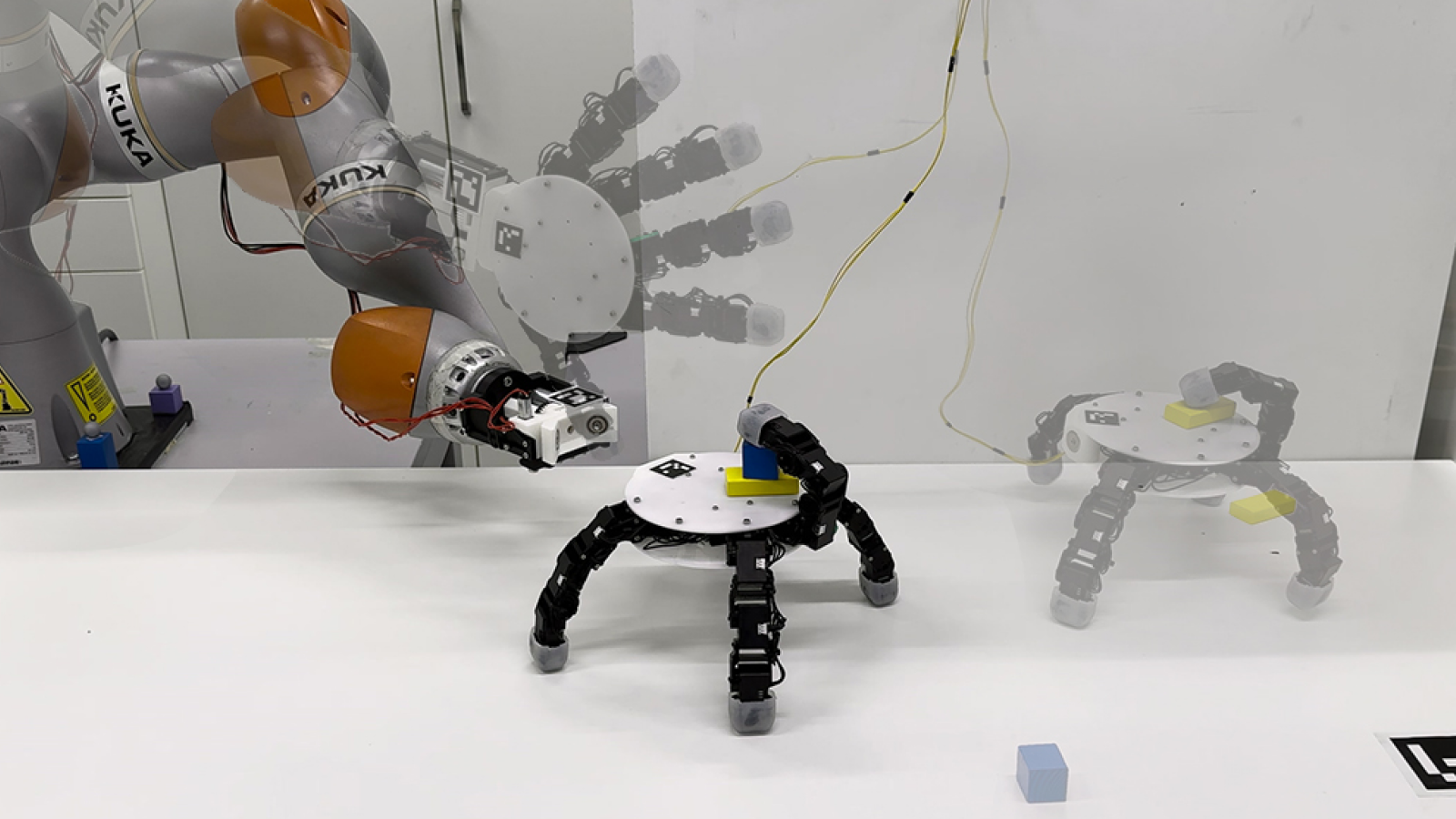
Engineers have developed a removable robotic hand that can crawl into hard-to-reach places and retrieve objects.
In a research paper published in the journal Nature Communications on January 20, scientists at the Swiss Federal Institute of Technology Lausanne (EPFL) said the robot was designed to combine two functions typically kept separate in robotics: manipulation and locomotion.
you may like
The hand can also operate without a fully mobile robot base. Instead, the robot simply detaches itself from the robotic arm, scuttles to where it is needed, picks up the object, returns and reattachs itself.
This could be useful in situations where robots need to reach or retrieve objects from spaces that are too small or too dangerous for human hands to access, such as industrial or exploration environments or areas affected by disasters, the researchers said.
“The limits of the human hand can quickly be seen when trying to reach objects under furniture or behind shelves, or performing simultaneous tasks like picking up a chip while holding a bottle,” study co-author Aude Billard, head of the Learning Algorithms and Systems Laboratory at EPFL’s School of Engineering, said in a statement.
“Similarly, it is very difficult to access objects behind the hand while keeping the grip steady, requiring awkward twists of the wrist and repositioning of the body.”
handy robotics
Hand-like robot appendages have been created before. After all, the human hand is considered a biological wonder. It gave humans the dexterity needed to make tools, prepare meals, and build shelter, all of which have proven to be key to survival as a species.
Still, the scientists said, there are clear biological limits to human hands. For example, the thumb may be asymmetrical or the hand may be permanently attached to the arm.
EPFL’s robots are essentially self-contained systems that can act like regular “grippers” at the end of their arms, or detach and run around on their own. The design was inspired by nature, with researchers likening it to how an octopus uses its arms to navigate the ocean floor and open its shell, and how a praying mantis uses its spiny forearms to move around and catch prey.
you may like
In their experiments, the researchers demonstrated that the hand not only performs a variety of standard grasping and grasping exercises, but also accomplishes more difficult feats of dexterity that humans struggle with on a daily basis. This includes holding multiple objects at the same time and grasping objects without using the thumb or index finger.
Not only can the robot hand grasp up to four objects at the same time, it can also crawl across the floor while carrying objects on its “back.”
Each of the robot’s fingers is driven by a small electric motor and linked by lightweight 3D-printed joints, allowing it to bend and unfold like human fingers. However, unlike the human hand, each joint in each finger can bend forward and backward, allowing it to grasp objects in both directions or “flip” the direction of work without having to rotate the wrist.
The fingertips are covered with a soft silicone layer that adds friction, helps hold objects firmly, and helps maintain traction when crawling. “There’s no real limit to the number of objects you can hold. If you need to hold more objects, just add more fingers,” Villard said.
The hand is reattached to the arm using a “snap and lock” system. Magnets help align the connector, and a small motor drives the locking bolt that secures the joint.
The researchers say the system could eventually be applied to human prosthetics or “limb” augmentation, but this is not the focus of the current prototype.
“Symmetric and reversible capabilities are particularly valuable in scenarios where users may benefit from capabilities beyond normal human capabilities,” Billard said.
“For example, previous studies with users of additional robotic fingers have demonstrated the brain’s remarkable adaptive ability to integrate additional appendages, suggesting that our non-traditional configuration may also function in specialized environments that require enhanced manipulative abilities.”
Source link
