

Close Menu
  • Home
  • Identity
  • Inventions
  • Future
  • Science
  • Startups
  • Spanish
What's Hot

Google is trying to tackle long-standing RCS spam in India, but it’s not alone

OpenAI reveals details about agreement with Department of Defense

Honor launches new slim foldable Magic V6 with 6,600 mAh battery

Facebook X (Twitter) Instagram
  • Home
  • About Us
  • Advertise with Us
  • Contact Us
  • DMCA
  • Privacy Policy
  • Terms & Conditions
  • User-Submitted Posts
Facebook X (Twitter) Instagram
Fyself News
  • Home
  • Identity
  • Inventions
  • Future
  • Science
  • Startups
  • Spanish
Fyself News
Home » Destruction caused by ‘silent’ earthquakes deep in the Earth’s crust can heal itself within hours
Science

Destruction caused by ‘silent’ earthquakes deep in the Earth’s crust can heal itself within hours

userBy userNovember 25, 2025No Comments4 Mins Read
Share Facebook Twitter Pinterest Telegram LinkedIn Tumblr Email Copy Link
Follow Us
Google News Flipboard
Share
Facebook Twitter LinkedIn Pinterest Email Copy Link

Cracks deep in the Earth’s crust can reattach within hours after certain earthquakes, a new study suggests.

Specifically, these cracks can heal rapidly after what geologists call a slow-slip event. This is when deformation and stress-induced movement between the two sides of a fault occurs over days, weeks, or months rather than seconds or, in the case of the largest earthquakes, minutes.

Amanda Thomas, lead author of the study and a professor of geophysics at the University of California, Davis, said slow-slip events are “quiet” earthquakes, meaning they slip much more slowly and don’t emit strong waves that can endanger normal earthquakes.

you may like

“Slow-slip events and regular earthquakes can occur on the same large fault system, but typically at different depths and under different physical conditions,” Thomas told Live Science via email. “It is the frictional behavior of the fault and the effective stress on the fault that determines whether the fault begins to slide slowly or suddenly.”

Thomas and her colleagues studied the slow-slip phenomenon that occurs deep within the Cascadia subduction zone, a “megafault” where the Juan de Fuca plate slides beneath the North American plate. Thomas said Cascadia has experienced many of these slow-slip events and has an exceptional seismic monitoring network, making it one of the best places in the world to study the phenomenon.

This massive fault can cause earthquakes of magnitude 8 and 9. “In subduction zones like Cascadia, large earthquakes occur in shallow, cold rock, while slow slips occur deep down, where temperatures and pressures are much higher and fluids are abundant,” Thomas explained.

Cascadia’s slow slip event is unusual in that the same zone can be repeatedly ruptured during a single event. One area of ​​a fault can rupture multiple times within just a few hours. This suggests that stress is rapidly reloaded and that a “healing” process occurs during fracture. “This repeated reactivation is one of the mysteries our study tried to explain,” Thomas said.

Get the world’s most fascinating discoveries delivered straight to your inbox.

The results were published in the November 19 issue of Science Advances.

Because the depths of Cascadia are inaccessible, the researchers recreated in the lab the conditions that are thought to exist deep within subduction zones. They filled silver capsules with bits of powdered quartz and water to mimic rocks and deep fluids, respectively. The researchers then welded the capsule closed, heated it to around 930 degrees Fahrenheit (500 degrees Celsius), and left it under pressure 10,000 times atmospheric pressure for up to 24 hours.
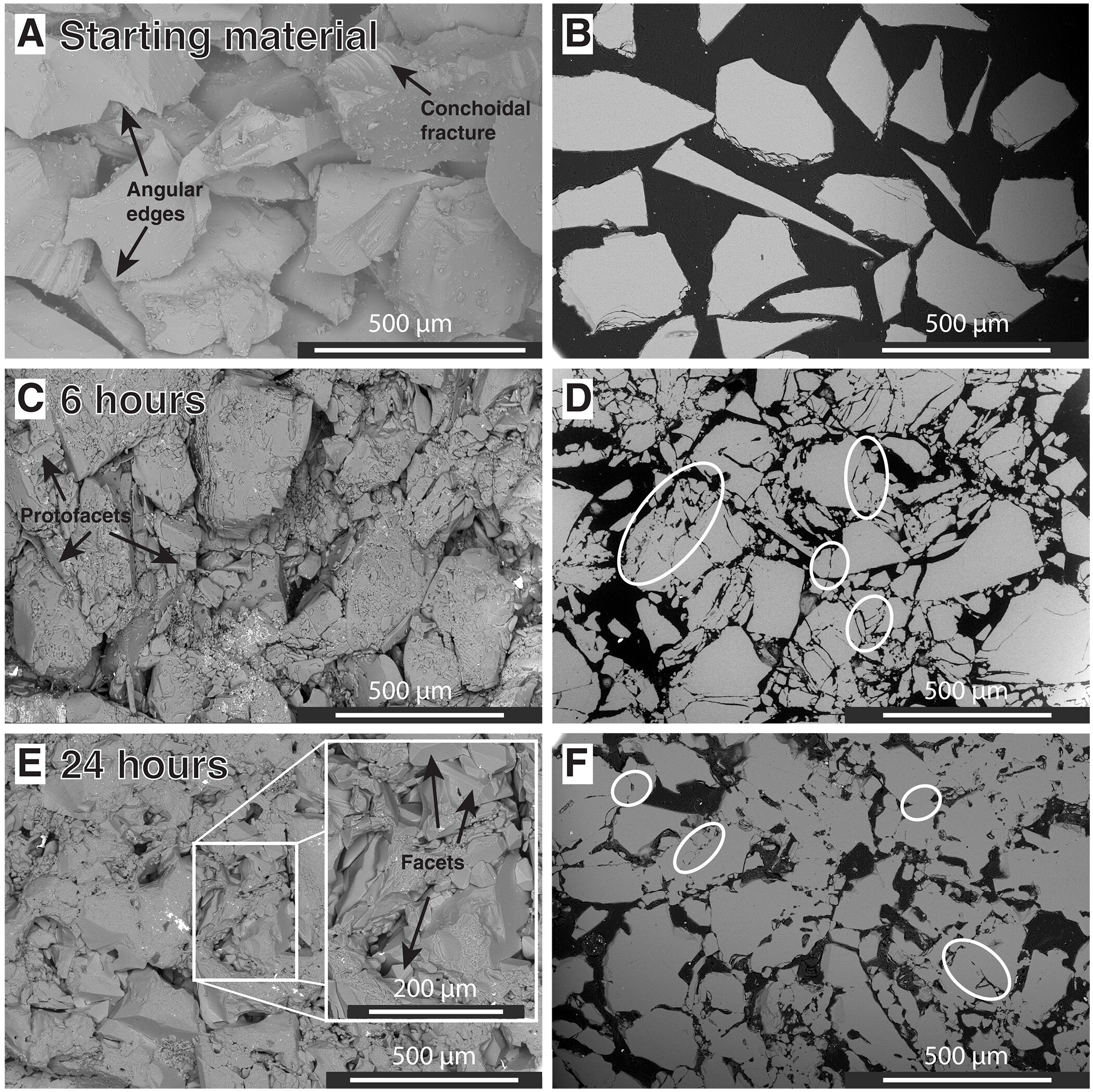
Scanning electron microscopy image of powdered quartz welded in the laboratory. You can see that the pieces stick together over time.

Scanning electron microscopy images show quartz fragments sticking together within the silver capsule after 6 and 24 hours. (Image credit: Watkins Lab, University of California, Davis)

The researchers then used an electron microscope to glean what happened to the quartz powder. They found that even in samples that had been “cooked” for just a few hours, the mineral particles were welded together.

you may like

“Fault repair is highly dependent on temperature, pressure, and the presence of fluid,” Thomas says. “In our experiments, these conditions produced measurable enhancement within a few hours.”

Because regular earthquakes usually occur in shallow regions of the Earth’s crust, fractures take much longer to heal, from years to decades. “Our results suggest that the same fundamental processes may operate throughout the Earth’s crust, but the time scales vary depending on the environment,” Thomas said.

Another part of the puzzle addressed in this study is how stresses are rapidly reloaded during slow-slip events at Cascadia. Low-frequency earthquakes occur in subduction zones. Low-frequency earthquakes are small seismic events triggered in bursts when the same area is repeatedly ruptured. These ruptures coincide with the ocean’s tidal cycles, suggesting that tidal changes can cause faults to repair and then re-rupture just hours later.

“At Cascadia, rapid repair means that some deep faults can re-strengthen quickly enough that they can be reactivated many times during one slow slip cycle,” Thomas said. “It affects how we model slow slip and how we interpret the signals we use to monitor deep faults.”

Fault repair is also an important consideration in shallower areas, such as areas known to produce large earthquakes. Thomas said the remediation process could improve our understanding of seismic risk and should be incorporated into next-generation models.


Source link

#Biotechnology #ClimateScience #Health #Science #ScientificAdvances #ScientificResearch
Follow on Google News Follow on Flipboard
Share. Facebook Twitter Pinterest LinkedIn Tumblr Email Copy Link
Previous ArticleDevelopment of PFAS-free fuel cells and electrolyzers
Next Article ‘Never seen a skull like this before’: Medieval Spanish knight who died in battle had a rare genetic disorder, study finds
user
  • Website

Related Posts

History of Science: Discovery of Carbon-14 Opens Window on Past Civilizations — February 27, 1940

March 1, 2026

This week’s science news: Spider webs on Mars, tigers returned to Kazakhstan, 2,000-year-old skull with permanently blackened teeth

February 28, 2026

Passing this new AI exam (which its creators say is the world’s most difficult) could show the first signs of AGI

February 27, 2026
Add A Comment
Leave A Reply Cancel Reply

Latest Posts

Google is trying to tackle long-standing RCS spam in India, but it’s not alone

OpenAI reveals details about agreement with Department of Defense

Honor launches new slim foldable Magic V6 with 6,600 mAh battery

SaaS inflow, SaaS outflow: Here’s what drives SaaSpocalypse

Trending Posts

Subscribe to News

Subscribe to our newsletter and never miss our latest news

Please enable JavaScript in your browser to complete this form.
Loading

Welcome to Fyself News, your go-to platform for the latest in tech, startups, inventions, sustainability, and fintech! We are a passionate team of enthusiasts committed to bringing you timely, insightful, and accurate information on the most pressing developments across these industries. Whether you’re an entrepreneur, investor, or just someone curious about the future of technology and innovation, Fyself News has something for you.

Castilla-La Mancha Ignites Innovation: fiveclmsummit Redefines Tech Future

Local Power, Health Innovation: Alcolea de Calatrava Boosts FiveCLM PoC with Community Engagement

The Future of Digital Twins in Healthcare: From Virtual Replicas to Personalized Medical Models

Human Digital Twins: The Next Tech Frontier Set to Transform Healthcare and Beyond

Facebook X (Twitter) Instagram Pinterest YouTube
  • Home
  • About Us
  • Advertise with Us
  • Contact Us
  • DMCA
  • Privacy Policy
  • Terms & Conditions
  • User-Submitted Posts
© 2026 news.fyself. Designed by by fyself.

Type above and press Enter to search. Press Esc to cancel.