
Close Menu
  • Home
  • Identity
  • Inventions
  • Future
  • Science
  • Startups
  • Spanish
What's Hot

n8n webhook has been exploited since October 2025 to deliver malware via phishing emails

After selling its shoe business, Allbirds shifts focus to AI

Reid Hoffman weighs in on the ‘token maxing’ debate

Facebook X (Twitter) Instagram
  • Home
  • About Us
  • Advertise with Us
  • Contact Us
  • DMCA
  • Privacy Policy
  • Terms & Conditions
  • User-Submitted Posts
Facebook X (Twitter) Instagram
Fyself News
  • Home
  • Identity
  • Inventions
  • Future
  • Science
  • Startups
  • Spanish
Fyself News
Home » DNA analysis reveals that entire lower-class families were sacrificed to honor local royalty in South Korea 1,500 years ago
Science

DNA analysis reveals that entire lower-class families were sacrificed to honor local royalty in South Korea 1,500 years ago

By April 9, 2026No Comments3 Mins Read
Share Facebook Twitter Pinterest Telegram LinkedIn Tumblr Email Copy Link
Follow Us
Google News Flipboard
Share
Facebook Twitter LinkedIn Pinterest Email Copy Link

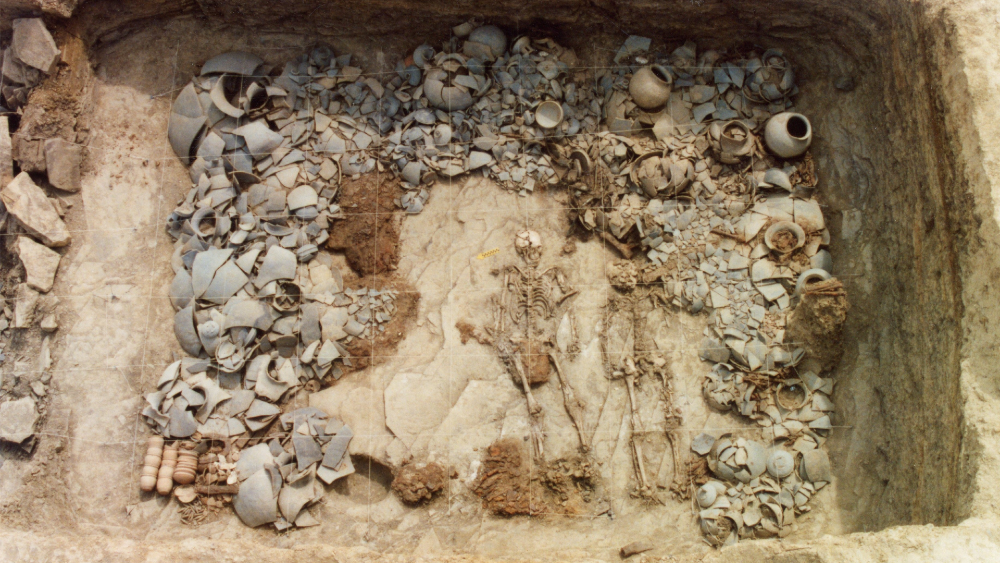
About 1,500 years ago, entire families were sacrificed in what is now South Korea to honor local royalty, new genetic research has found. The analysis also revealed a strong kinship system focused on women and their offspring.

In a research paper published in the journal Science Advances on Wednesday (April 8), an international research team examined 78 human bones excavated from Imdang-Seongyeong Cemetery in Gyeongsan, in the southeastern part of the Korean peninsula. The tombs in this cemetery were built between the 4th and 6th centuries during the Three Kingdoms period (c. 57 BC to 668 AD). Historical records show that in the Silla Kingdom, people practiced “sungjang,” a form of human sacrifice in which servants and “vassals” were killed and buried with local elites, suggesting that society supported “incestuous marriage” between related individuals.

Researchers analyzed the DNA of 78 human bones found in the Imdang and Seongyeong tombs and found 11 pairs of first-degree relatives (parents and children, siblings, etc.) and 23 pairs of second-degree relatives (grandparents and grandchildren, aunts and nieces, etc.), suggesting that Silla society preferred to bury closely related people together.

you may like

However, the researchers also found five individuals (both royal and non-royal) whose parents were closely related, including one pair of first cousins, proving that both the Silla royal elite and their Silla national victims practiced incestuous marriage.

The researchers used genomic data to reconstruct 13 family trees of people buried at the Lintang Chengyeong cemetery, revealing extensive kinship networks across the two burial sites and more than 100 years of relationships, with a focus on maternal lineage.

However, the burial style of the sacrificed “vassals” was slightly different. Elite “grave owners” were given their own burials, while “vassals” were sometimes collected as sacrifices.

Researchers found three cases where parents and children were sacrificed together in the same grave, corroborating historical reports that sunjang can affect entire households.

Get the world’s most fascinating discoveries delivered straight to your inbox.

“Genetic relatedness among victims across generations may suggest the presence of family members who served generations as victims of the gravemaster class,” the researchers said in their study.

Jack Davey, director of the Center for Early Korean Studies in Cambridge, Massachusetts, who was not involved in the study, told Live Science in an email that the study is an important contribution to Korean archeology, especially since preservation of human remains from the Three Kingdoms period is rare.

“If that is correct, the existence of what appears to be a sacrificial caste in this community outside the Silla core will have a significant impact on how we understand Silla society,” Davey said. Specifically, the practice of sunjang for the whole family raises questions about institutionalized violence, slavery, and social mobility in this 1,500-year-old Korean kingdom. “This study could serve as a model for future studies at other sites where skeletal material has been obtained,” he added.

Researchers say this is the first study to analyze whole-genome data from the Three Kingdoms period and reveal the Silla Kingdom’s “unique family structure,” which differs from the male-centered systems seen in ancient Korea and other parts of ancient Europe.

“We believe that further archaeological research on the Korean peninsula will reveal more information about the demographics and family structures of ancient East Asia,” the researchers wrote in their study.

Moon, H., Kim, D., Hiss, A.N., Lee, D.-N., Lee, J., Skourtanioti, E., Gnecchi-Ruscone, G.A., Krause, J., Woo, E.J., Jeong, C. (2026). Ancient genomes reveal extensive kinship networks and endogamous relationships in Korea’s Three Kingdoms period society. Science Advances 12(15) https://doi.org/10.1126/sciadv.ady8614


Source link

#Biotechnology #ClimateScience #Health #Science #ScientificAdvances #ScientificResearch
Follow on Google News Follow on Flipboard
Share. Facebook Twitter Pinterest LinkedIn Tumblr Email Copy Link
Previous ArticleIs Anthropic restricting the release of Mythos to protect the internet? Or Anthropic?
Next Article Backdoored Smart Slider 3 Pro update distributed via compromised Nextend servers

Related Posts

Physicists witnessed the needle of darkness traveling faster than the speed of light without violating the theory of relativity

April 14, 2026

Scotland’s Stone Age graves reveal ‘web of descent’ between male relatives

April 13, 2026

Preservative-resistant bacteria spread through hospital air, early research suggests

April 13, 2026
Add A Comment
Leave A Reply Cancel Reply

Latest Posts

n8n webhook has been exploited since October 2025 to deliver malware via phishing emails

After selling its shoe business, Allbirds shifts focus to AI

Reid Hoffman weighs in on the ‘token maxing’ debate

This energy startup’s 100-year bet on grid technology is paying off

Trending Posts

Subscribe to News

Subscribe to our newsletter and never miss our latest news

Please enable JavaScript in your browser to complete this form.
Loading

Welcome to Fyself News, your go-to platform for the latest in tech, startups, inventions, sustainability, and fintech! We are a passionate team of enthusiasts committed to bringing you timely, insightful, and accurate information on the most pressing developments across these industries. Whether you’re an entrepreneur, investor, or just someone curious about the future of technology and innovation, Fyself News has something for you.

Castilla-La Mancha Ignites Innovation: fiveclmsummit Redefines Tech Future

Local Power, Health Innovation: Alcolea de Calatrava Boosts FiveCLM PoC with Community Engagement

The Future of Digital Twins in Healthcare: From Virtual Replicas to Personalized Medical Models

Human Digital Twins: The Next Tech Frontier Set to Transform Healthcare and Beyond

Facebook X (Twitter) Instagram Pinterest YouTube
  • Home
  • About Us
  • Advertise with Us
  • Contact Us
  • DMCA
  • Privacy Policy
  • Terms & Conditions
  • User-Submitted Posts
© 2026 news.fyself. Designed by by fyself.

Type above and press Enter to search. Press Esc to cancel.