
Close Menu
  • Home
  • Identity
  • Inventions
  • Future
  • Science
  • Startups
  • Spanish
What's Hot

Unmasking new TOAD attacks hidden in legitimate infrastructure

Fortinet patches CVE-2026-24858 after active FortiOS SSO exploit detected

Anduril has invented a novel drone flying contest where work is the prize

Facebook X (Twitter) Instagram
  • Home
  • About Us
  • Advertise with Us
  • Contact Us
  • DMCA
  • Privacy Policy
  • Terms & Conditions
  • User-Submitted Posts
Facebook X (Twitter) Instagram
Fyself News
  • Home
  • Identity
  • Inventions
  • Future
  • Science
  • Startups
  • Spanish
Fyself News
Home » Electron beam technology emerges as new weapon against PFAS
Inventions

Electron beam technology emerges as new weapon against PFAS

userBy userJanuary 21, 2026No Comments3 Mins Read
Share Facebook Twitter Pinterest Telegram LinkedIn Tumblr Email Copy Link
Follow Us
Google News Flipboard
Share
Facebook Twitter LinkedIn Pinterest Email Copy Link

Cleaning up PFAS contamination has long been a challenge for environmental engineers, but a solution may emerge from an unexpected field.

Rather than relying on filters and chemical additives, researchers are turning to the destructive power of particle accelerators and electron beams.

By harnessing high-energy electrons, scientists believe they can break down some of the most stubborn synthetic pollutants, offering a fundamentally new way to treat contaminated water and soil.

The global PFAS challenge

PFAS compounds, also known as “forever chemicals,” are present in groundwater, rivers, and soils around the world.

Because they are chemically stable, they resist natural degradation and accumulate in the environment, posing a risk to human health.

Traditional filtration systems trap these chemicals but do not destroy them, creating a lingering disposal problem.

Electron beam technology offers a way to go beyond containment by directly targeting PFAS molecules and breaking them down into harmless components.

High-energy electrons contribute to environmental purification

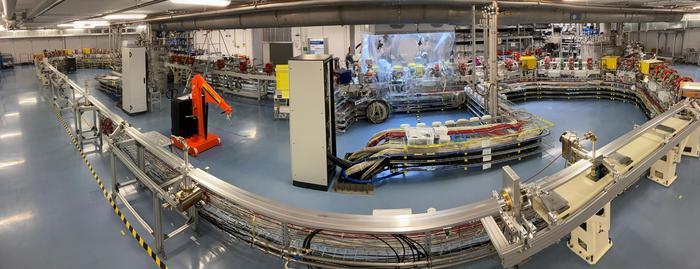
At the forefront of this approach is an advanced type of particle accelerator, the superconducting radiofrequency (SRF) photoinjector.

By producing a continuous high-power beam of electrons, the system can deliver precisely the energy needed to cause radiolysis, or chemical breakdown of PFAS molecules.

Researchers at Helmholtz Zentrum Berlin (HZB) have demonstrated that this technology can effectively fragment PFAS compounds under controlled laboratory conditions.

Electron beams are highly adaptable because their energy and power levels can be adjusted. Different PFAS chemicals respond differently to radiation, allowing scientists to fine-tune the beam to optimize chemical yield and maximize destruction.

This flexibility makes the technology superior to traditional methods, which are more versatile and often less efficient in dealing with complex mixtures of PFAS.

Aiming for practical treatment in the field

One interesting prospect is a compact, container-sized electron beam therapy device.

Such a system could be deployed directly at pollution hotspots, such as the former Berlin Tegel Airport, reducing the need for expensive infrastructure and transporting contaminated water.

Initial analysis suggests that with further development, electron beam technology may be able to achieve operational costs comparable to existing filtration systems, while offering the significant advantage of actual chemical destruction.

By combining accelerator physics and environmental engineering, researchers are turning a tool traditionally associated with basic science into a practical solution to one of today’s most persistent pollutants.

Electron beam water treatment has the potential to revolutionize PFAS remediation, offering a faster, more complete, and environmentally sustainable approach than ever before.

A future powered by electrons

Although commercial applications are still being developed, this research confirms that electron beam technology is more than a theoretical practice.

Its adaptability, efficiency, and scalability make it a promising candidate to permanently address locations where chemicals accumulate, ushering in a new era of pollution remediation.


Source link

#CreativeSolutions #DigitalTransformation. #DisruptiveTechnology #Innovation #Patents #SocialInnovation
Follow on Google News Follow on Flipboard
Share. Facebook Twitter Pinterest LinkedIn Tumblr Email Copy Link
Previous ArticleDiagnostic Dilemma: A woman experienced delusions of communicating with her dead brother after a late-night chatbot session.
Next Article How smart MSSPs leverage AI to increase profits with half their staff
user
  • Website

Related Posts

A simple blood test could change the diagnosis of Alzheimer’s disease

January 27, 2026

Neuromorphic computers promise to reduce energy consumption for AI

January 27, 2026

EU tightens import regulations regarding food safety

January 27, 2026
Add A Comment
Leave A Reply Cancel Reply

Latest Posts

Unmasking new TOAD attacks hidden in legitimate infrastructure

Fortinet patches CVE-2026-24858 after active FortiOS SSO exploit detected

Anduril has invented a novel drone flying contest where work is the prize

Bluesky previews 2026 roadmap: Discover feed, real-time features, and more improvements

Trending Posts

Subscribe to News

Subscribe to our newsletter and never miss our latest news

Please enable JavaScript in your browser to complete this form.
Loading

Welcome to Fyself News, your go-to platform for the latest in tech, startups, inventions, sustainability, and fintech! We are a passionate team of enthusiasts committed to bringing you timely, insightful, and accurate information on the most pressing developments across these industries. Whether you’re an entrepreneur, investor, or just someone curious about the future of technology and innovation, Fyself News has something for you.

Castilla-La Mancha Ignites Innovation: fiveclmsummit Redefines Tech Future

Local Power, Health Innovation: Alcolea de Calatrava Boosts FiveCLM PoC with Community Engagement

The Future of Digital Twins in Healthcare: From Virtual Replicas to Personalized Medical Models

Human Digital Twins: The Next Tech Frontier Set to Transform Healthcare and Beyond

Facebook X (Twitter) Instagram Pinterest YouTube
  • Home
  • About Us
  • Advertise with Us
  • Contact Us
  • DMCA
  • Privacy Policy
  • Terms & Conditions
  • User-Submitted Posts
© 2026 news.fyself. Designed by by fyself.

Type above and press Enter to search. Press Esc to cancel.