

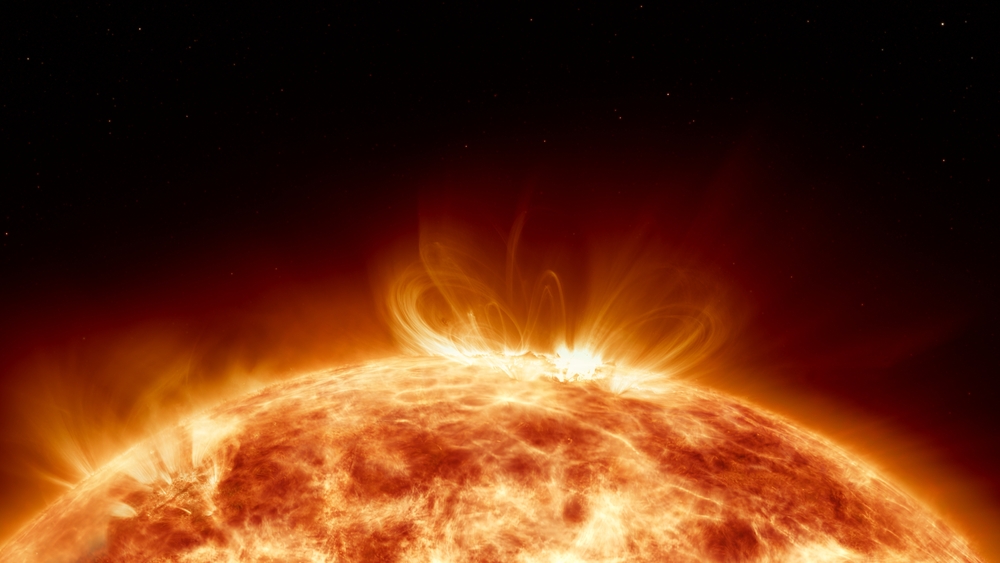
In May 2024, Earth was hit by the largest solar superstorm recorded in over 20 years, which also hit Mars.
What happens when a solar superstorm hits Mars? Fortunately, ESA’s two Mars rovers, Mars Express and ExoMars Trace Gas Orbiter (TGO), were in the right place at the right time, and their onboard radiation monitors detected doses equivalent to 200 “normal” days in just 64 hours.
A new study explains this extraordinary event in more detail, documenting how the storm affected Mars’ atmosphere.
“The effect was significant: Mars’ upper atmosphere was filled with electrons,” said ESA researcher Jacob Parrott, lead author of the study. “This was the largest response to a solar storm we’ve ever seen on Mars.”

Sudden crisis caused by space weather
This superstorm caused a dramatic increase in electrons in two different layers of Mars’ atmosphere at altitudes of about 110 kilometers and 130 kilometers, increasing their numbers by 45% and a whopping 278%.
“The storm also caused computer errors on both orbiting satellites, a typical hazard in space weather because the particles involved are highly energetic and difficult to predict,” Parrott said.
“Fortunately, the spacecraft was designed with this in mind and was built with radiation-resistant components and special systems to detect and correct these errors. They recovered quickly.”
Measuring the effects of solar superstorms using radio occultation
To study the superstorm’s impact on Mars, Jacob and his colleagues used a technique currently under development at ESA known as radio occultation.
First, Mars Express, which was disappearing over the Martian horizon, sent a radio signal to TGO.
Once the TGO disappeared, the radio signal was bent by the different layers of Mars’ atmosphere and then received by the rover, allowing scientists to gather more details about each layer.
Colin Wilson, ESA project scientist for Mars Express and TGO and co-author of the study, explains:
“It’s only in the last five years or so that we’ve started using it on Mars between two spacecraft, like Mars Express and TGO. Typically, those radios are used to beam data between the orbiter and the rover. It’s great to see it in action.”
Understand how different worlds have different weather
The solar superstorm was experienced in very different ways on Earth and Mars, highlighting the differences between the two worlds.
On Earth, the upper atmosphere’s response was more moderate, thanks to the shielding effect of Earth’s magnetic field.
The magnetic field not only moved many solar storm particles away from Earth, but also deflected some toward Earth’s poles, where they lit up the sky with aurora borealis.
Although their differences can make it difficult to directly compare planets, understanding space weather forecasts is very important.
On Earth, solar storms can be dangerous and damaging to astronauts and equipment in space, and further downstream they can disrupt satellites and systems (power, radio, navigation).
Overcoming the difficulties of space weather observation
But studying space weather is difficult because the Sun emits radiation and matter erratically, making targeted measurements largely opportunistic.
“Fortunately, we were able to use this new technology on Mars Express and TGO just 10 minutes after a massive solar flare hit Mars. The timing was very fortunate, as we currently only make observations on Mars twice a week,” Parrott said.
Together, these events sent a flood of fast, high-energy magnetized plasma and X-rays toward Mars. When this large amount of material hits the planet’s upper atmosphere, it collides with neutral atoms, stripping them of their electrons and filling the region with electrons and charged particles.
Wilson concluded: “Our findings deepen our understanding of Mars by revealing how solar storms deposit energy and particles into the Martian atmosphere.
“This is important because we know that Earth has lost both a large amount of water and a large part of its atmosphere to space, likely due to winds of particulate matter that continue to blow from the Sun.”
Source link
