

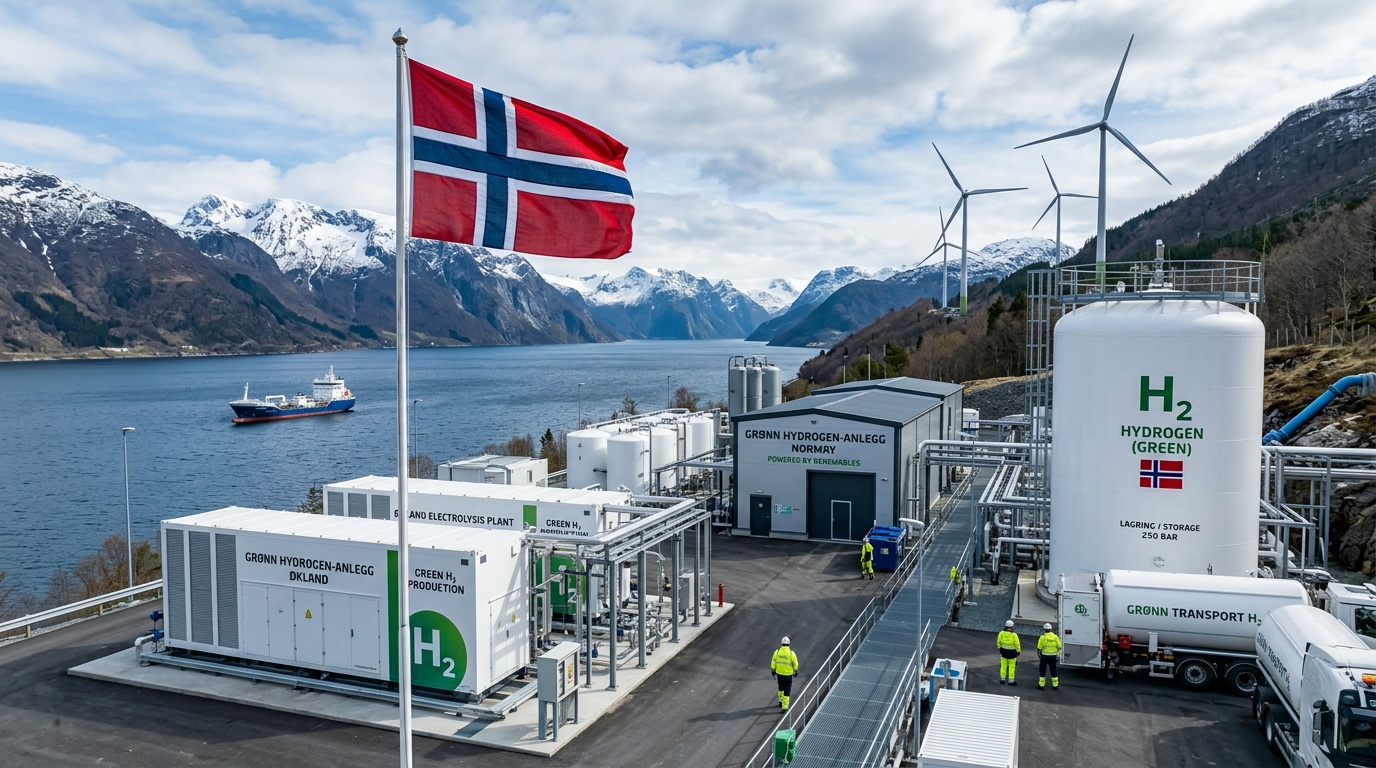
The new project aims to increase Norway’s hydrogen production to 37,081 tonnes per year by 2030.
The project, known as NORHyWAY, positions Norway as a European leader in industrial hydrogen production and supports emissions reductions and green competitiveness.
Andreas Bjelland Eriksen, Norway’s Minister of Climate and Environment, commented: “In many ways, this project is what was missing to unlock the potential that exists in the next phase of our energy transition.
“Hydrogen is going from being something that people debate whether it is good or bad to something that the business world actively uses and relies on, both to tackle climate change and to develop jobs and grow industry.”
SINTEF will act as the project’s R&D partner, ensuring that research and innovation lead to industrial implementation and large-scale deployment.
Overcoming barriers to hydrogen production in Norway
Hydrogen is expected to play an important role in the field of decarbonization, where direct electrification is difficult.
However, several barriers remain, including the mismatch between production and demand, regulatory uncertainty, and high costs.
NORHYWAY aims to overcome these challenges by working with 16 industrial partners to develop four complete local value chains spanning the maritime sector, land transport and the national power system.
In doing so, the project aims to develop Norway’s hydrogen production capacity of 37,081 tonnes per year by 2030. This equates to a reduction in CO2 emissions of up to 345,000 tonnes per year, which is equivalent to the emissions of approximately 8,000 to 10,000 flights between London and Oslo.
The project is Norway’s first large-scale hydrogen valley and is part of Europe’s efforts to establish regional value chains based on green hydrogen as an alternative to fossil fuels.
Bridging the gap between development and implementation
As the project’s R&D partner, SINTEF helps ensure that research and innovation activities are relevant, effective and lead to industrial dissemination.
“We must bridge the infamous ‘valley of death’ between technology development and real-world implementation,” said Kyrre Sundseth, Senior Business Developer at SINTEF and Technology Coordinator at NORHyWAY.
“NORHyWAY aims to develop effective and scalable solutions across the Norwegian hydrogen value chain through collaboration between research, industry and authorities.”
SINTEF has had extensive cooperation with the European hydrogen ecosystem over the years, as evidenced by its extensive EU project portfolio, including H2Glass, H2Accelerate Trucks and REFHYNE.
Hydrogen Valley spread across Europe
The total investment in NORHyWAY is approximately €963.3 million, including €21 million in funding from Horizon Europe.
With this project, SINTEF moves from being a participant in the European Hydrogen Initiative to supporting large-scale industrial implementation within the European Hydrogen Valley program.
The EU aims to have 50 hydrogen valleys in operation or under development by 2030.
Nils Lokke, Vice President Sustainability at SINTEF and Director of FME HYDROGENi, concluded: “The Nordhighway solution will have high international transfer value. We believe that by combining Norwegian efforts with European efforts and accelerating development towards a zero-emission society, this can become a reality.”
Source link
