

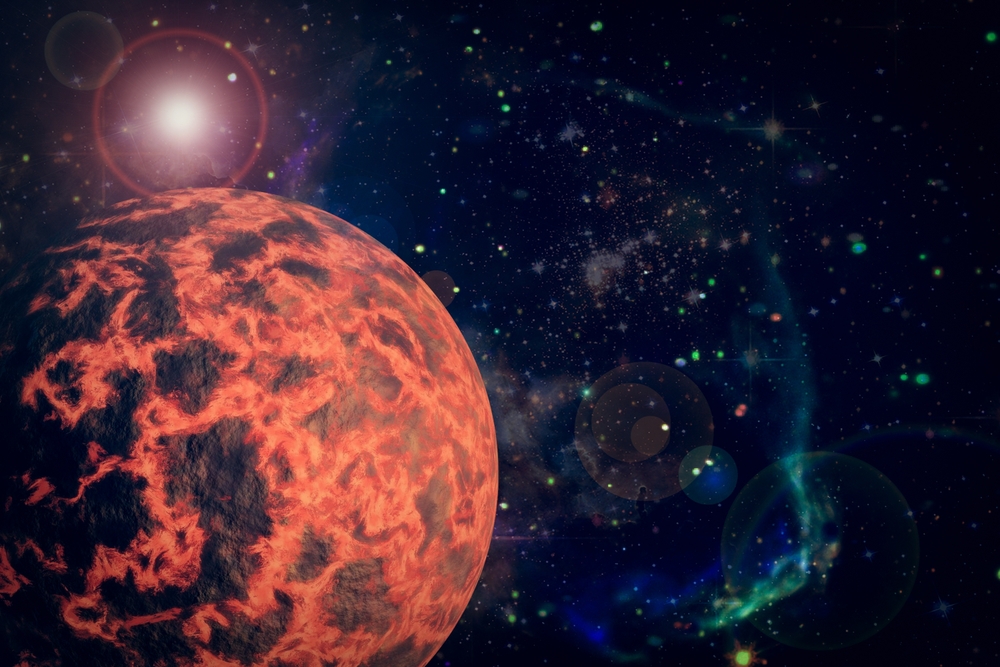
An international team used the James Webb Space Telescope (JWST) to map the climate of rocky exoplanets with Earth-like masses in the TRAPPIST-1 system.
First discovered in 2000, TRAPPIST-1 is a red dwarf star thought to be about 3 billion years older than our solar system. Further discoveries in 2016 and 2017 confirmed at least seven exoplanets orbiting the star, all of which are tidally locked and likely to have circular orbits with periods between 1.5 and 19 days.
At least four planets in TRAPPIST-1’s orbit (TRAPPIST-1d, TRAPPIST-1e TRAPPIST-1f, and TRAPPIST-1g) are thought to be potentially habitable because their orbital distances allow for the presence of liquid water, but there is no evidence that any of the planets in the system have an atmosphere.
The two planets studied, TRAPPIST-1b and TRAPPIST-1c, are thought to have a temperature difference of more than 500 degrees Celsius between day and night, and are likely to have no atmosphere.
“The TRAPPIST-1 system is incredible! Seven planets with Earth-like masses orbit the same star. At least three of the planets are located in the star’s habitable zone, where surface temperatures allow for the presence of liquid water. It is the perfect playground for comparative planetology to unravel the mysteries of this type of planet and test hypotheses about the development of life around these stars,” enthuses Emmeline Bolmont, Associate Professor in the School of Engineering. Astronomer in the Faculty of Science, Director of the UNIGE Center for Space and Life (CVU), and co-author of this study.
As published in Nature Astronomy, an international team from the Universities of Bern (UNIBE) and Universities of Geneva (UNIGE), members of the national research competency center PlanetS, celebrated the 10th anniversary of the discovery of the TRAPPIST-1 system with an observational campaign.
Red dwarfs are common and very active
Red dwarfs, which are colder and smaller than the Sun, make up 75% of the stars in our galaxy. Many planets are exoplanets (planets outside our solar system), but the conditions on these worlds are very different from our own.
Red dwarfs are known to emit high levels of ultraviolet light and high-energy particle fluxes, which can erode the planet’s atmosphere and reduce the chances of life surviving. Exoplanets in a red dwarf’s habitable zone are located very close to the star (for example, TRAPPIST-1’s planetary orbits all fall within the distance between the Sun and Mercury) and are tidally locked. This means that the rotation of the planet’s axis is synchronized with its orbit, and one side of the planet permanently faces the star, creating a permanent day and night system.
“The presence of an atmosphere around these tidally locked planets would allow for the transfer of energy between the dayside and the nightside, resulting in more moderate temperatures across the planet, which would have a significant impact on its potential habitability,” added Bryce Oliver-Demoly, professor and director of UNIBE’s Space and Habitability Center and co-author of the study. “Successful detection of the atmosphere of one of these planets is therefore an important goal for our community and highlights the importance of the TRAPPIST-1 system with JWST,” he explains.
After 60 hours of observation, researchers were able to rule out the existence of an atmosphere on the two rocky exoplanets.
JWST continuously observed the two rocky exoplanets closest to the star in infrared light throughout their orbits. By measuring the luminous flux from TRAPPIST-1 and planets b and c for 60 hours, astronomers were able to calculate the surface temperature and climate of each exoplanet’s dayside and nightside.
TRAPPIST-1b and TRAPPIST-1c exhibit large temperature differences between their two hemispheres, suggesting a lack of energy redistribution between the two sides of each exoplanet, which suggests a lack of an atmosphere. During the day, the surface temperatures of the two planets are over 200 °C and close to 100 °C, respectively, but at night they experience frigid temperatures below -200 °C. If the planet had an atmosphere, it was likely stripped away by the force exerted by the red dwarf.
The telescope is currently focused on TRAPPIST-1e
The lack of dense atmospheres in the two inner planets of the TRAPPIST-1 system supports the hypothesis that intense radiation and high-energy emissions play an important role in the evolution of planets around red dwarfs. However, planets further away in the system may not be affected as severely as future studies plan to investigate. JWST is currently observing planet ‘e’, which resides in the so-called Goldilocks zone, where planetary atmospheric conditions permit the presence of liquid water.
“TRAPPIST-1 serves as a reference system. Our theoretical model shows that the outermost planets in the TRAPPIST-1 system may have an atmosphere, even though the inner two planets do not have an atmosphere. This is similar to Mercury, which is closest to the Sun, while Venus and Earth retain atmospheres. We look forward to continuing our exploration of the TRAPPIST-1 system!” concluded Emmeline Bolmont.
Source link
