

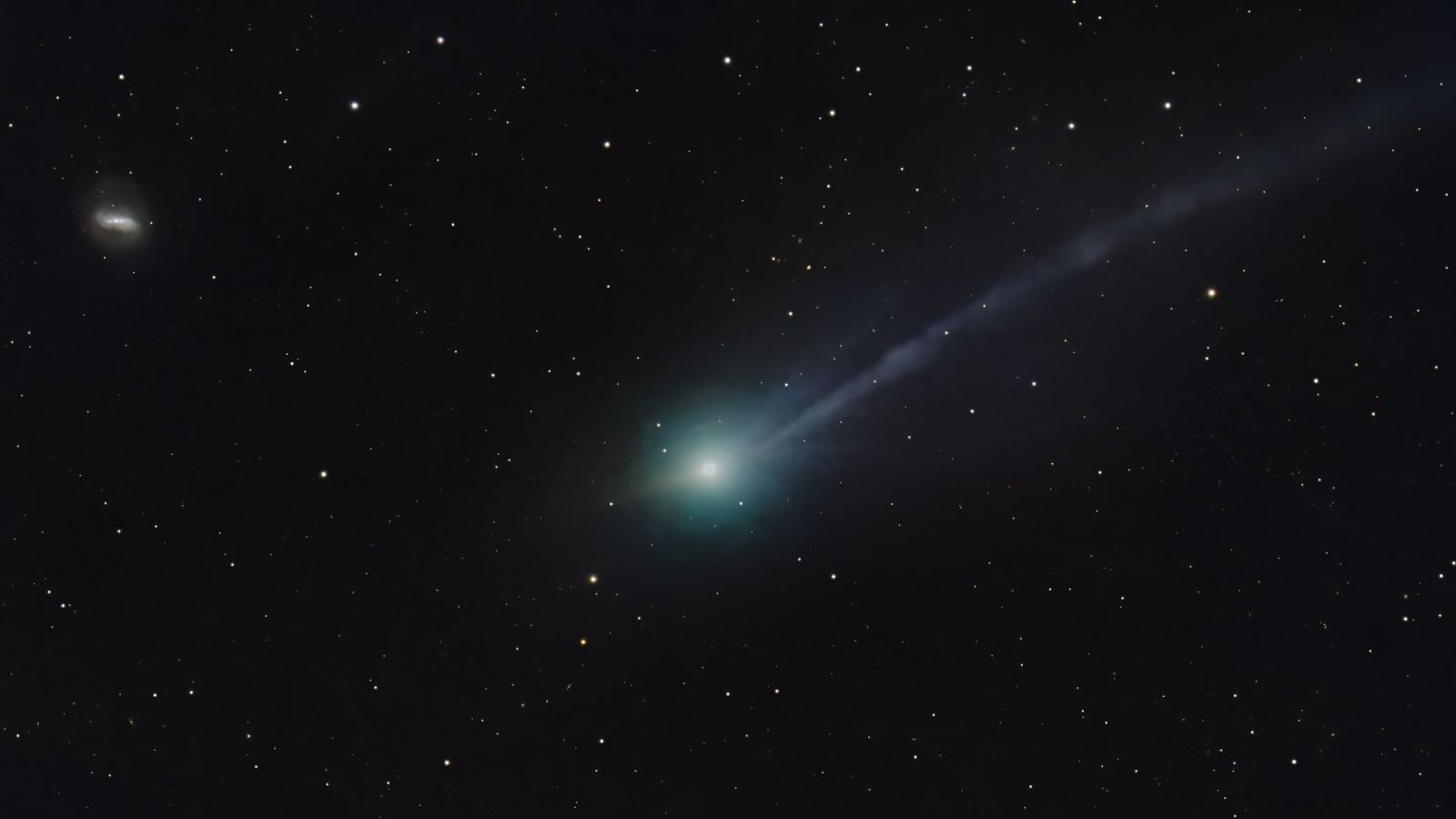
An astrophotographer has captured stunning shots of interstellar visitor 3I/ATLAS light-bombing distant galaxies in the night sky. The remarkable image, which also captures the comet’s tails, is a reminder of the object’s otherworldly nature, but the photographer insists that doesn’t mean it was created by aliens.
Satoru Murata, a New Mexico-based photographer who has worked on multiple astronomical research projects, used a 0.2 meter (0.7 foot) telescope to take the new image just before sunrise on Sunday (November 16). The comet shows the familiar green glow emanating from 3I/ATLAS’s coma, as well as the reappearance of the comet’s long ion tail and a short tail, likely caused by excess dust blown off its surface. In recent weeks, the comet briefly appeared to be missing both tails, but this was an optical illusion due to its position relative to Earth.
you may like
At the top left of the image is NGC 4691, a barred spiral galaxy located about 70 million light-years from Earth. Seeing the interstellar comet alongside NGC 4691 “really gave the impression that this object came from another world,” Murata wrote in a recent Facebook post. (However, this comet originated from a star system within the Milky Way, not from another galaxy.)
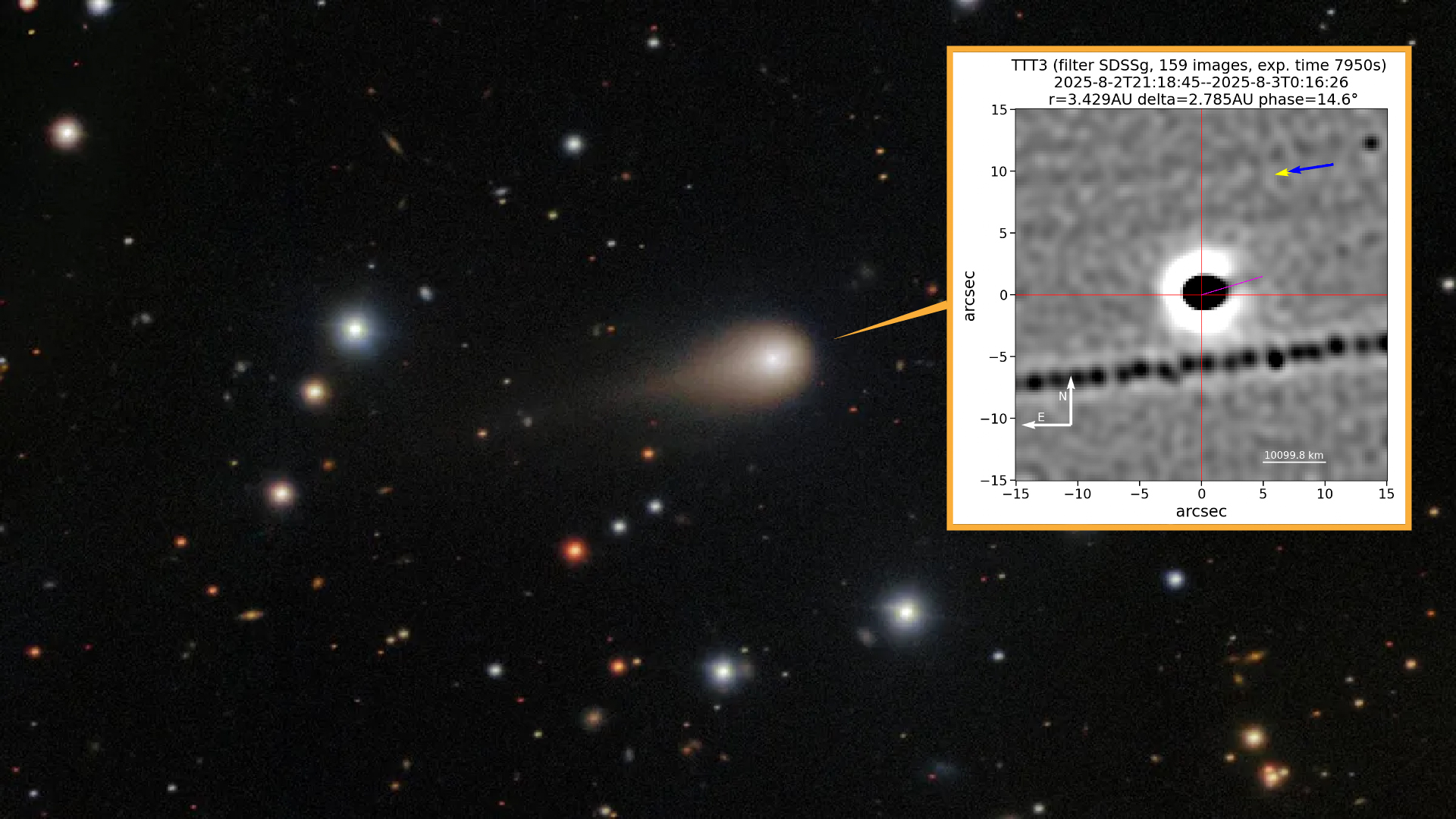
While this new photo gave us an impressive glimpse of 3I/ATLAS, astronomers are eagerly awaiting a new high-resolution NASA photo of the comet that will be released on Wednesday (November 19). The images were taken by NASA’s Mars Reconnaissance Orbiter as the comet approached Mars on October 3, but remain unreleased due to the recent government shutdown.
On Friday (November 14), the European Space Agency revealed that its Mars photos helped researchers narrow down 3I/ATLAS’ predicted trajectory through the solar system.
interstellar visitor
3I/ATLAS is the third interstellar object ever discovered, first discovered in early July and hurtling toward the Sun at more than 130,000 miles (210,000 km) per hour. It likely originated from a “remote” region of the Milky Way galaxy, and its age could be up to 7 billion years, making it considerably older than our solar system.
The comet recently reemerged from the far side of the Sun relative to Earth, and reached its closest point to our home star on October 29th. Its journey around the Sun was eventful, and 3I/ATLAS experienced unexpected brightening events and temporary color changes. The comet has also shown several other unusual features in recent months, including a high degree of irradiation on its surface and an excess of certain chemicals.
These unusual features have led some researchers to controversially suggest that 3I/ATLAS may be an alien spacecraft in disguise. However, most of the astronomical community agrees that this object is almost certainly a comet. (Similar claims have been made about ‘Oumuamua, the first interstellar object discovered in 2017, which is most likely an asteroid.)
Mr. Murata is also convinced that 3I/ATLAS has the status of a comet.
“No, this is not an alien mothership. The chances of it being some kind of object created by an extraterrestrial civilization are close to zero,” he wrote about the new photo in an Instagram post. “As people have said, if it looks like a duck and acts like a duck, it’s a duck.”
3I/ATLAS will make its closest approach to Earth on December 19th, reaching a minimum distance of 168 million miles (270 million km) from Earth.
Source link
