

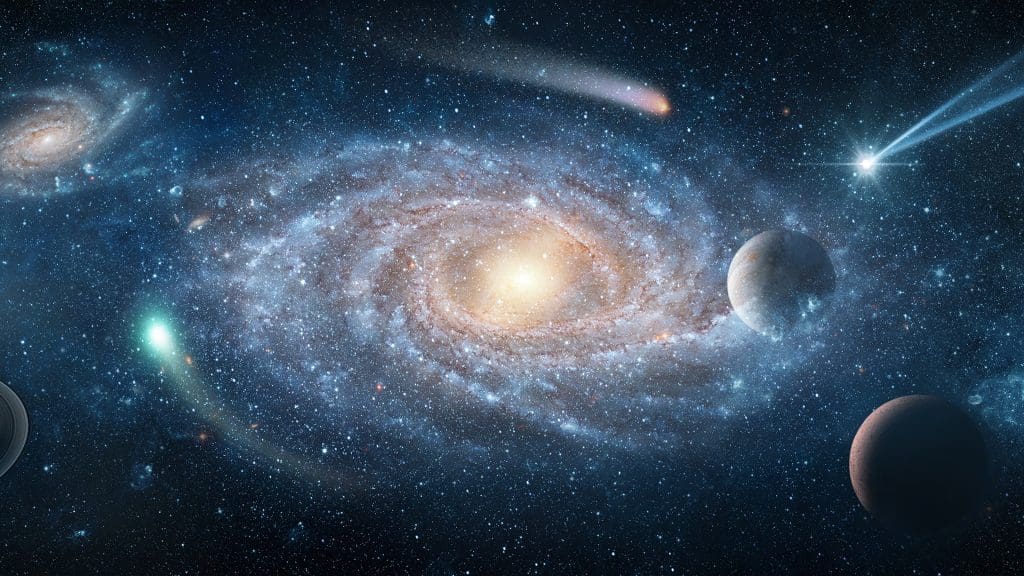
European Space Agency (ESA) project scientist Johannes Sahlmann spoke to editor Maddy Hall about the Gaia Space Telescope and the discovery of the Galactic Wave.
Gaia, a scientific mission carried out by the European Space Agency, aims to improve our understanding of how our galaxy, the Milky Way, functions and evolves. To accomplish this, Gaia will map approximately 2 billion stars and other celestial objects. Although these represent only about 1% of the Milky Way’s total stellar content, they create an extensive collection of data from which information about the galaxy as a whole can be extrapolated.
Although we can’t send spacecraft beyond our galaxy, Gaia’s extraordinary ability to capture three-dimensional data gives scientists the tools to create detailed maps of our galaxy’s structure and dynamics.
Through this research, Gaia discovered large waves that ripple out from the center of the galaxy and extend tens of thousands of light years from the solar system. To discuss this discovery in more detail and understand the Gaia space telescope’s important role in understanding galaxies, editor Maddy Hall spoke with Johannes Sahlmann, project scientist at the European Space Agency.
Can you explain the meaning of the great wave discovered by Gaia? What can the existence of this great wave tell us?
Observing the positions, distances, movements, and other properties of these stars provides insight into the structure and dynamics of the Milky Way. It was through these measurements, announced in the 2022 data release, that the Great Wave was discovered.
Although the existence of such waves was expected, Gaia’s ability to conduct both qualitative and quantitative studies, allowing precise measurements and characterization of stellar motions, facilitated such discoveries. The confirmed wave is currently the largest known in our galaxy, covering a vast area of the Milky Way.
This discovery is part of Gaia’s core goals and will help us achieve the fundamental goal of understanding how the galaxy functions and evolves. Gaia’s multidimensional measurements of stellar motions open new avenues for understanding the relationships between these motions and other large-scale structures within the Milky Way.
The Milky Way galaxy has structures such as a galactic bar, a central stratum, and spiral arms. All these components interact with each other, but none are independent as they all have mass and gravitational effects. Gaia introduced many complexities that must be considered in theoretical models. The quality of the data is so high that scientists cannot study these effects in isolation. They need to be understood and modeled together.
Simulating galaxies requires a combination of computer simulations and observational data, using knowledge of the properties and interactions of stars within the Milky Way and with neighboring galaxies to inform simulated models and shed light on wave formation.
This wave may be due to collisions with dwarf galaxies. Can you tell us more about how such interactions create such ripples and how we can further investigate this? Are there other potential causes that we are investigating?
Although the Gaia mission is ongoing and has only released a small portion of the data collected by the satellite, it has already yielded important new insights about our galaxy, suggesting that the Milky Way is far more dynamic and complex than previously thought.
One important discovery is the correlation between the passage of another galaxy and an increase in the rate of star formation within our galaxy. There are interactions between the Milky Way and other dwarf galaxies, resulting in similar correlations. Although correlation does not imply causation, it is reasonable to think that these interactions influence star formation. The improved quality of data now available makes it possible to investigate these questions that were difficult to address before missions like Gaia.
Essentially, these gravitational interactions produce the various effects that can be observed in the Milky Way. Large-scale perturbations can wobble or distort the galactic disk, changing the distribution of stars. An analogy often used to explain this to the general public is that of a pond. If you throw a stone (representing a small galaxy) into water (representing the Milky Way), it will cause ripples on the surface, similar to perturbations in the Milky Way.
However, the physics involved are quite complex. It’s not just a solid rock falling into water. This dynamic is caused by gravitational interactions between various celestial bodies. In addition to galactic collisions, other factors also influence these perturbations. For example, dark matter, which also exists in our galaxy.
The concept that young stars retain a memory of wave information is attractive. How does this work and why is it useful for us?
Stars can live for billions of years, and if you think about our galaxy, it doesn’t stand still. It rotates. For example, the Sun takes about 200 million years to orbit the center of our galaxy, which is only a fraction of the lifespan of a typical star.

As a result, old stars made many rotations around the galactic center and experienced interactions with the spiral arms of the galaxy, for example. Over time, they lose information about their place of birth and the early circumstances of their formation.
In contrast, young stars that are only a few million years old remain close to where they formed. Therefore, they hold more information about the conditions of their formation, such as the movement of the gas and dust from which they originate.
Using information from both young and old stars provides complementary insights that improve our understanding of what’s happening in galaxies. In this case, young stars are especially useful because they retain information. Additionally, young stars are often bright, making it easier to observe them with high precision. This is an interesting example of how when tackling a scientific problem, you need to choose which spacecraft will most efficiently provide the answer. In this case, it was a young star.
Can you tell us more about Gaia and the technology that discovered and understood waves? What are the challenges of observing and mapping galaxies?
Gaia, launched in 2013, was designed to investigate the origin and evolution of the Milky Way galaxy. Equipped with a sunshade with a diameter of 10m and optical components with a diameter of approximately 3m. The satellite rotates continuously, making one revolution every six hours. Three instruments on board will measure the position, brightness, color, and chemical composition of billions of stars and other celestial objects.
Gaia boasts the largest focal plane ever flown in space, with nearly 1 billion pixels across 106 charge-coupled devices (CCDs). To cope with the satellite’s rotational motion, new reading modes in the electronics were developed, allowing Gaia to collect more than 3 trillion individual observations. Processing this huge dataset presents many challenges. The consortium responsible for data processing and analysis is made up of around 450 engineers, scientists and experts from across Europe. This team converts satellite data into catalogs for publication. All catalog data is freely available and hosted at the European Space Astronomy Center near Madrid, where the ESA Space Science Archive is managed.
The next data release, scheduled for the end of 2026, will include approximately 5.5 years of Gaia data and 500 terabytes, and the final release will cover 10.5 years of data and approximately 1 petabyte and will occur by the end of 2030. There have been several interim data releases so far, but the next release will be the first major data compilation from Gaia’s nominal mission.
What do you hope to learn from future data releases from Gaia? What specific questions do you think future research on large waves should answer?
More data requires the use of more sophisticated models, and as data increases and improves, more complex modeling approaches can be adopted.
One important aspect of future research is the motion of stars. These movements are derived from measurements at individual locations, and the next data release will include measurements over a longer time range, providing more accurate results. This next stage of research is expected to not only confirm the existence of the waves, but also allow for more detailed investigations, such as investigating secondary signatures within the waves.
As we gain a clearer understanding of these features, modeling techniques will also advance. This could potentially help determine the origin of this important wave, disentangling different influences such as different perturbations, or pinpointing the specific events that contributed to the wave’s existence.
Looking to the future, what potential missions and projects do you think could be built on the findings of the Great Wave? Could there be a Great Wave in other galaxies?
One of the key aspects of Gaia’s mission is to observe the visible part of the light spectrum that is affected by interstellar annihilation. Basically, gas and dust between us and distant stars obstructs our view, making certain parts of the galaxy inaccessible. A mission concept called Voyage 2050, outlined in ESA’s long-term science program, aims to address this problem by making observations in the infrared part of the optical spectrum, which can provide insight into the inner regions of galaxies.
Billow waves have been observed in other galaxies, but they are not as detailed as in the Milky Way. The advantage of studying our galaxy is that our position within it allows for more complex analyses. There are synergies between ESA’s science missions, particularly Gaia, and the Euclid mission, which focuses primarily on cosmology, such as investigating large-scale structure, dark energy, and dark matter. Euclid maps billions of galaxies, including relatively nearby galaxies. The combination of these two missions is likely to yield important scientific insights and improve our understanding of our galaxy within the broader context of the universe.
Approximately 450 dedicated individuals are working diligently to transform the vast amount of Gaia data into products that scientists can use, and their efforts are being communicated to the public. This European project involves collaboration across many countries and institutions and highlights decades of teamwork and commitment.
The Gaia satellite was deactivated in March 2025 because it ran out of gas needed to control its position, but Gaia’s mission is far from over. It will still take five years for the data collected to be processed and published. Gaia’s mission will only end when the final release of this data is completed, which is expected by the end of 2030.
This article will be published in an upcoming issue of Special Focus Publication.
Source link
