

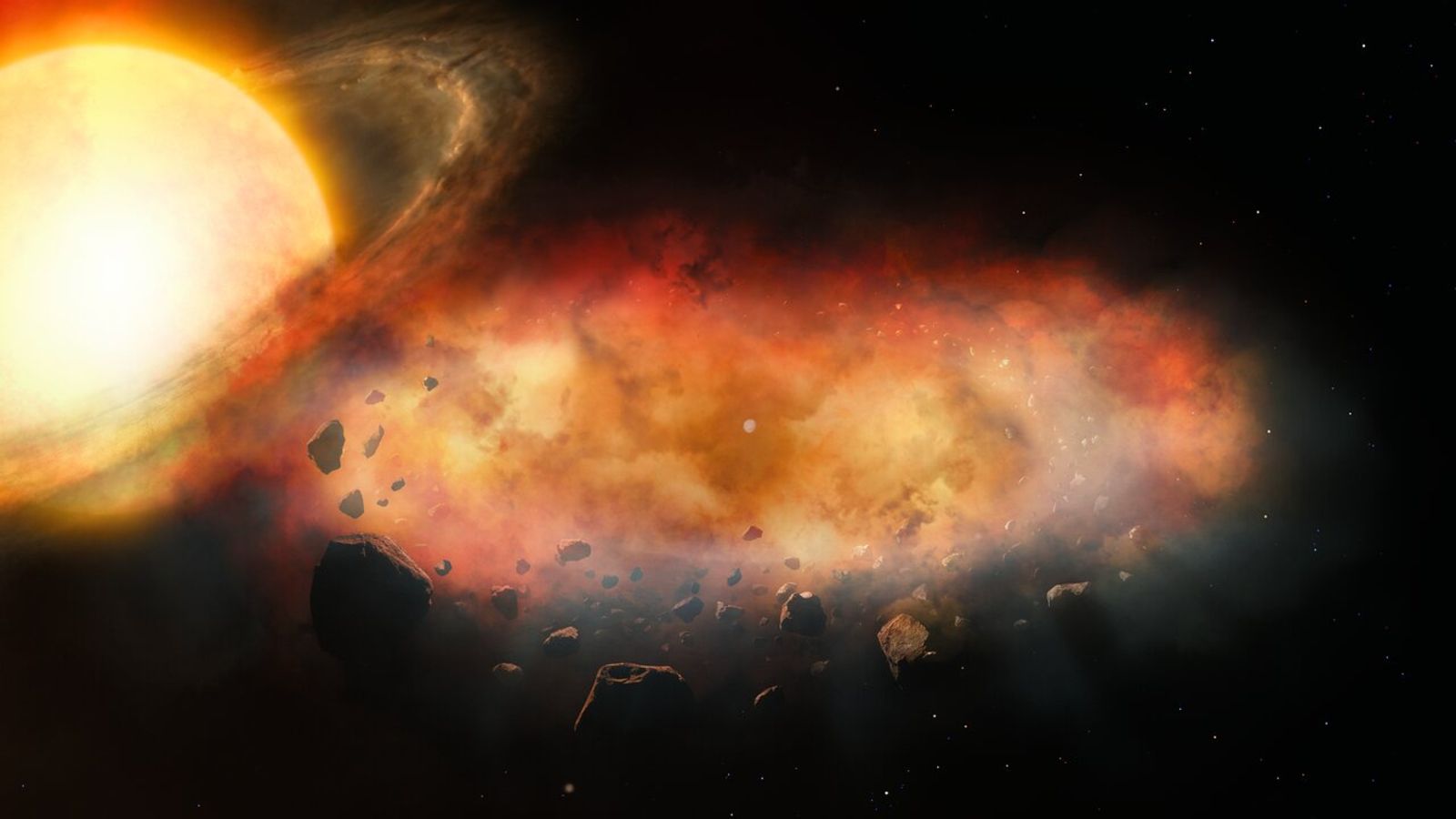
A huge cloud of vaporized metal could be hiding a secret planet or a second alien sun in a nearby star system, new research has revealed.
This mysterious cloud is up to 15,000 times wider than our planet, and during the nearly nine months this ghostly object oozed between it and Earth, its host star almost completely disappeared from telescope observations.
Astronomers first noticed the existence of this mysterious cloud in September 2024, when they detected a surprising dimming phenomenon around the Sun-like main-sequence star J0705+0612 (also known as ASASSN-24fw), about 3,000 light-years from Earth. The star’s brightness suddenly dropped by a factor of 40, to about 3% of its original brightness, and remained so for about eight and a half months before returning to its maximum brightness in May 2025.
you may like
In a study published January 21 in The Astronomical Journal, Zakamska and her team used data captured by Chile’s Gemini South telescope and Magellan telescope to analyze this strange event and found that a massive object either passed in front of J0705+0612 or was obscured. After ruling out things like giant planets or asteroid belts that were too small or too diffuse to block out much light for long, the researchers concluded that the occulting object was a thick cloud of molecular gas.
The unnamed cloud is approximately 125 million miles (200 million kilometers) in diameter and located approximately 13.3 astronomical units (or approximately 13.3 times the distance between Earth and the Sun) from J0705+0612. For context, if it were located in our solar system, it would be approximately halfway between Saturn and Uranus. At this distance, it takes the cloud about 44 years to complete a complete orbit around its host star.
Gemini South’s newly commissioned Gemini High-Resolution Optical Spectrometer (GHOST) instrument, which captures light at specific wavelengths emitted by various molecules, played a key role in this research. This telescope was able to peer deeper into clouds than other telescopes, allowing researchers to see exactly what the clouds were made of.
Zakamska said the results “exceeded all expectations” and revealed a high content of metals such as iron and calcium. GHOST data also allowed the team to track subtle movements within the cloud. This is “something we have never been able to do before with a system like this,” she added.
Observing the movement of the cloud, it quickly became clear that the mass of metal was supported by a heavy object at its center. Based on the size of the cloud, this could be either a gas giant several times larger than Jupiter, a low-mass star in a binary pair with J0705+0612, or a brown dwarf (a type of planet-star hybrid that is more massive than Jupiter but not heavy enough to sustain nuclear fusion at its center).
If a cloud surrounds a star, the cloud is classified as a secondary disk because its host star is the second or smaller star in the binary pair. However, if they are joined by a planet, it is called a circumplanetary disk. Researchers suggest that the cloud is likely bound by a star, due to the high levels of infrared radiation emitted by the cloud. However, it is too early to tell for sure.
you may like
The next mystery is how clouds formed. Researchers predict that the cloud is about 2 billion years old, suggesting it is younger than J0705+0612 and probably closer in age to the Sun (about 4.6 billion years old). This means that it is not a leftover from the creation of the star system, like most other similar disks.
Instead, researchers predict that it was created by a planetary collision, similar to how the moon was created. The researchers argue that this could explain not only the cloud’s age, but also its surprisingly high metal content.
“This event shows that even in mature planetary systems, dramatic large-scale collisions are still possible,” Zakamska said. “This is a vivid reminder that the universe is not static, but an ongoing story of creation, destruction, and transformation.”
Researchers will learn more about this mysterious cloud when it next passes between J0705+0612 and Earth in 2068.
Source link
