

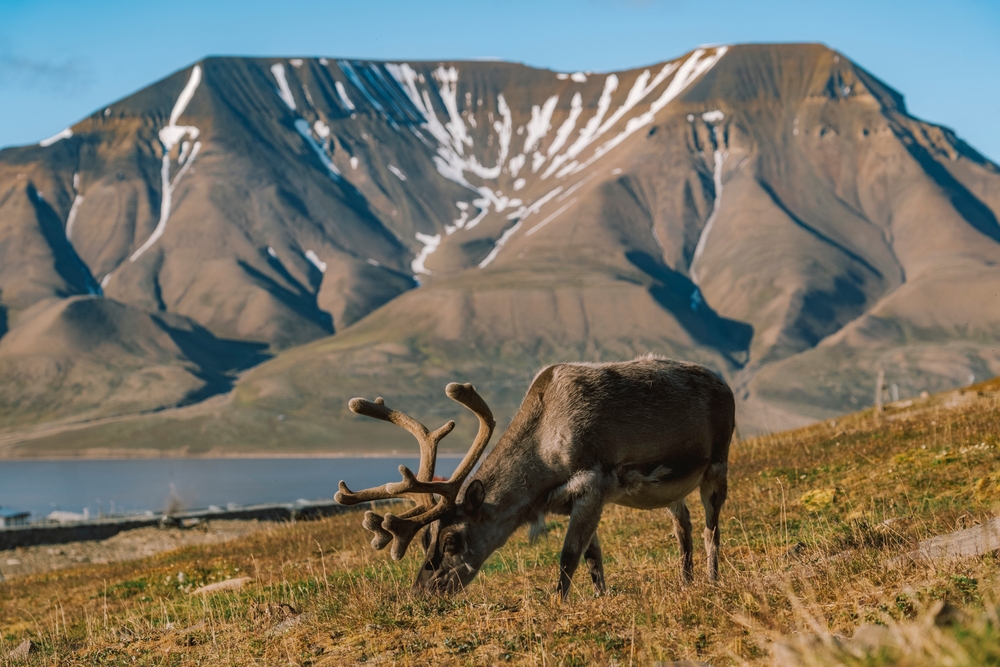
Although toxic metals in reindeer populations have declined over the past decade, levels of permanent chemicals have increased dramatically, raising concerns for species that consume reindeer, including polar bears and humans.
The Svalbard reindeer is a subspecies of reindeer (or caribou) found only on this island and has been around for at least 5,000 years. Roughly one-third the size of typical reindeer species, they were threatened with extinction in the early 20th century, but their population has rebounded to around 22,000 individuals.
The Arctic is known to produce heavy metals and other pollutants, especially for species at the top of the food chain, such as polar bears.
But Svalbard’s reindeer are the only major herbivores in the European Arctic, eating tundra plants and feeding themselves to local predators, as well as being hunted for their meat by humans, and questions remain about how much organic pollutants their meat and fur contain.
Marin Anderson Stavridis spent four years studying reindeer on Svalbard.
Stavridis, a PhD student at the Norwegian University of Science and Technology NTNU, was interested in the health status of Svalbard reindeer, especially given their important role in the ecosystem.
Mr. Stavridis took part in an international interdisciplinary research project partially funded by the Norwegian Research Council and the Svalbard Environmental Protection Fund and approved by the Governor of Svalbard. The project resulted in the culling of 68 female reindeer over three years.
Reindeer research has typically been limited to non-invasive sample collection using fur and feces. However, Stavridis’ involvement in the project enabled researchers to collect more extensive samples of the reindeer’s brains, kidneys, livers, feces and thighs in October 2021.
Stavridis also took samples in August 2022 and October 2023. In October, reindeer reach their peak weight in preparation for winter. Samples showed that levels of mercury, cadmium and PFAS were higher in October, coinciding with reindeer increasing their diet to bulk up for winter.
Heavy metals and PFAS in the Arctic
Mercury accumulates in large quantities in the Arctic environment, and it arrives through several different routes. Emitted by burning fossil fuels. Airborne infections caused by forest fires and volcanic eruptions. It then concentrates on the fish and mammals that have ingested it.
As Stavridis warned, mercury in the air can also be absorbed by plants and become part of permafrost.
“Permafrost is just old vegetation that has slowly accumulated over a long period of time, which is why arctic soils have so much mercury,” she says.
As global warming continues, permafrost is beginning to melt at an alarming rate.
“In that context, I just wanted to foreground how we can determine whether mercury concentrations are becoming bioavailable,” she said. “If we don’t know the current mercury levels, how can we know what’s happening to the mercury in the Arctic?”
Stavridis found that levels of cadmium and lead in reindeer had decreased compared to levels reported in the 1980s, indicating that overall heavy metals were stabilizing rather than increasing. This was similar to other reindeer populations surveyed across the Arctic.
But PFAS levels were rising so rapidly that “we thought we might have made a mistake.”
Over the past decade, PFAS levels have increased by more than 900%, from about 0.6 nanograms per gram to 5.48 nanograms per gram.
Chemical indicators suggest that the previous spike in forever chemicals was due to fire drills in nearby Longyearbyen. However, chemical fingerprints suggested that the recent rise in PFAS was from another, unidentified source.
“We are now seeing profiles dominated by another type of PFAS, and their concentrations are very high, possibly the highest concentrations ever measured in reindeer,” she said.
“I only have samples taken from reindeer. I can tell you there is something that is affecting their exposure. It could be as simple as their diet being different.” But she went on to say, “Even if their diet was different, the levels shouldn’t be that different after 10 years.”
Contaminants in Svalbard reindeer are currently below toxicity thresholds
Sample handling limitations limited genetic testing, but Stavridis was able to screen for 20 different genes, primarily related to fat metabolism. Arctic animals need to gain large amounts of body fat in a short period of time in preparation for the peak of the bleak winter, so some genes allow for faster fat production.
Stavridis observed that downregulated genes (producing less fatty substances) had increased concentrations of pollutants, consistent with studies on polar bears and killer whales.
In Svalbard, hunters are allowed to take one animal per hunter per season. Stavridis’ research shows that the overall risk of exposure is low because levels of individual contaminants are below current wildlife toxicity thresholds, but “if you want to eat Svalbard reindeer, you can only consume 11.5 grams of liver per week per year to avoid exceeding the PFAS threshold,” Stavridis said.
Svalbard’s reindeer are “remote,” she says. “So this is one route of exposure from something that is supposed to be completely safe, and yet here we are.”
The entire study was published in the journal Environment Science and Technology.
Source link
