
Close Menu
  • Home
  • Identity
  • Inventions
  • Future
  • Science
  • Startups
  • Spanish
What's Hot

CERN detects new particle at Large Hadron Collider

AI is everywhere, but CISOs are still protecting it with yesterday’s skills and tools, study finds

The physical issues behind PFAS removal

Facebook X (Twitter) Instagram
  • Home
  • About Us
  • Advertise with Us
  • Contact Us
  • DMCA
  • Privacy Policy
  • Terms & Conditions
  • User-Submitted Posts
Facebook X (Twitter) Instagram
Fyself News
  • Home
  • Identity
  • Inventions
  • Future
  • Science
  • Startups
  • Spanish
Fyself News
Home » Hubble and Euclid capture the final acts of a dying star – and it’s amazing: This week’s space photo
Science

Hubble and Euclid capture the final acts of a dying star – and it’s amazing: This week’s space photo

By March 15, 2026No Comments3 Mins Read
Share Facebook Twitter Pinterest Telegram LinkedIn Tumblr Email Copy Link
Follow Us
Google News Flipboard
Share
Facebook Twitter LinkedIn Pinterest Email Copy Link

overview

What is it: Cat’s Eye Nebula (NGC 6543).

Location: Located 4,300 light-years from Earth in the constellation Draco.

Share date: March 3, 2026.

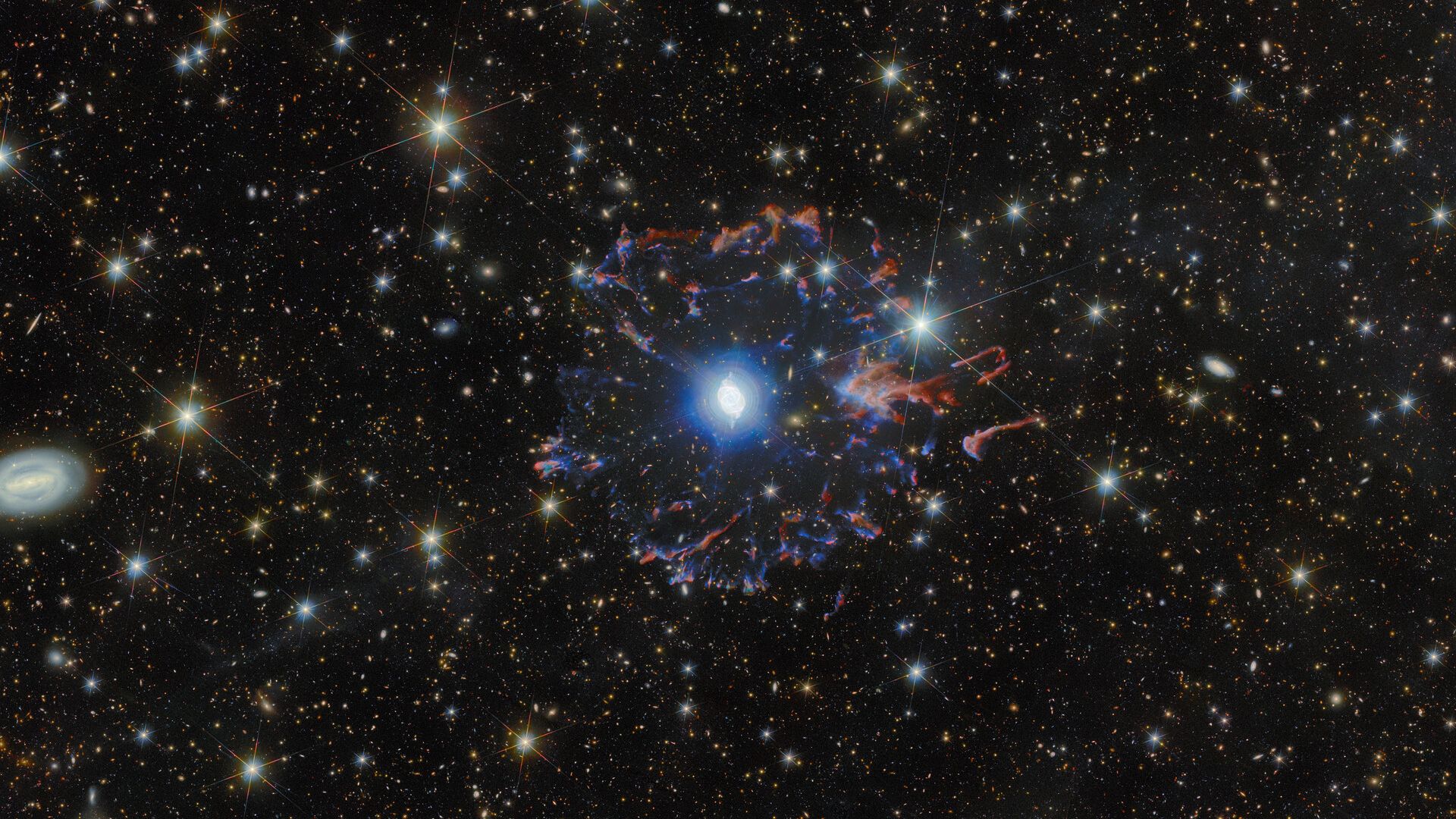
These amazing snapshots of the universe show distorted, glowing rings of blue, orange and red gas moving away from a dying star. Against a backdrop of a sea of ​​galaxies and stars, this image shows the famous Cat’s Eye Nebula, also known as NGC 6543.

It looks serene and beautiful, but don’t be fooled. This scenic nebula was formed by the messy interaction between the star’s violent winds, outer layers, and powerful jets, which formed its intricate eye-like structure.

Located approximately 4,300 light-years from Earth, Cat’s Eye is a planetary nebula, an expanding cloud of glowing gas ejected by low- to intermediate-mass stars that have reached the final stages of their lives. Unlike more massive stars that die in violent supernova explosions, the central star slowly ejected its outer layers into space, creating a beautifully complex shell of discarded material.

Article continues below

you may like

These stunning images were created using observations from the Hubble Space Telescope and the European Space Agency’s (ESA) Euclid Space Telescope.

Two images of planetary nebulae in space. The image on the left is labeled

The Cat’s Eye Nebula as seen from both the Hubble and Euclid telescopes. (Image credits: ESA/Hubble & NASA, ESA Euclid/Euclid Consortium/NASA/Q1-2025, J.-C. Cuillandre & E. Bertin (CEA Paris-Saclay), Z. Tsvetanov)

Wide-field views of Euclid in visible and near-infrared light show faint arcs and delicate filaments of gas surrounding a bright central region. These faint structures appear to fly away from the scene into space, and are thought to have been ejected during the early stages of a star’s death, before the outer layers forming the main nebula were shed.

Hubble captured details in the nebula’s bright central region. This close-up view was taken using visible light and shows a dead but bright star surrounded by white bubbles and loops of blue gas. Hubble used advanced survey cameras to reveal even finer and more intricate details in the nebula’s core, including intricate bubbles and delicate filamentary structures embedded within the bubbles.

These details serve as a “fossil record” of the nebula, ESA said in a statement. Each bubble corresponds to an episode of mass loss in the dying star. In the image, these bubbles are followed by concentric circles or rings within a brown halo. Each ring marks the boundary of a bubble. Additionally, the data reveals jets of high-energy, high-velocity gas ejecting from the top and bottom of the nebula, shown in pink. There are also dense knots formed by the impact interaction of high-velocity jets and slowly expanding ejected material.

Get the world’s most fascinating discoveries delivered straight to your inbox.

Hubble captures unprecedented detail of the dying star’s bright nest and its surroundings, while Euclid reveals faint arcs and colorful gas filaments just a short distance from the nebula, and a wide cosmic landscape dotted with distant galaxies. Together they present an almost cinematic perspective of a dying star’s final acts.


Source link

#Biotechnology #ClimateScience #Health #Science #ScientificAdvances #ScientificResearch
Follow on Google News Follow on Flipboard
Share. Facebook Twitter Pinterest LinkedIn Tumblr Email Copy Link
Previous ArticleWill the day come when the script of the Indus Valley will be deciphered?
Next Article Physics first, Chinese scientists create a rare “hexagonal diamond” that is harder than natural diamonds

Related Posts

Live Science Today: Scaling down “hexagonal” diamonds and fish

March 16, 2026

Measles resurgence in the US is a frightening sign of what’s to come

March 15, 2026

The government takes UFOs very seriously. So why are researchers being held back?

March 15, 2026
Add A Comment
Leave A Reply Cancel Reply

Latest Posts

CERN detects new particle at Large Hadron Collider

AI is everywhere, but CISOs are still protecting it with yesterday’s skills and tools, study finds

The physical issues behind PFAS removal

Konni introduced EndRAT through spear phishing and used KakaoTalk to spread malware

Trending Posts

Subscribe to News

Subscribe to our newsletter and never miss our latest news

Please enable JavaScript in your browser to complete this form.
Loading

Welcome to Fyself News, your go-to platform for the latest in tech, startups, inventions, sustainability, and fintech! We are a passionate team of enthusiasts committed to bringing you timely, insightful, and accurate information on the most pressing developments across these industries. Whether you’re an entrepreneur, investor, or just someone curious about the future of technology and innovation, Fyself News has something for you.

Castilla-La Mancha Ignites Innovation: fiveclmsummit Redefines Tech Future

Local Power, Health Innovation: Alcolea de Calatrava Boosts FiveCLM PoC with Community Engagement

The Future of Digital Twins in Healthcare: From Virtual Replicas to Personalized Medical Models

Human Digital Twins: The Next Tech Frontier Set to Transform Healthcare and Beyond

Facebook X (Twitter) Instagram Pinterest YouTube
  • Home
  • About Us
  • Advertise with Us
  • Contact Us
  • DMCA
  • Privacy Policy
  • Terms & Conditions
  • User-Submitted Posts
© 2026 news.fyself. Designed by by fyself.

Type above and press Enter to search. Press Esc to cancel.