

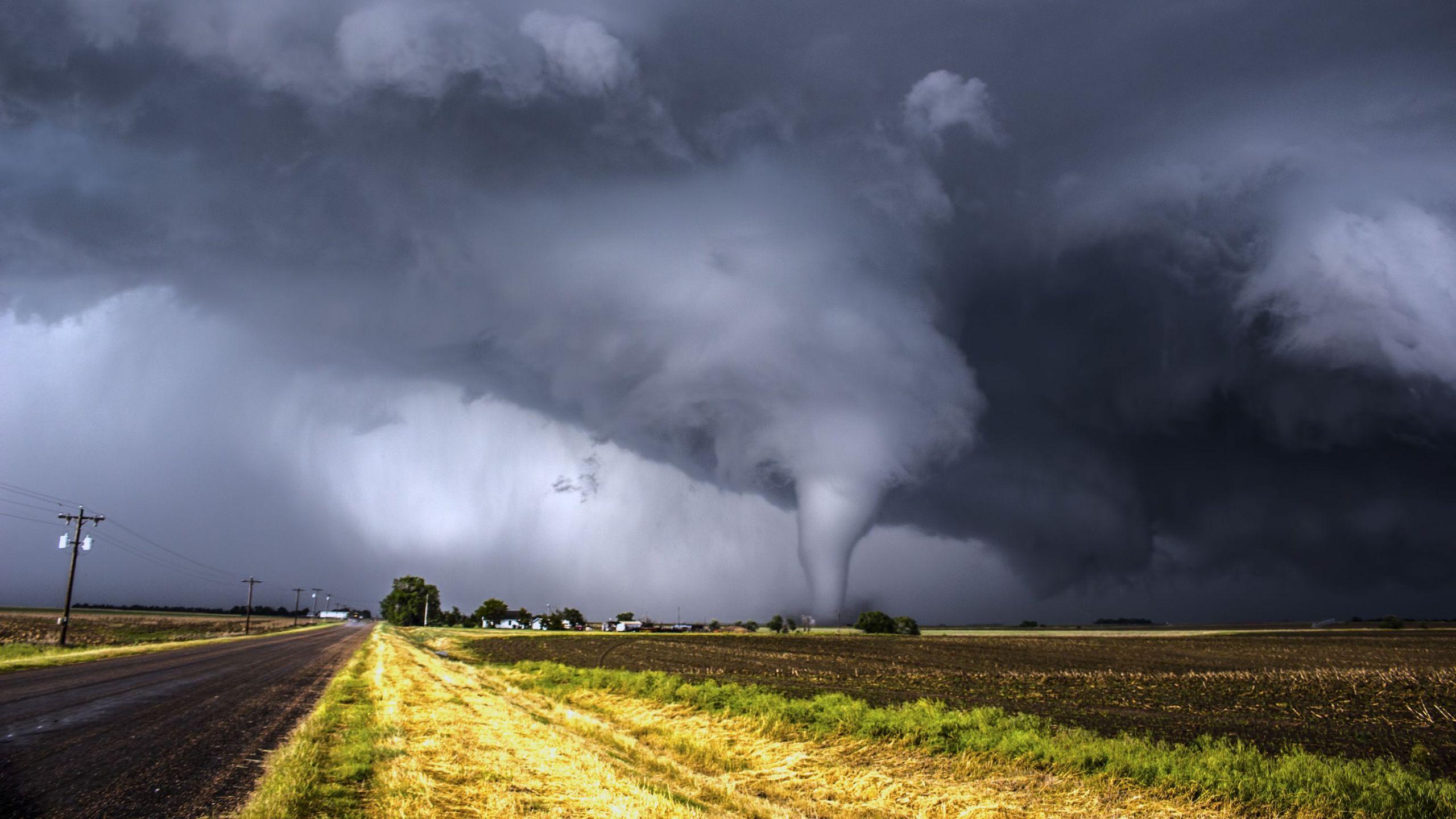
Tornadoes produce some of the highest wind speeds in the world and can cause monumental destruction. In 2008, atmospheric scientist Perry Samson was investigating a supercell storm in Oberlin, Kansas when he got a closer look at the devastating weather event than he expected and got caught in a tornado.
Samson, professor emeritus of atmospheric science at the University of Michigan, was on an educational trip helping students learn how to make measurements and observations. He established a foundation to allow students to go out there and study these thunderstorms, giving them the opportunity to learn how to conduct large-scale field investigations.
you may like
A supercell is a thunderstorm with a continuously rotating updraft. If the updraft is fed by warm, moist air at the ground level, it can transform into a tornado, but this is relatively rare. According to the National Oceanic and Atmospheric Administration’s National Severe Storms Laboratory, about 20% of supercell storms end up as tornadoes.
Hannah Osborn: How fast did the tornado occur and when did you realize you were in danger?
PERRY SAMSON: It turns out that there was movement within these clouds that could produce tornadoes. We quickly realized that it formed to the south of us and that the winds in the upper atmosphere were from south to north, so this object would be moving toward us. Despite all the training and preparation we have done, it can be a little surprising to realize that a tornado is approaching.
My biggest concern was obviously to keep my students safe. We decided to drive east to get out of the way. And although my students moved out of the way, I wasn’t as fast as them.
HO: What were you thinking at this point?
What to read next
PS: I was so caught up in the debris that I couldn’t see in front of the car. There was a lot of debris flying and I now found myself near the center of the tornado. I knew the flow of the wind and how it moved because I had trained and studied these things myself. So I tried to position the vehicle to take full advantage of its aerodynamic properties. This is the point where I always have to promote the Chevrolet Cobalt. The car has good aerodynamics, so I aimed it as far into the wind as possible.
Please also understand that I come from a family of meteorologists. My sister and brother are also meteorologists. So for me, this was very exciting. But I also knew the dangers of objects slamming into the windshield and all kinds of debris, such as sticks and twigs, vibrating and flying off. And I thought, “Oh my god, is there a cow in this field? I’ve seen the movie. What a terrible way to die.”
I tried to take a photo. Because I jokingly proposed in the course that the first student who could take a video of the inside of a tornado from above would receive an instant Ph.D. To. Of course, you have to live long enough to write it. So, I knew it was a joke and decided to take a photo. It was interesting, but it was pitch black inside and the camera didn’t work. I couldn’t take pictures inside the tornado, so I crouched down in the front seat and tried to get as low as possible, expecting to get hit by my car.
Thankfully, the storm passed over me. And when I got out of the car, there was straw embedded in every crack in the car. It could be anything between the door and the window, just a straw embedded straight into the car. In reality, the front roof of the vehicle was lifted slightly off the vehicle. We just went to the next town and took her to the car wash.
HO: What did the rental car company say when you brought the car home?
SP: You know, I forgot to mention that. They asked, “How was the car?” I said, “Oh, that worked out great. Thank you.”
HO: When you were in the middle of a tornado, was being in a tornado completely different than you imagined?
SP: I never thought about it, but if a tornado stays on the ground for more than a few minutes, it will pick up dirt, straw, and anything in its path. The biggest danger there is flying debris. In fact, we teach our students to get out of the car and into the ditch if a car is in their path. However, the wind speed is lowest at the surface, so it should be as low as possible from the ground.
I tried to open the door, but [but] It was so windy that we couldn’t even open the door. So I said, “I did everything wrong.” It’s one of those moments where you think, “Oh, I should have been more religious.”
HO: How long did it take from the time you realized you couldn’t get out of this situation to the end?
SP: It wasn’t long. I mean, it seemed like a long time back then. But I think it actually took less than a minute because I had the data. Our car was measuring everything from wind speed and direction to air pressure and humidity. We found that the changes in wind and atmospheric pressure were significant.
It’s like riding an elevator that goes from the bottom of a 20-story building to the top in 10 seconds. In other words, you will notice a considerable pressure change. And even if it goes down, it will come up again. But beyond that, wind speeds were close to 200 miles per hour [322 km/h]estimate based on measurements. It’s hard to explain. It’s a very fast change.
[With] We know that hurricanes can come over many days. We know it will happen. But I think I understand this. It took 1 minute from start to finish.HO: What was your first thought when you finished?
SP: The first thing I did was call my colleagues at Texas Tech University. And he claimed to still have a recording of my voice. His voice was a mixture of fear and enthusiasm. a), I almost committed suicide, and b), worst of all, this is what it looks like inside.
I think he just felt sorry for me because I myself was in a terrible situation and my students were also in a terrible situation.
HO: Has that experience changed the way you view or approach tornadoes?
SP: I taught a class for many years, and the class was called “Extreme Weather and Climate Change.” The topic of discussion was how abnormal weather phenomena would change as the climate warmed. So being able to bring videos of these experiences and stories into the classroom and allowing students to ask questions about it and ask more detailed questions about what the storm is like, I think it made the conversation more engaging.
It didn’t affect my research, but my research isn’t really about extreme weather. It’s just a passion. To this day, I am always asked to come speak. Because it’s so stupid that people want to hear it over and over again.
we continue, [student field trip] For the next few years. In fact, my university continued to build an entire endowment, so it had the resources to send students even after I left. It wasn’t necessarily about chasing storms. I also took a team of students to the interior of Greenland, where they made atmospheric measurements related to climate change, giving students the opportunity to be out in the field and discover their passion for the field, not just the science.
HO: But I don’t recommend going inside a tornado, do you?
SP: Absolutely not.
Editor’s note: This interview has been condensed and lightly edited for clarity.
Source link
