

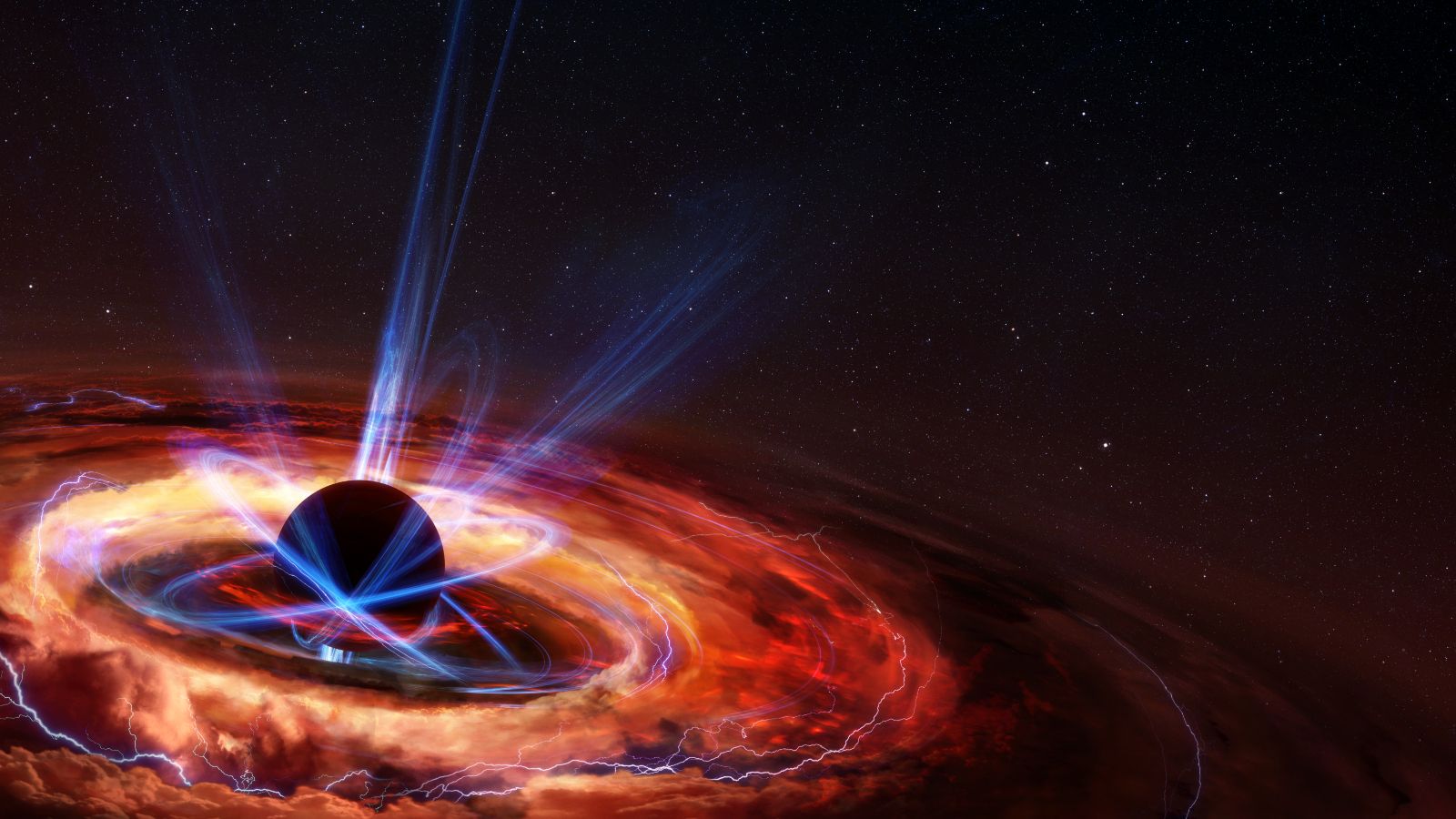
Incredibly powerful ‘ghost particles’ that recently crashed into Earth may have come from a rare type of explosive black hole, researchers claim.
If true, the researchers claim, this unusual event could prove a theory that could upend our understanding of both particle physics and dark matter. However, this is just one theory and there is no direct evidence to confirm that this actually happened.
In early 2023, researchers at the Cubic Kilometer Neutrino Telescope (KM3NeT), a new gigantic set of sensors built on the seabed of the Mediterranean Sea, detected neutrinos, ghostly particles that have little mass and don’t easily interact with most matter.
you may like
In addition to the typical strangeness of neutrinos, this particular particle was also notable for its unusual intensity. The energy is estimated to be up to 2.2 quintillion electron volts, at least 100 times more powerful than other neutrinos detected so far, and about 100,000 times more powerful than neutrinos observed in artificial particle accelerators such as CERN’s Large Hadron Collider.
explain the impossible
Researchers were initially unsure why this “impossible” neutrino appeared. It may have been created when cosmic rays entered Earth’s atmosphere, unleashing a cascade of high-energy particles that rained down on the planet’s surface. But its unprecedented power led experts to speculate that it must have arisen from some high-energy cosmic event that we don’t fully understand.
In a new paper accepted for publication in the journal Physical Review Letters, a group of researchers believes they have finally identified what really gave birth to neutrinos: exploding primordial black holes (PBHs).
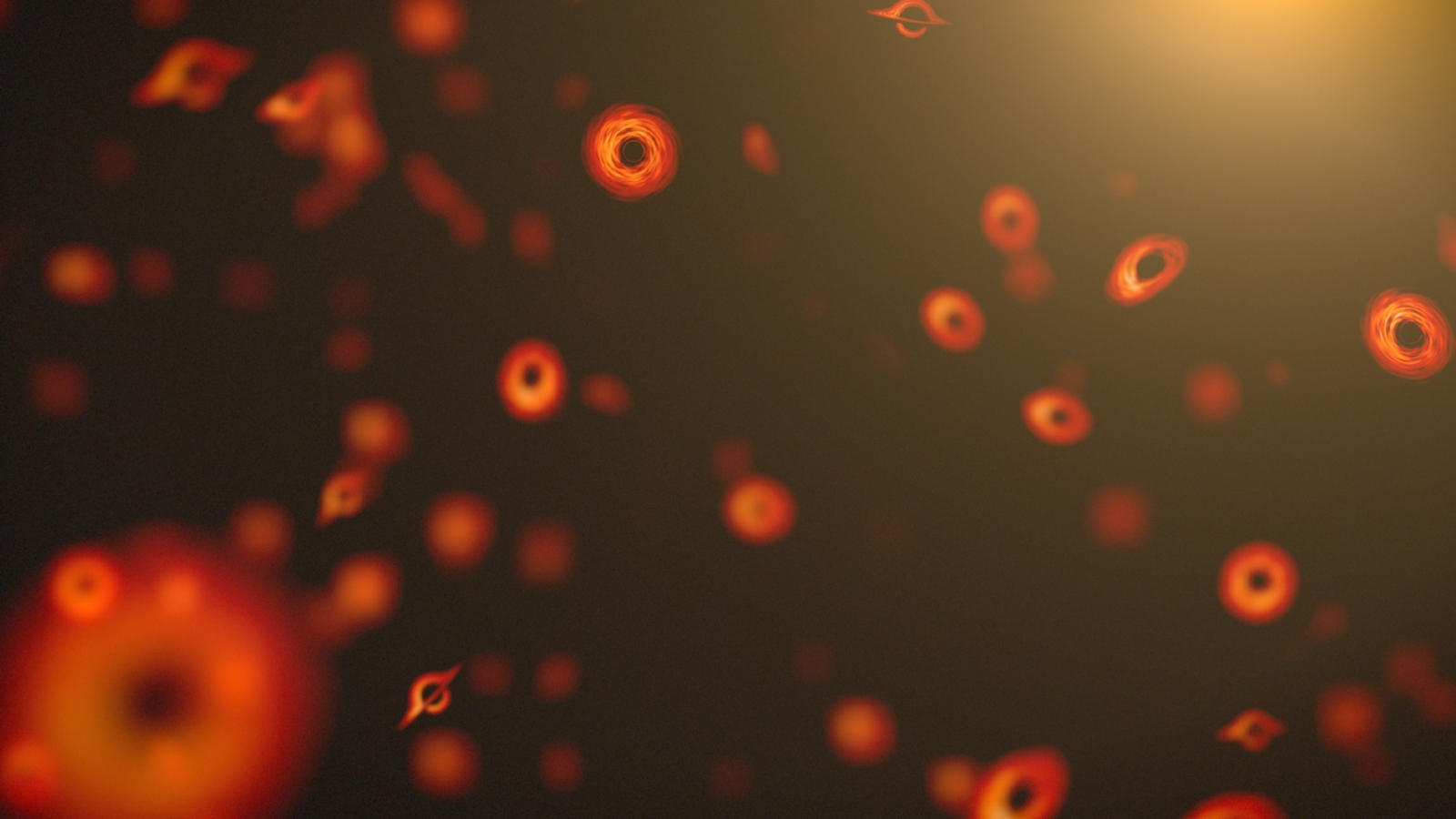
PBHs are a hypothetical class of very small black holes, potentially ranging from atoms to the head of a needle, whose origins are thought to date back to the first moments after the Big Bang. The concept was first popularized by British physicist Stephen Hawking in the early 1970s. He also hinted that as these tiny singularities slowly evaporate, they would emit large amounts of high-energy particles called Hawking radiation. In theory, this also means it has the ability to explode.
“The lighter the black hole, the hotter it is, so it should emit more particles,” study co-author Andrea Tam, a theoretical physicist at the University of Massachusetts Amherst, said in a statement. “As the PBH evaporates, it becomes lighter and lighter, becomes very hot, and releases even more radiation in a runaway process leading to an explosion.”
One of the biggest mysteries surrounding impossible neutrinos, aside from their immense power, is that they have not been detected by other neutrino detectors around the world, such as the IceCube Neutrino Observatory buried beneath the surface of Antarctica’s ice. Given that PBH is thought to be fairly common throughout the universe, one could reasonably expect that similarly powerful particles would have also been detected before and after this possible discovery, especially since the number of neutrino detectors is rapidly increasing.
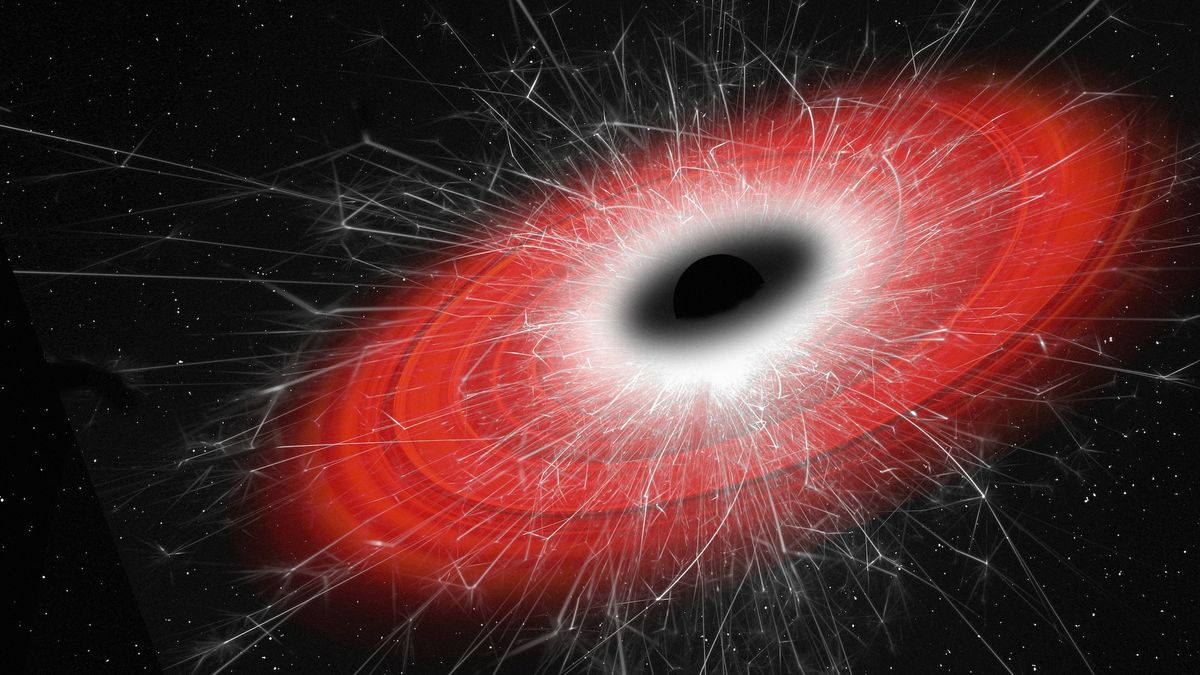
The researchers said this was because the neutrinos were emitted by a special type of PBH called sub-extreme PBH. This PBH has a “dark charge.” This is a version of the normal electric force and involves hypothetical very heavy electrons called “dark electrons.”
you may like
The dark properties of this theoretical type of PBH make it less likely that these black hole explosions will be detected, the researchers suggested. The researchers added that some of the less powerful neutrinos detected so far may be partially due to incomplete detection of these phenomena.
“PBH with dark charge has unique properties and behaves differently than other simple PBH models,” Tam said. “We showed that this can explain all of the seemingly contradictory experimental data.”
overturn our understanding of the universe
The new study hints at the existence of sub-extreme PBH, but does not confirm it or prove it will explode as researchers think. (Normal PBHs have also never been directly observed, but there is strong consensus that they exist.)
However, the team is confident that it won’t take long for these dark explosions to prove to be real. The same research group recently predicted that there is a 90% chance of seeing the first sub-extreme PBH explosion by 2035. This will be very interesting for two main reasons.
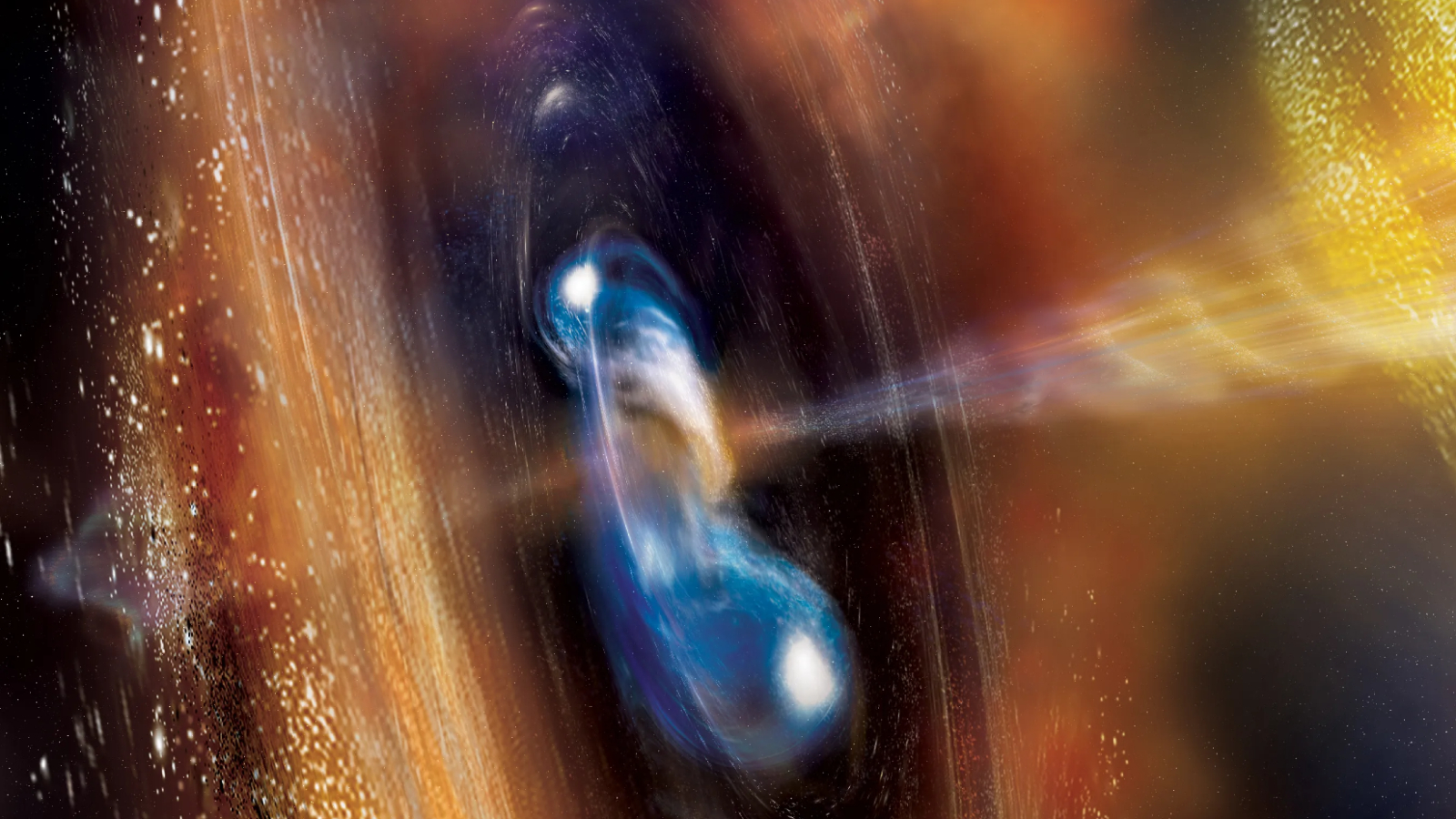
First, these explosions are so powerful that they could release “the definitive catalog of all elementary particles in existence,” including known entities like the Higgs boson. Theorized particles like gravitons and time-traveling tachyons. and “all others that are so far completely unknown to science,” the researchers said in a statement.
Second, these black holes could help unravel the mysterious nature of dark matter. Dark matter is something we cannot see, but whose gravity can be detected in almost all observed galaxies, including the Milky Way. The researchers write that discovering subextreme PBH could help solve this mystery, as it “may make up all of the observed dark matter in the universe.” (Although the names are similar, dark matter is not directly related to dark charges or dark electrons.)
The researchers, along with several other teams in the fields of physics and cosmology, are now all waiting with bated breath to see when the first explosion will be detected.
This “incredible event” provides “a new window into the universe” and will help “explain this unexplainable phenomenon,” study lead author Michael Baker, a theoretical physicist at Amherst College, said in a statement.
M.J. Baker, J. Iguazu-Juan, A. Simmons, and A. Tam (2025). We explain the PeV neutrino flux in KM3NeT and IceCube with quasi-extreme primordial black holes. Physical review letter. https://doi.org/10.1103/r793-p7ct
Source link
