

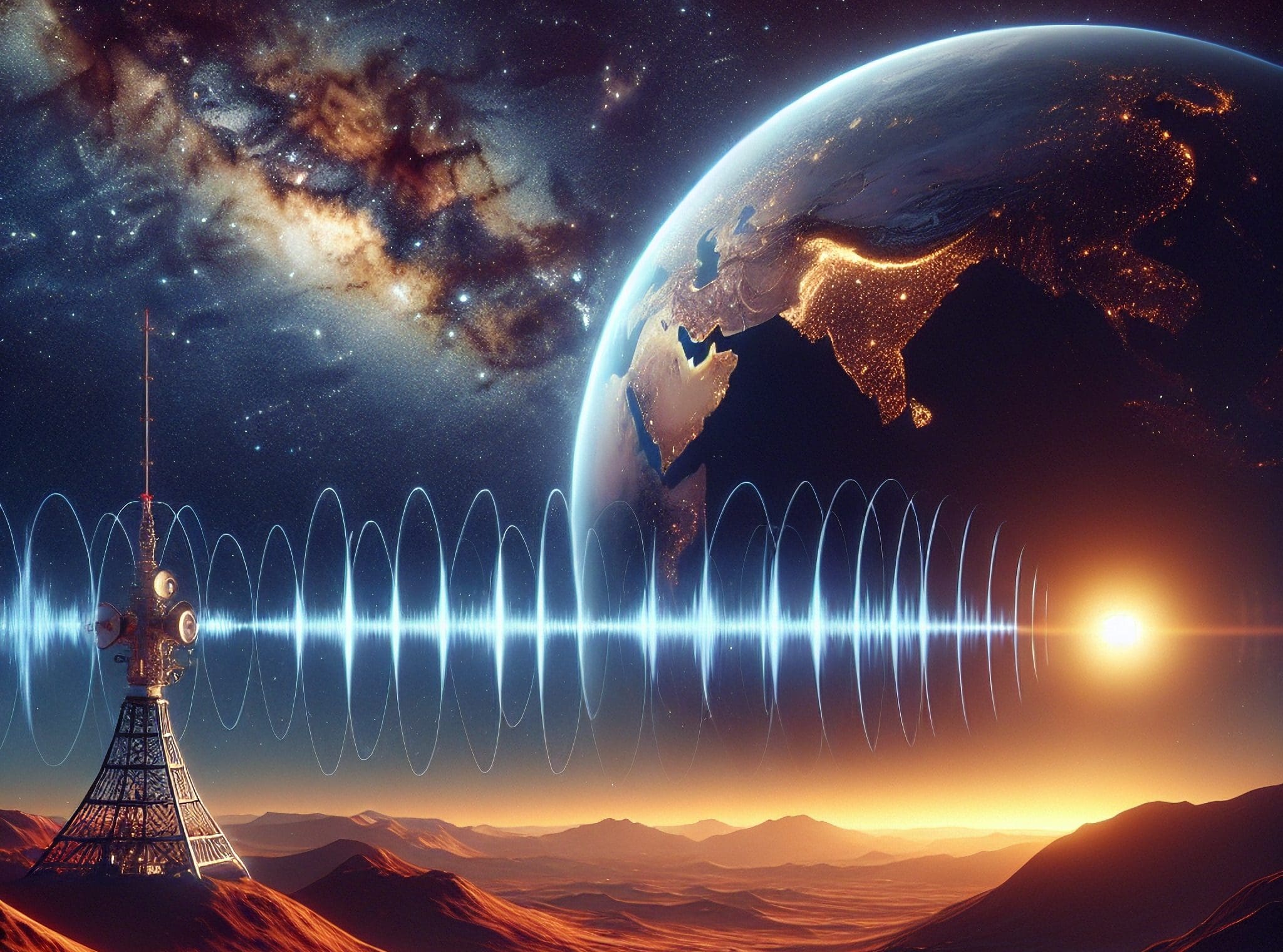
Star turbulence can distort extraterrestrial radio transmissions before they leave their home system.
Scientists searching the skies for alien signals may have overlooked an important obstacle much closer to the signal’s source.
A new study suggests that turbulent “space weather” around distant stars could distort radio transmissions from potential extraterrestrial civilizations, making them difficult for astronomers on Earth to detect.
The study, conducted by researchers at the SETI Institute, shows that stellar activity near the transmitting planet can spread very narrow radio signals over a wider frequency range.
This process reduces the peak strength of the signal, potentially below the detection threshold used in many searches for extraterrestrial intelligence.
The discovery points to a potential blind spot in traditional SETI strategies and may help explain why no alien signals have been confirmed in decades of observations.
How space weather distorts alien signals
For many years, SETI experiments have focused on identifying very narrow spikes in the radio spectrum. These narrow frequency signals are considered promising technosignatures because they are unlikely to arise naturally from astrophysical sources.
But signals sent with perfect precision may not stay that way for long, according to new research.
Before radio transmissions leave their home system, they must travel through turbulent plasma produced by stellar winds and eruptive phenomena such as coronal mass ejections.
These disturbances can change the characteristics of the radio waves, effectively spreading the signal’s energy over a wider frequency range.
When this happens, the signal becomes weaker at any single frequency. Most search pipelines are optimized to identify sharp spikes, so even if a spread signal is present, it may be missed.
Researchers say this effect could be an underappreciated barrier in the search for extraterrestrial communications.
Why narrowband searches can miss signals
Many SETI projects already take into account the distortions that occur when radio waves traverse the vast distances between stars. Interstellar gas and plasma can shift or scatter the signal on its way to Earth.
But new research highlights another stage of the signal path: the environment immediately surrounding the transmitter.
Fluctuations in the plasma density of the stellar wind can subtly change the shape of radio waves near their origin. The effect can be even more pronounced during periods of high stellar activity.
The result is a blurred signal spread across multiple frequencies, rather than appearing as a single sharp spike.
If detection algorithms are tuned only for ultra-narrow signals, these widespread transmissions can remain hidden in observational data.
Use spacecraft signals as a reference
To understand how strongly space weather affects radio transmissions, the research team turned to a useful benchmark: spacecraft operating within the solar system.
Signals sent by spacecraft traveling in the solar wind experience similar plasma turbulence. These transmissions can be directly measured, providing empirical data on how radio waves change as they pass through a magnetized plasma.
The researchers used these measurements to calibrate a model that explains how turbulent plasma spreads radio signals. They then extended the model to simulate conditions around different types of stars and across different observational frequencies.
The result is a framework that estimates the amount of distortion that extraterrestrial radio communications may undergo before escaping from their home system.
Active stars can be the most difficult targets
One important implication of this study concerns the types of stars most likely to host detectable alien signals.
M-type dwarfs make up about three-quarters of the number of stars in the Milky Way and are known for their intense magnetic activity and frequent stellar eruptions.
These conditions can cause strong space weather, increasing the likelihood that narrowband transmissions will become distorted before leaving the system.
If extraterrestrial civilizations exist around these common stars, their radio signals may have already spread or weakened by the time they reach Earth.
This possibility suggests that future SETI efforts may need to adapt search techniques. Detection pipelines that can identify signals over a wider frequency range could increase the likelihood of detecting technosignatures influenced by stellar turbulence.
Rethinking the search for techno signatures
The study adds another layer of complexity to the decades-long effort to detect alien signals. Rather than assuming that transmissions remain in their original state when they leave their home system, astronomers may need to consider the chaotic environments that surround many stars.
In practice, this means designing search strategies that are also sensitive to signals that are not perfectly narrow.
The researchers hope that by accounting for the effects of space weather near distant transmitters, future SETI observations will be improved to ensure that potentially meaningful signals are not missed simply because they arrive in a slightly different format than expected.
Source link
