
Close Menu
  • Home
  • Identity
  • Inventions
  • Future
  • Science
  • Startups
  • Spanish
What's Hot

China-linked Amaranth-Dragon exploits WinRAR flaws for espionage

European Commission launches €605 million Africa Initiative IV

Orchid Security brings continuous identity observability to enterprise applications

Facebook X (Twitter) Instagram
  • Home
  • About Us
  • Advertise with Us
  • Contact Us
  • DMCA
  • Privacy Policy
  • Terms & Conditions
  • User-Submitted Posts
Facebook X (Twitter) Instagram
Fyself News
  • Home
  • Identity
  • Inventions
  • Future
  • Science
  • Startups
  • Spanish
Fyself News
Home » James Webb Telescope discovers closest galaxy to the Big Bang ever observed
Science

James Webb Telescope discovers closest galaxy to the Big Bang ever observed

userBy userJanuary 29, 2026No Comments4 Mins Read
Share Facebook Twitter Pinterest Telegram LinkedIn Tumblr Email Copy Link
Follow Us
Google News Flipboard
Share
Facebook Twitter LinkedIn Pinterest Email Copy Link

Editor’s note: This article was updated on January 29, 2026. This article was originally published in May 2025 when related research was released as a preprint. The research is currently undergoing peer review and published in the Open Journal of Astrophysics. A quote from NASA’s statement has also been added.

The James Webb Space Telescope (JWST) has once again broken its own record by discovering the most distant galaxy ever observed.

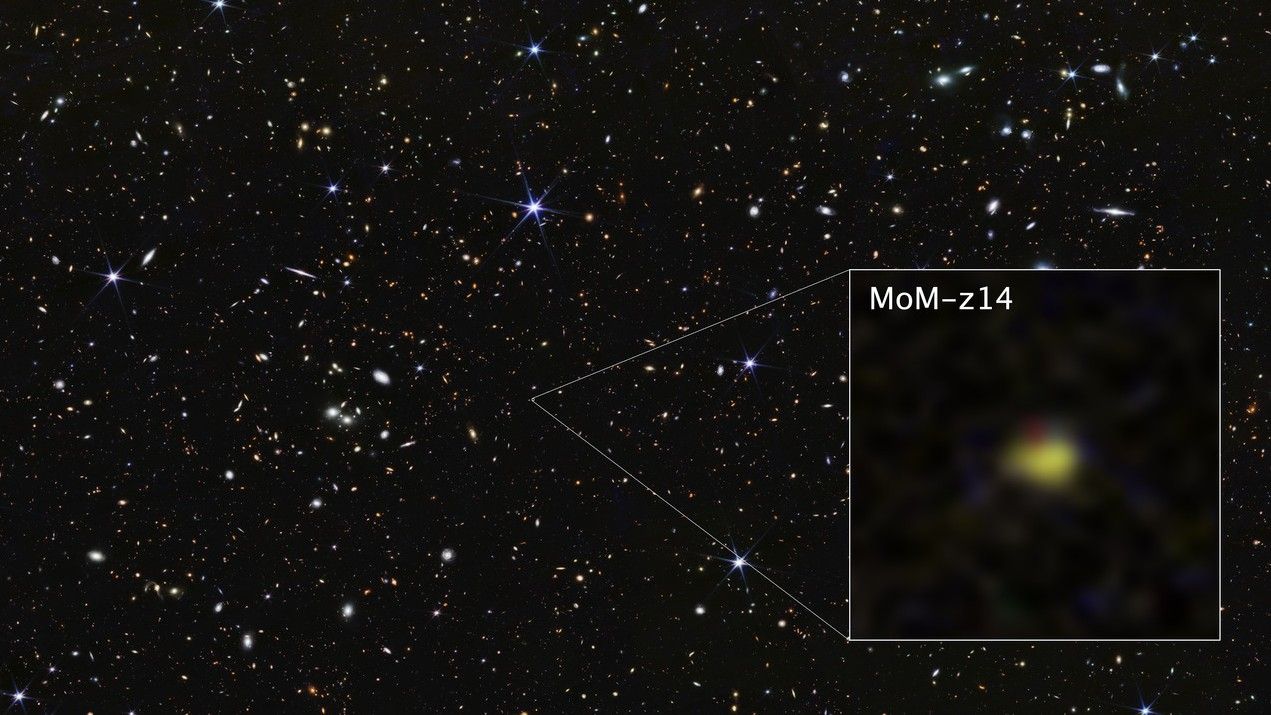
The galaxy, called MoM-z14, “has the most distant origin ever confirmed by spectroscopy, extending the observational frontier to just 280 million years after the Big Bang,” the researchers say in the new study, which was published on the preprint server arXiv on May 23, 2025, and in the Open Journal of Astrophysics in January 2026.

In other words, galaxies emitted light just 280 million years after the birth of the universe. After a long journey across space, that light has now finally reached Earth and JWST’s infrared sensors.

you may like

“Thanks to the Webb, we can now see farther than humans have ever seen before, and it’s completely different than we predicted. This is challenging and exciting,” lead author Rohan Naidu of the Kavli Institute for Astrophysics and Space Studies at the Massachusetts Institute of Technology said in a Jan. 28 statement from NASA.

Searching for the dawn of the universe

Since it began operations in 2022, JWST has discovered more bright ancient galaxies than scientists expected, casting doubt on previous theories about the early universe. “This unexpected population shocked the community and raised fundamental questions about the first 500 years of galaxy formation.” [million years after the Big Bang]” the authors wrote in their study.

As more examples trickle in, scientists are working to confirm whether these luminous objects are indeed ancient galaxies. Naidu and colleagues combed through existing JWST images looking for possible early galaxies. After identifying MoM-z14 as a potential target, they aimed their telescopes at this unusual object in April 2025.

One way scientists measure the age of astronomical objects is by measuring their redshifts. As the universe expands, the light emitted by distant objects stretches into longer and “redder” wavelengths. The farther and longer light travels, the greater its redshift.

Get the world’s most fascinating discoveries delivered straight to your inbox.

In this new study, which has not yet been peer-reviewed, the research team confirmed that MoM-z14 has a redshift of 14.44. This is larger than the 14.18 of JADES-GS-z14-0, the record holder for the most distant galaxy ever observed.
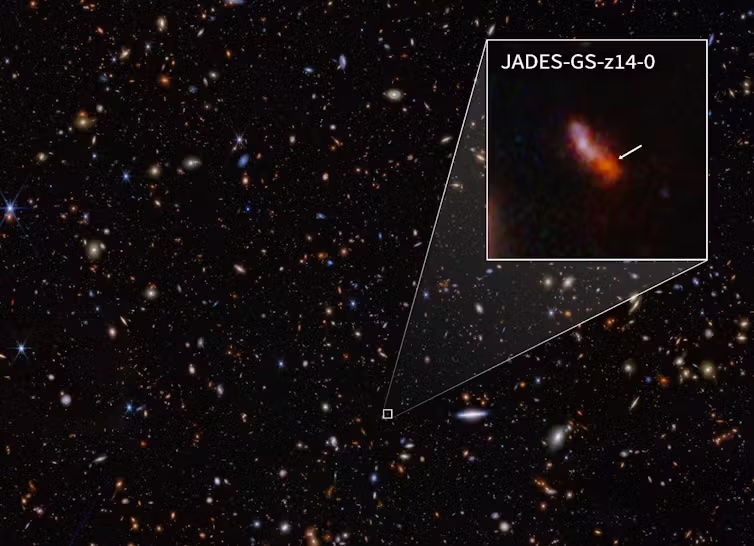
Enlarged inset showing the location of jADES-GS-z14-0 in deep-field images of hundreds of stars and galaxies.

The previous record holder for the oldest known galaxy, JADES-GS-z14-0, was also discovered by JWST. (Image credit: A collaboration between NASA, ESA, CSA, STScI, Brant Robertson (University of California, Santa Cruz), Ben Johnson (CfA), Sandro Tacchella (Cambridge), Phill Cargile (CfA), and JADES.)

MoM-z14 is quite compact considering the amount of light it emits. It has a diameter of about 240 light years, making it about 400 times smaller than our galaxy. And this galaxy contains about the same mass as the Small Magellanic Cloud, a dwarf galaxy that orbits the Milky Way.

The researchers observed MoM-z14 during rapid star formation. Also, similar to the globular clusters observed in the Milky Way, they are rich in nitrogen compared to carbon.

you may like

These ancient, tightly knit groups of thousands to millions of stars are thought to have formed during the first billions of years of the universe, making them the oldest known stars in the nearby universe. The similarity of MoM-z14 could suggest that stars formed in a similar way, even at the very early stages of the universe’s development.

Scientists are still aiming to identify more high-redshift galaxies, but they hope to find more candidates using the Nancy Grace Roman Space Telescope, an infrared telescope designed to observe large swaths of the sky, which could be launched as early as late 2026.

But before that, JWST may break its own record again.

“JWST itself appears poised to drive a series of major expansions of the cosmic frontier,” the authors write. “A previously unimaginable redshift approaches the age of the first stars, which is no longer a distant story.”

Naidu, Rohan P., Pascal A. Oesch, Gabriel Brammer, Andrea Weibel, Ejia Li, Jorit Massey, John Chisholm, et al. 2026. “Cosmic Miracle: Extraordinarily bright galaxy with zspec = 14.44 identified in JWST.” The Open Journal of Astrophysics 9 (January). https:/ /doi.org/ 10.33232/ 001c.156033.


Source link

#Biotechnology #ClimateScience #Health #Science #ScientificAdvances #ScientificResearch
Follow on Google News Follow on Flipboard
Share. Facebook Twitter Pinterest LinkedIn Tumblr Email Copy Link
Previous ArticleSouth Carolina measles outbreak is the largest since the U.S. eradicated measles
Next Article Fintech company Marquis blames hacking of firewall provider Sonic Wall for data breach
user
  • Website

Related Posts

‘Groundbreaking’ elephant bones discovered in Spain may date from Hannibal’s war against Rome

February 3, 2026

‘System in flux’: Scientists reveal what happened when wolves and cougars returned to Yellowstone

February 3, 2026

In their search for bees, Mozambique’s honey hunters and birds share a language with regional dialects.

February 3, 2026
Add A Comment
Leave A Reply Cancel Reply

Latest Posts

China-linked Amaranth-Dragon exploits WinRAR flaws for espionage

European Commission launches €605 million Africa Initiative IV

Orchid Security brings continuous identity observability to enterprise applications

LanzaTech aims for Humberside as sustainable aviation fuel facility

Trending Posts

Subscribe to News

Subscribe to our newsletter and never miss our latest news

Please enable JavaScript in your browser to complete this form.
Loading

Welcome to Fyself News, your go-to platform for the latest in tech, startups, inventions, sustainability, and fintech! We are a passionate team of enthusiasts committed to bringing you timely, insightful, and accurate information on the most pressing developments across these industries. Whether you’re an entrepreneur, investor, or just someone curious about the future of technology and innovation, Fyself News has something for you.

Castilla-La Mancha Ignites Innovation: fiveclmsummit Redefines Tech Future

Local Power, Health Innovation: Alcolea de Calatrava Boosts FiveCLM PoC with Community Engagement

The Future of Digital Twins in Healthcare: From Virtual Replicas to Personalized Medical Models

Human Digital Twins: The Next Tech Frontier Set to Transform Healthcare and Beyond

Facebook X (Twitter) Instagram Pinterest YouTube
  • Home
  • About Us
  • Advertise with Us
  • Contact Us
  • DMCA
  • Privacy Policy
  • Terms & Conditions
  • User-Submitted Posts
© 2026 news.fyself. Designed by by fyself.

Type above and press Enter to search. Press Esc to cancel.