
Close Menu
  • Home
  • Identity
  • Inventions
  • Future
  • Science
  • Startups
  • Spanish
What's Hot

Resolve AI, a startup led by former Splunk executives, reaches $1 billion Series A valuation

Establish a venture-backable company in a highly regulated field

Cursor continues acquisition spree with deal with Graphite

Facebook X (Twitter) Instagram
  • Home
  • About Us
  • Advertise with Us
  • Contact Us
  • DMCA
  • Privacy Policy
  • Terms & Conditions
  • User-Submitted Posts
Facebook X (Twitter) Instagram
Fyself News
  • Home
  • Identity
  • Inventions
  • Future
  • Science
  • Startups
  • Spanish
Fyself News
Home » James Webb Telescope discovers supermassive black hole hidden inside ‘Jekyll and Hyde’ galaxy
Science

James Webb Telescope discovers supermassive black hole hidden inside ‘Jekyll and Hyde’ galaxy

userBy userDecember 17, 2025No Comments3 Mins Read
Share Facebook Twitter Pinterest Telegram LinkedIn Tumblr Email Copy Link
Follow Us
Google News Flipboard
Share
Facebook Twitter LinkedIn Pinterest Email Copy Link

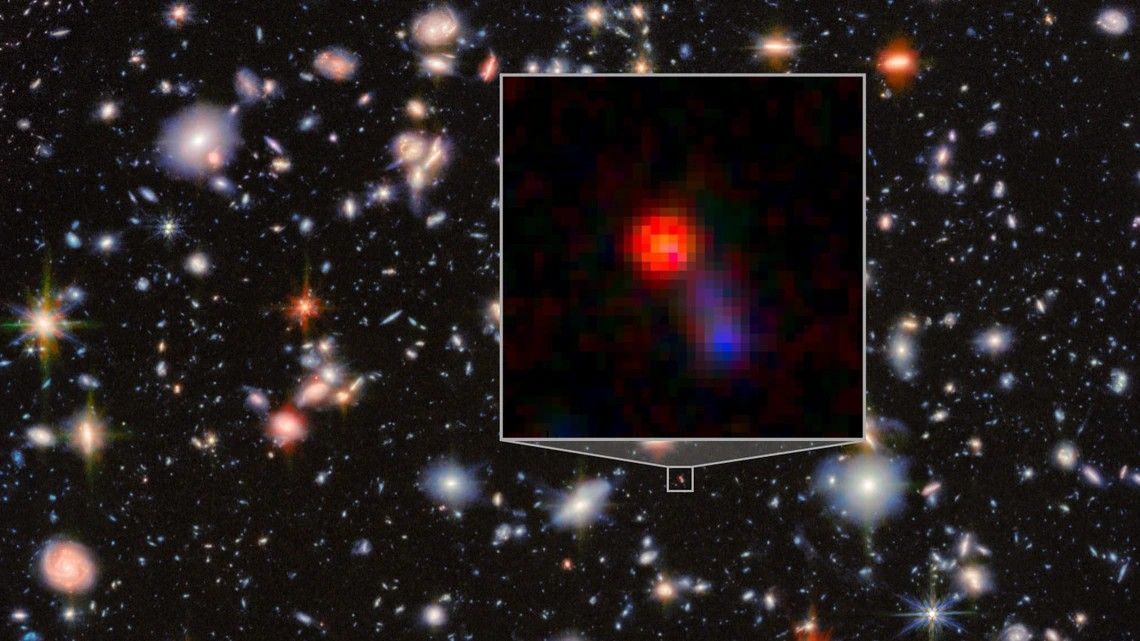
NASA’s James Webb Space Telescope (JWST) has detected a supermassive black hole hidden in an ancient “Jekyll and Hyde” galaxy that changes its appearance depending on the angle from which it is viewed.

The galaxy, nicknamed Virgil, looked like a normal star-forming galaxy when observed at optical wavelengths (the kind of light that the human eye and optical telescopes like Hubble can see). However, when JWST observed celestial bodies in infrared light through the Mid-Infrared Instrument (MIRI), a monster black hole was visible at the center of the galaxy.

“Virgil has two personalities,” University of Arizona astronomer George Rieke, who co-led the discovery, said in a statement on Dec. 10. “The ultraviolet light and optics show its ‘good’ side, a typical young galaxy quietly forming stars. But when the MIRI data is added, Virgil transforms into a host to a heavily hidden supermassive black hole pouring out enormous amounts of energy.”

you may like

Rieke and his colleagues published their findings on November 17 in The Astrophysical Journal. This discovery suggests that some of the most extreme objects in our universe may be invisible unless observed at infrared wavelengths.

Because light takes a long time to travel across a galaxy, when powerful telescopes like JWST observe distant objects, they appear to have appeared in the distant past. Essentially, JWST acts like a time machine to the early universe. JWST shows Virgil as he existed 800 million years after the Big Bang. (By the way, the age of the universe is thought to be about 13.8 billion years.)

Researchers classified Virgil as a small red dot (LRD). This is the name given to a mysterious red object that appears in JWST observations of the distant early universe and is not fully understood by astronomers.

LRDs appear in large quantities about 600 million years after the Big Bang, and rapidly decline about 1.5 billion years after the Big Bang. Observing galaxies like Virgil should help researchers unravel the mysteries of the LRD. LRDs are thought to be associated with actively feeding supermassive black holes that are heavily obscured by dust.

Get the world’s most fascinating discoveries delivered straight to your inbox.

JWST’s Virgil observations will also help researchers better understand how supermassive black holes grew in the early universe. At the center of Virgil is a so-called “supermassive” black hole, meaning it is so large that it would not be possible to exist in its host galaxy, the statement said.

Astronomers thought that the black hole at the center of a galaxy grows at the same rate as its host, with the galaxy first forming and the black hole growing over time as large amounts of matter coalesce at its center. However, these JWST observations suggest that the opposite may be true. First the black hole appears, then the galaxy around it.

“JWST showed that our ideas about how supermassive black holes form were almost completely wrong,” Rieke said. “In many cases, black holes actually appear to be further ahead than galaxies. That’s the most interesting thing we’re discovering.”


Source link

#Biotechnology #ClimateScience #Health #Science #ScientificAdvances #ScientificResearch
Follow on Google News Follow on Flipboard
Share. Facebook Twitter Pinterest LinkedIn Tumblr Email Copy Link
Previous ArticleSnakes’ amazing ‘thermal vision’ inspires scientists to build 4K imaging systems that could one day fit into smartphones
Next Article Skana Robotics helps underwater robot fleets communicate with each other
user
  • Website

Related Posts

Interstellar comet 3I/ATLAS is rapidly moving away from us. Can we ‘intercept’ it before it leaves us forever?

December 19, 2025

Japan trials 100-kilowatt laser weapon – capable of cutting metal and drones while in flight

December 19, 2025

2025 Urids meteor shower: When and where to see ‘shooting stars’ on the longest night of the year

December 19, 2025
Add A Comment
Leave A Reply Cancel Reply

Latest Posts

Resolve AI, a startup led by former Splunk executives, reaches $1 billion Series A valuation

Establish a venture-backable company in a highly regulated field

Cursor continues acquisition spree with deal with Graphite

Elon Musk’s $56 billion Tesla pay package reinstated by Delaware Supreme Court

Trending Posts

Subscribe to News

Subscribe to our newsletter and never miss our latest news

Please enable JavaScript in your browser to complete this form.
Loading

Welcome to Fyself News, your go-to platform for the latest in tech, startups, inventions, sustainability, and fintech! We are a passionate team of enthusiasts committed to bringing you timely, insightful, and accurate information on the most pressing developments across these industries. Whether you’re an entrepreneur, investor, or just someone curious about the future of technology and innovation, Fyself News has something for you.

Castilla-La Mancha Ignites Innovation: fiveclmsummit Redefines Tech Future

Local Power, Health Innovation: Alcolea de Calatrava Boosts FiveCLM PoC with Community Engagement

The Future of Digital Twins in Healthcare: From Virtual Replicas to Personalized Medical Models

Human Digital Twins: The Next Tech Frontier Set to Transform Healthcare and Beyond

Facebook X (Twitter) Instagram Pinterest YouTube
  • Home
  • About Us
  • Advertise with Us
  • Contact Us
  • DMCA
  • Privacy Policy
  • Terms & Conditions
  • User-Submitted Posts
© 2025 news.fyself. Designed by by fyself.

Type above and press Enter to search. Press Esc to cancel.